common blue violet
Viola sororia
BloomEDU
Identify it today. Know it next time.
Add common blue violet to BloomEDU and a short quiz tomorrow will check if the name stuck.
Get BloomEDU — add common blue violetFree · iOS · Android
From Instagram
Identity & Classification
Scientific name: Viola sororia
Common names: common blue violet, wood violet, purple violet
Family: Violaceae
Genus: Viola
This species belongs to the temperate violet group in the genus Viola; closely related wild violets and garden violas form a species complex in eastern and central North America.
Visual Description
Overall form: A perennial, herbaceous plant that typically grows as a low, basal rosette with flowering stalks rising above the leaves. Plants often form loose colonies from seed and short-lived roots.
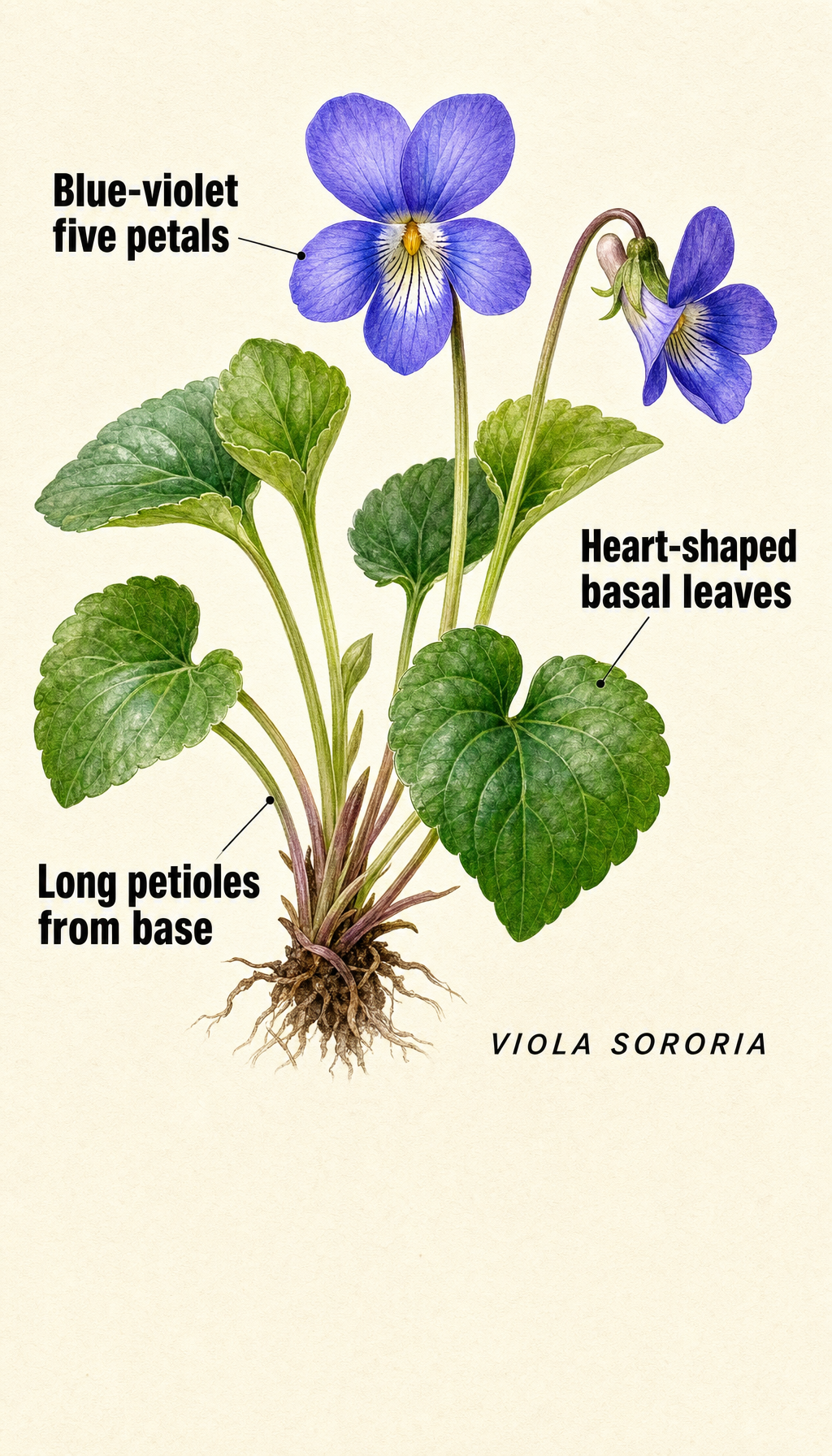
Flowers: Zygomorphic (bilaterally symmetrical) flowers with 4–6 petals, typically 5, colored usually blue to blue‑purple; white-flowered forms are also common. Upper petals are often darker, the lower petal commonly bears nectar guides and a small spur. Flowers are borne singly on leafless stalks above the foliage; both open (chasmogamous) and closed, self-pollinating (cleistogamous) flowers may be produced.
Leaves: Simple, generally heart-shaped (cordate) leaves with scalloped margins, arising mainly from the base in a rosette; petioles may be of variable length and occasional leafy stems can occur.
Distinctive features: Low basal rosette of heart-shaped leaves, blue‑purple zygomorphic flowers on slender stalks, presence of both chasmogamous and cleistogamous flowers, and seeds often associated with elaiosomes (fleshy appendages) that attract ants.
Seasonal variation: Flowering typically occurs in spring and may continue sporadically; cleistogamous flowers often appear later in the season. Leaf and flower abundance can vary with light and moisture.
Habitat & Distribution
Typical habitats: Often found in lawns, meadows, woodland edges, shaded garden areas, and other disturbed or semi-natural sites. Common in both open and shaded conditions.
Moisture, light, soil: Prefers moist to mesic soils and can tolerate a range from part shade to full sun; soils are often loamy or rich but the species adapts to a variety of soil types.
Geographic distribution: Native to much of eastern and central North America and recorded in states including AL, AR, CT, DE, FL and many additional states across the region; commonly encountered throughout its range.
Ecological Role
Pollination and reproduction: Produces open, nectar-bearing flowers that attract small bees and other insect pollinators; also produces cleistogamous (closed, self-fertilizing) flowers that ensure seed set without pollinators. Seeds bear elaiosomes and are commonly dispersed by ants (myrmecochory).
Wildlife interactions: Serves as an important larval food plant for several fritillary butterfly species. Flowers provide nectar and pollen to small bees and other insect visitors.
Conservation & Interesting Facts
Conservation: Generally common across much of its range and not typically of conservation concern.
Notable adaptations and facts: Produces both open and self-fertilizing closed flowers (cleistogamy), and uses ant-mediated seed dispersal (elaiosomes), strategies that promote local persistence and colonization. White-flowered forms are a frequent and natural variant.