red clover
Trifolium pratense
BloomEDU
Identify it today. Know it next time.
Add red clover to BloomEDU and a short quiz tomorrow will check if the name stuck.
Get BloomEDU — add red cloverFree · iOS · Android
From Instagram
Identity & Classification
Trifolium pratense — commonly called red clover (also purple clover or meadow clover) — is a herbaceous flowering plant in the bean/pea family Fabaceae (subfamily Faboideae). The genus name Trifolium refers to the characteristic three-part leaves (tri‑folium = “three leaves”), and the specific epithet pratense comes from Latin prātum, meaning “meadow,” reflecting its common habitat. Taxonomically it sits in the large clover group (Trifolium) and is distinct from white clover (T. repens) and other regional Trifolium species by its erect habit and rounded, pinkish flower heads.
Physical Description
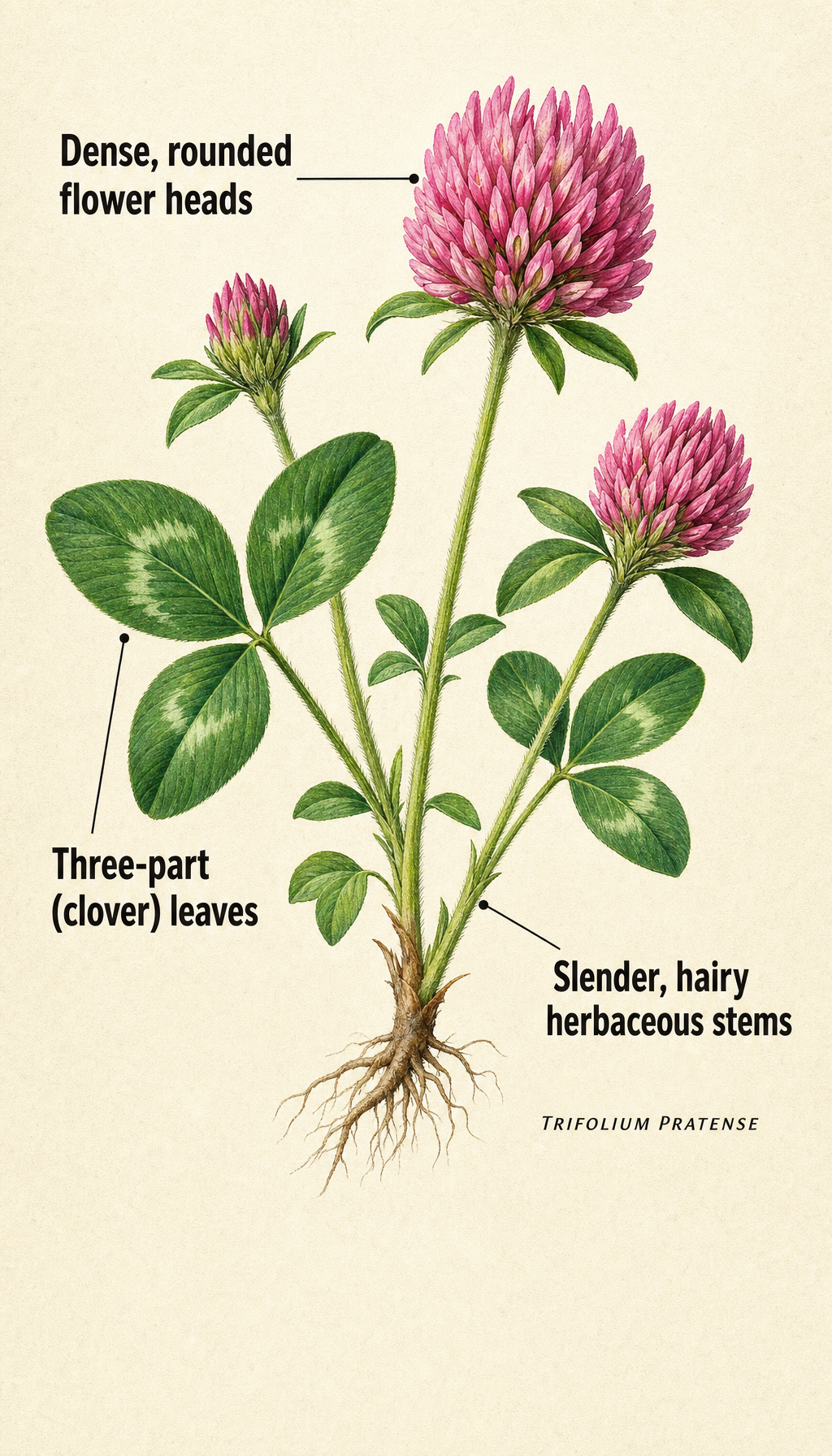
Red clover is a short-lived perennial herb with several distinctive features. Key characteristics:
Growth form: Erect stems arising from a crown; typically a short-lived perennial (often persisting a few years under favorable conditions).
Height: Often in the range of tens of centimetres tall (commonly up to roughly 20–80 cm), depending on site and management.
Leaves: Trifoliate (three leaflets per leaf); leaflets are obovate to elliptic and frequently bear a pale chevron or “V” marking on the upper surface. Stipules (small leaf-like appendages at the base of the leaf stalk) are present.
Surface texture: Stems and leaves are often softly hairy.
Inflorescence: Globose (rounded) flower heads composed of many small papilionaceous (pea‑type) flowers; individual flowers are tubular with a standard (banner), wings and keel, giving the aggregate head a fluffy appearance. Flower color ranges from deep pink to purplish.
Fruit: Each flower develops into a small pod (a legume), formed from a single carpel, produced in the calyx; the pods are small and generally inconspicuous compared with the showy flower heads.
Roots: Typically develops a taproot with a branching crown; helps access deeper soil moisture and contributes to perennial habit.
Habitat & Range
Native and general distribution: Native to the Old World — broadly associated with Europe and parts of Asia and North Africa — and widely planted and naturalized in many other temperate regions worldwide.
Typical habitats: Frequently found in meadows, pastures, road verges, field margins and other open, sunny or partly shaded grassy places.
Soil and light preferences: Prefers well‑drained soils with moderate fertility; tolerates a range of soil types but does best in neutral to slightly acidic soils and in full sun to partial shade.
Climate: Commonly a component of temperate grasslands and agricultural systems; persistence and productivity vary with local climate and management.
Ecological Role
Nitrogen fixation: Forms a root‑nodule symbiosis with nitrogen‑fixing rhizobia bacteria (the Trifolium–rhizobium partnership), which helps convert atmospheric nitrogen into forms usable by plants — an important ecosystem and agricultural service.
Pollinators: Flowers produce nectar and pollen attractive to bees, especially long‑tongued bumblebees and honeybees; the flower morphology favors insects that can reach the nectar in the tubular flowers.
Forage and food web contributions: Serves as forage for domesticated livestock and wild herbivores; as a nectar source it supports pollinator populations and, indirectly, higher trophic levels that depend on those pollinators.
Soil and plant community effects: As a legume that adds nitrogen to soil, red clover often increases soil fertility and can influence plant community composition where it is abundant.
Interesting Facts
Three’s a theme: The genus name Trifolium literally points to its three-part leaves — an easy mnemonic for remembering clovers.
Flower heads are many flowers in one: What looks like a single “pom‑pom” blossom is actually an aggregation of many individual pea‑type flowers, each capable of producing a small legume fruit.
Farmer’s friend: Because of its nitrogen‑fixing ability and usefulness as forage, red clover has been an important species in temperate agriculture and soil‑improvement strategies for centuries.
Pollinator specialist architecture: The tubular flowers are especially suited to long‑tongued bees; if you see bumblebees working a clover patch, you’re watching a great plant–pollinator match in action.
Meadow etymology: The species epithet pratense comes from Latin for “meadow,” which is both linguistically tidy and ecologically accurate.