small ballmoss
Tillandsia recurvata
BloomEDU
Identify it today. Know it next time.
Add small ballmoss to BloomEDU and a short quiz tomorrow will check if the name stuck.
Get BloomEDU — add small ballmossFree · iOS · Android
From Instagram
Identity & Classification
Scientific name: Tillandsia recurvata. Verified common names: small ballmoss, ball moss. Family: Bromeliaceae. Genus: Tillandsia. Taxonomically it is a member of the air‑plant bromeliads; it is related to other Tillandsia species such as Spanish moss (T. usneoides).
Visual Description
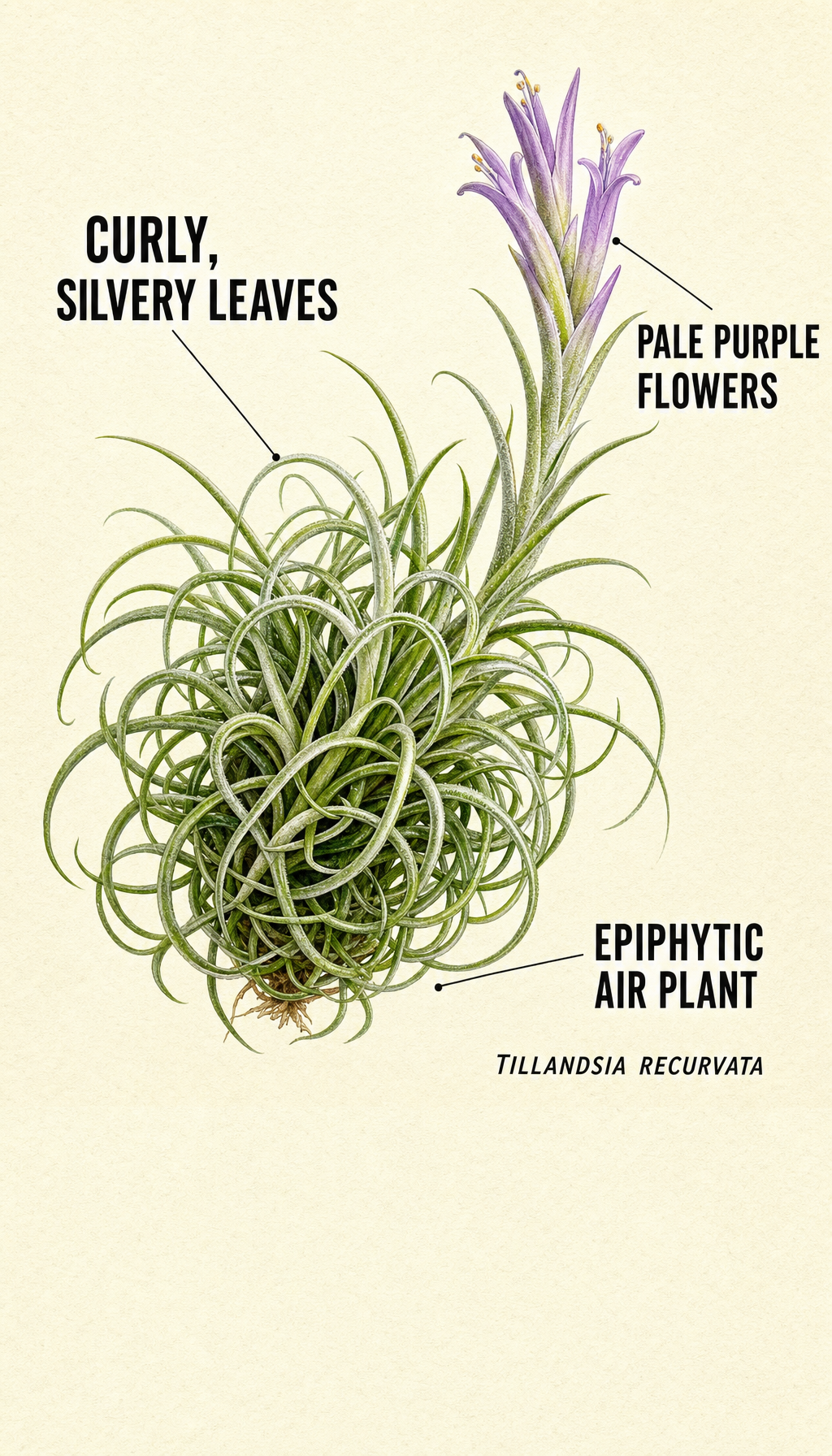
Small ballmoss grows as a dense, globe‑shaped mass of many individual shoots, forming spherical clumps that can vary in size depending on age and growing site. Leaves are narrow, stiff to slightly curved, often gray‑green to silvery in appearance due to a dense covering of trichomes (scale‑like hairs). Roots are wiry and primarily used for anchoring to bark or other substrates rather than for water uptake. Flowers are produced from the interior of the clump and are relatively small and tubular; as with many bromeliads the floral parts are typically in threes and colors may range from pale to purplish tones in different individuals. Inflorescences are not conspicuous compared with the mass of foliage. Seasonal display can vary with local climate; flowering and seed release often follow periods of adequate moisture.
Habitat & Distribution
Tillandsia recurvata is an epiphyte that commonly colonizes tree branches (frequently on oaks and other hardwoods), fence posts, wires, roofs, and other exposed structures in warm regions. It typically occurs in open to partly shaded sites with good air circulation and can tolerate a range of moisture conditions by relying on atmospheric humidity and rainfall. It does not require soil and is often found in xeric to mesic environments where humidity and intermittent wetting occur. Geographic distribution includes the southern United States — documented in the states listed (AZ, FL, GA, LA, NM and one additional state) — and extends beyond into Mexico, Central America and parts of South America in suitable climates.
Ecological Role
Tillandsia recurvata functions as an atmospheric epiphyte: trichomes on leaves capture water and nutrients from rain, dew and airborne dust. It is not parasitic on its hosts and often forms microhabitats for invertebrates and small arthropods. Flowers are typically visited by small insect pollinators; seeds are produced in capsules and dispersed by wind with fine, silky appendages that aid long‑distance dispersal. Dense clumps can influence light and moisture on branches but generally do not extract resources from host trees.
Conservation & Interesting Facts
Tillandsia recurvata is generally common across its range and is not known to be threatened. Unique adaptations include highly developed foliar trichomes for absorbing water and nutrients directly from the air and wind‑borne seeds with silky hairs for effective dispersal. A notable fact: despite the name "moss," it is a bromeliad (a flowering plant) and is more closely related to tropical air plants than to true mosses.