Bartram's airplant
Tillandsia bartramii
BloomEDU
Identify it today. Know it next time.
Add Bartram's airplant to BloomEDU and a short quiz tomorrow will check if the name stuck.
Get BloomEDU — add Bartram's airplantFree · iOS · Android
Identity & Classification
Scientific name: Tillandsia bartramii
Common names: Bartram's airplant, Bartram's tillandsia
Family: Bromeliaceae
Genus: Tillandsia
Taxonomic relationships: A member of the atmospheric epiphytic Tillandsia group within Bromeliaceae; closely related to other Southeastern U.S. Tillandsia species.
Visual Description
Overall form: An epiphytic or sometimes lithophytic rosette-forming bromeliad that typically grows in small clumps of multiple individuals. Plants generally form tufts or mats on bark or rock and can produce several offsets (pups) after flowering.
Size: Individual rosettes are typically small to medium for Tillandsia species.
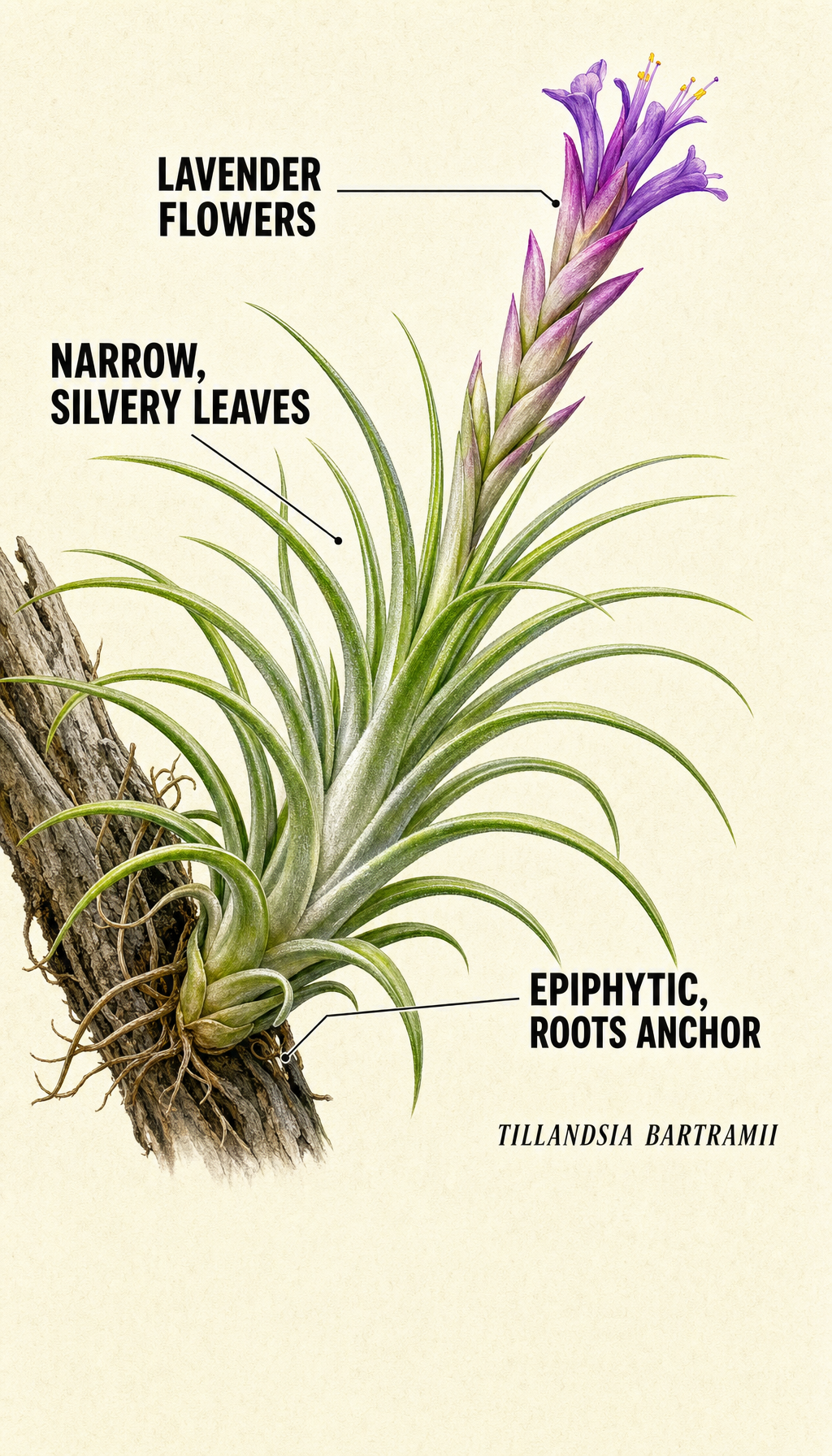
Leaves: Leaves are narrow, generally linear to stiffly lanceolate, often erect to arching. Leaf surfaces are covered in silvery-gray trichomes (scales) that give the plant a gray-green or silvery appearance and aid in water capture from the air.
Flowers: Inflorescences arise from the center of the rosette and typically bear tubular, three-part (three-petaled) flowers. Flower color is often in the purple-to-lavender range and may be accompanied by colorful bracts. Flowers are borne on a short scape and may be presented in small clusters.
Distinctive features: Dense trichome cover on leaves creating a silvery cast, clumping habit, and tubular purple-lavender flowers make this species distinctive among Southeastern Tillandsias.
Seasonal variation: Flowering is seasonal and may occur in warmer months; plants often produce pups after flowering, changing the immediate clump architecture.
Habitat & Distribution
Growing conditions: Typically epiphytic on tree branches and trunks, and occasionally found on rock outcrops or man-made substrates. Often found in open woodlands, hammocks, pine flatwoods, and scrub habitats where air movement and humidity permit aerial water capture.
Moisture, light, soil: Prefers humid to seasonally moist air environments and receives water primarily from rainfall, dew, and humidity via leaf trichomes. Commonly occupies sites with bright light to dappled sun; does not require soil.
Geographic distribution: Native to the southeastern United States and recorded in Florida, Georgia, and South Carolina.
Ecological Role
Pollination and wildlife: Flowers with tubular, vividly colored corollas suggest pollination by hummingbirds or large nectar-feeding insects; such pollinator relationships are common in tubular-flowered Tillandsia species. Clumps provide microhabitats for small invertebrates and can contribute to canopy biodiversity.
Niche: Functions as an atmospheric epiphyte, obtaining water and nutrients from the air and intercepted debris rather than from soil, and often occupying exposed branches where it benefits from light and air flow.
Human Uses & Cultural Significance
Ornamental: Like many Tillandsia, Bartram's airplant is sometimes cultivated as an ornamental atmospheric plant in collections and displays. Generally considered non-toxic to humans and pets.
Conservation & Interesting Facts
Adaptations: Dense leaf trichomes enable rapid absorption of water and dissolved nutrients from the atmosphere; many Tillandsia also use water-conserving photosynthetic pathways (e.g., CAM) to tolerate intermittent hydration.
Reproduction: Produces offsets (pups) after flowering, forming persistent clumps.
Interesting fact: As an airborne epiphyte that needs no soil, Bartram's airplant illustrates how some vascular plants complete their life cycles entirely above ground, relying on specialized leaf structures to survive in aerial microhabitats.
From Instagram