common lilac
Syringa vulgaris
BloomEDU
Identify it today. Know it next time.
Add common lilac to BloomEDU and a short quiz tomorrow will check if the name stuck.
Get BloomEDU — add common lilacFree · iOS · Android
From Instagram
Identity & Classification
Syringa vulgaris L. — commonly called the common lilac (often shortened to “lilac”; sometimes referred to as “French lilac”). It is a member of the olive family, Oleaceae. Higher-level placement: angiosperm (flowering plant), eudicot, order Lamiales, family Oleaceae, genus Syringa, species S. vulgaris. Taxonomic notes: S. vulgaris is the species most widely grown in gardens and is the archetype for many cultivated varieties and garden hybrids. Numerous cultivars and hybrids derived from S. vulgaris and related Syringa species have been selected for flower color, form and fragrance.
Physical Description
A charismatic deciduous shrub or small tree that announces spring with clustered, scented flowers. Key characteristics:
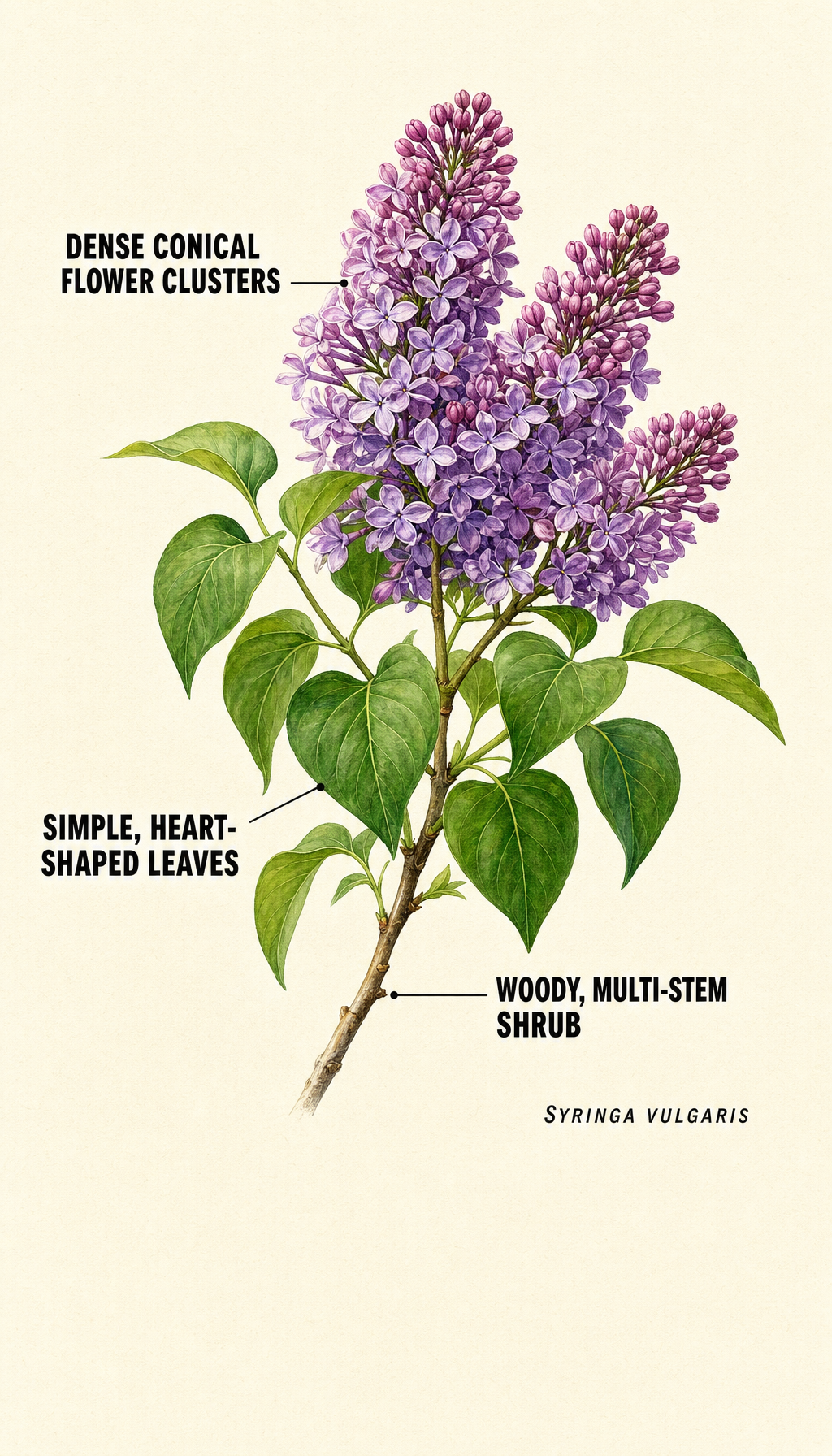
Growth form: multi-stemmed shrub or small tree; often forms a rounded to irregular crown. Plants are typically shrub-sized in cultivation but may reach taller dimensions in favorable sites.
Leaves: opposite (pairs directly across the stem — a hallmark of Oleaceae), simple (single leaf blade), usually ovate to cordate (egg-shaped to heart-shaped) in outline with an entire margin. Leaves are green and give a dense backdrop to the flowers.
Flowers: produced in dense, conical to pyramidal panicles (clusters). Individual flowers are tubular with a four-lobed corolla (four petals fused into a tube with spreading lobes). Flower colors commonly include shades of lilac-purple, violet, pink and white; many cultivars vary in hue and intensity. Flowers are usually fragrant.
Fruit: a dry capsule that develops after flowering and typically contains one or two seeds. Capsules turn brown as they mature.
Bark and stems: older stems show grey-brown bark; many garden specimens produce basal shoots or suckers from the rootstock.
Phenology: flowers in spring (usually before the canopy fully leafs out), and fruits mature later in the season.
Habitat & Range
Native range: the species is native to the Balkan Peninsula.
Cultivation and distribution: widely cultivated across temperate Europe (particularly northern and western parts) and in North America as a beloved ornamental.
Preferred conditions: does best in temperate climates with a period of winter chill, in full sun to light shade. Prefers well-drained soil and tolerates a range of soil types, including alkaline soils. Lilacs typically perform best where they receive good sunlight—flowering tends to be more prolific in sunnier spots. Note: Local performance and hardiness depend on cultivar and site; specific elevation or precise native-site distributions are variable and beyond the scope of universally applicable statements here.
Ecological Role
Pollinators: the fragrant spring flowers provide nectar and pollen to a variety of nectar-seeking insects; gardens and hedgerows of lilac commonly attract bees, butterflies and other insects.
Wildlife: lilac shrubs can offer shelter and nesting structure for small birds and insects; however, the plant is generally used more for floral resources than as a major wildlife food source.
Reproduction and spread: reproduces by seed and by vegetative suckering in some plants; in cultivation it can naturalize locally where conditions permit. Specific, tightly coevolved relationships (e.g., exclusive pollinators or specialist herbivores) are not well-documented for S. vulgaris.
Interesting Facts
Name origin: the genus name Syringa comes from the Greek syrinx, meaning “pipe” or “tube,” a reference to hollow stems used historically as conduits or simple pipes/whistles in folklore.
Old-wood blooming: common lilac typically flowers on the previous year’s growth (“old wood”), so timing of pruning is important—pruning at the wrong time can remove the next season’s flower buds.
Family ties: lilac is in the same family (Oleaceae) as olives (Olea), ashes (Fraxinus) and jasmines (Jasminum) — a neat reminder that a fragrant garden shrub and an olive tree are distant botanical cousins.
Cultivar diversity: centuries of horticulture have produced many named cultivars and garden hybrids selected for unusual colors, compact habit, double flowers and enhanced fragrance; gardeners prize them for spring scent and display.
Fragrance magnet: the scent of the lilac is one reason it remains a garden favorite — its strongly scented flower clusters are a notable early-season attractant for people and pollinators alike. vulgaris apart from other Syringa species.