aster
Symphyotrichum ×woldenii
BloomEDU
Identify it today. Know it next time.
Add aster to BloomEDU and a short quiz tomorrow will check if the name stuck.
Get BloomEDU — add asterFree · iOS · Android
Identity & Classification
Scientific name: Symphyotrichum × woldenii (the multiplication sign indicates an interspecific hybrid within the genus)
Common name(s): aster (hybrid aster), sometimes cited using the epithet Wolden's aster
Family: Asteraceae
Genus: Symphyotrichum
Taxonomic note: The species-group name with × denotes a hybrid origin within Symphyotrichum; further parentage may be reported where taxa overlap, but the hybrid status itself is the primary taxonomic point.
Visual Description
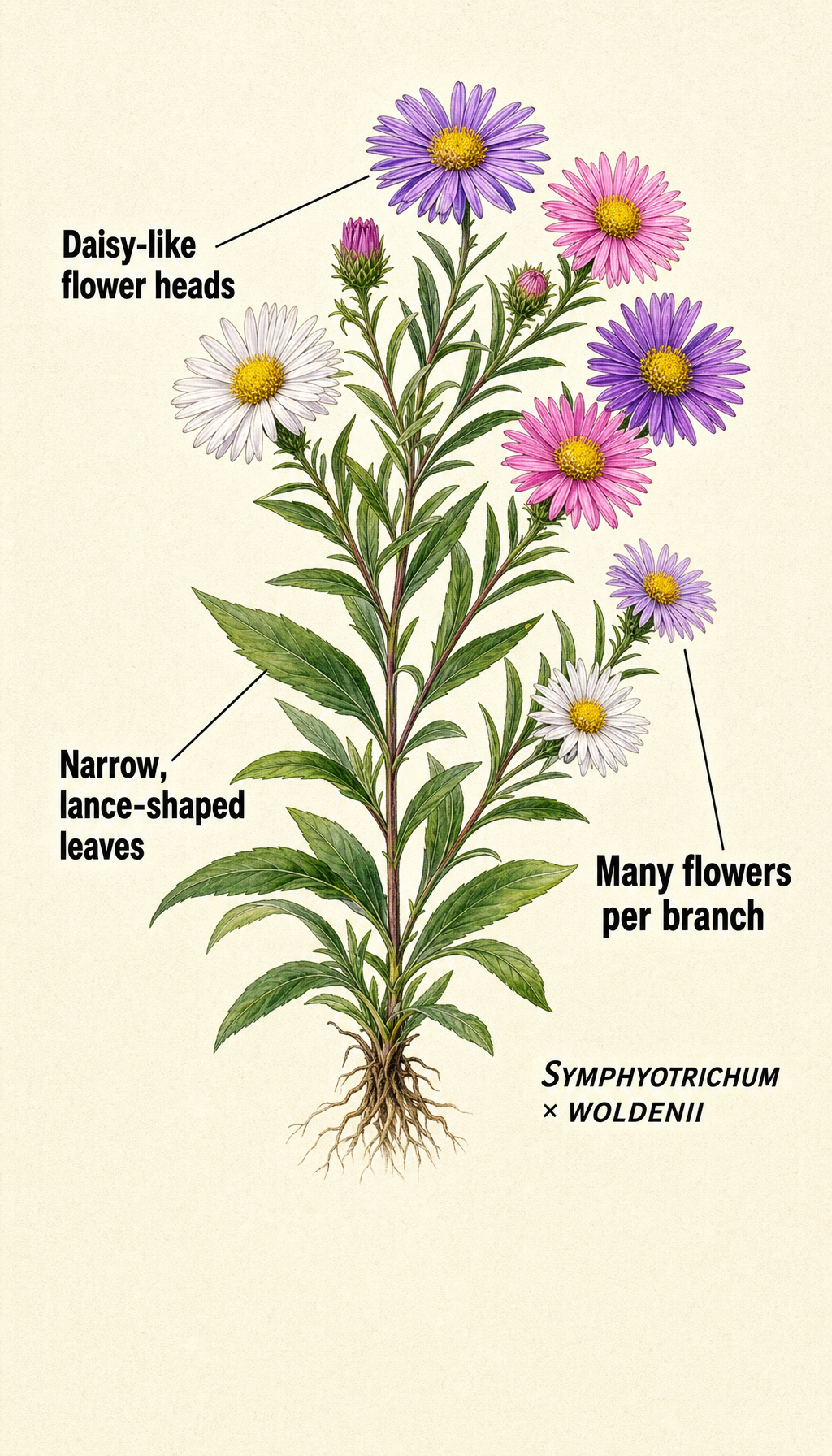
Form: A herbaceous, perennial aster that typically forms one or more upright to arching stems arising from a clump. Plants often reach roughly a few dozen centimeters to around a meter or more in height, depending on growing conditions.
Flowers: Flower heads are composite, with a central disk of tubular disk florets surrounded by multiple narrow ray florets. Ray florets are often numerous (several to many) and may appear white, pink, lavender, or purple depending on the cross. Disk florets are generally yellow when fresh, aging to darker tones.
Leaves: Leaves are simple and alternately arranged along the stem, generally lanceolate to elliptic in shape and often with toothed margins. Surface texture can be glabrous to lightly pubescent depending on parentage and environment.
Distinctive features: Late-season flowering, showy clusters of composite heads, and a tendency to form loose clumps of upright stems help distinguish it from other late-season wildflowers. Variability in flower color and leaf hairiness is common in hybrid asters.
Seasonal variation: Typically flowers in late summer into autumn, providing color after many summer-blooming species have finished.
Habitat & Distribution
Habitat: Often found in open, sunny to partly shaded settings such as meadows, roadsides, prairie edges, and disturbed ground. Frequently associated with mesic to moderately moist sites but capable of persisting in a range of soil textures.
Light, moisture, soil: Commonly grows in full sun to partial shade and typically tolerates a range from mesic to moderately moist soils; prefers well-drained sites but can be adaptable.
Geographic distribution: Documented in Iowa (IA); as a hybrid taxon it may occur where parental taxa overlap and under suitable habitat conditions.
Ecological Role
Pollinators: Provides nectar and pollen to a broad suite of late-season pollinators, including bees and butterflies, making it valuable for extending floral resources into autumn.
Wildlife interactions: Flower heads and seedheads can offer resources to insects and, later, to seed-eating wildlife; stems and foliage contribute to structural habitat in meadow communities.
Ecological niche: Functions as a late-season nectar source and as part of diverse herbaceous assemblages in prairie and meadow-type ecosystems.
Human Uses & Cultural Significance
No widely documented, species-specific traditional or medicinal uses are established for this hybrid; Symphyotrichum species in general are valued in horticulture for late-season color.
Conservation & Interesting Facts
The "×" in the name denotes its hybrid origin. Symphyotrichum asters are notable for their ecological role supplying nectar and pollen late in the season, supporting migrating and overwintering pollinators.
From Instagram