gray goldenrod
Solidago nemoralis
BloomEDU
Identify it today. Know it next time.
Add gray goldenrod to BloomEDU and a short quiz tomorrow will check if the name stuck.
Get BloomEDU — add gray goldenrodFree · iOS · Android
**Identity & Classification**
Solidago nemoralis — common name Gray Goldenrod (also called gray-stem goldenrod, old-field goldenrod, field goldenrod, prairie goldenrod, dwarf goldenrod, and dyersweed goldenrod) — is a member of the aster family, Asteraceae. It belongs to the genus Solidago, the group commonly called goldenrods. Taxonomically it is treated as a distinct species (S. nemoralis) within Solidago; the genus contains many closely related species and infraspecific taxa, and different floras may recognize varieties or subspecies of Solidago nemoralis. **Physical Description**
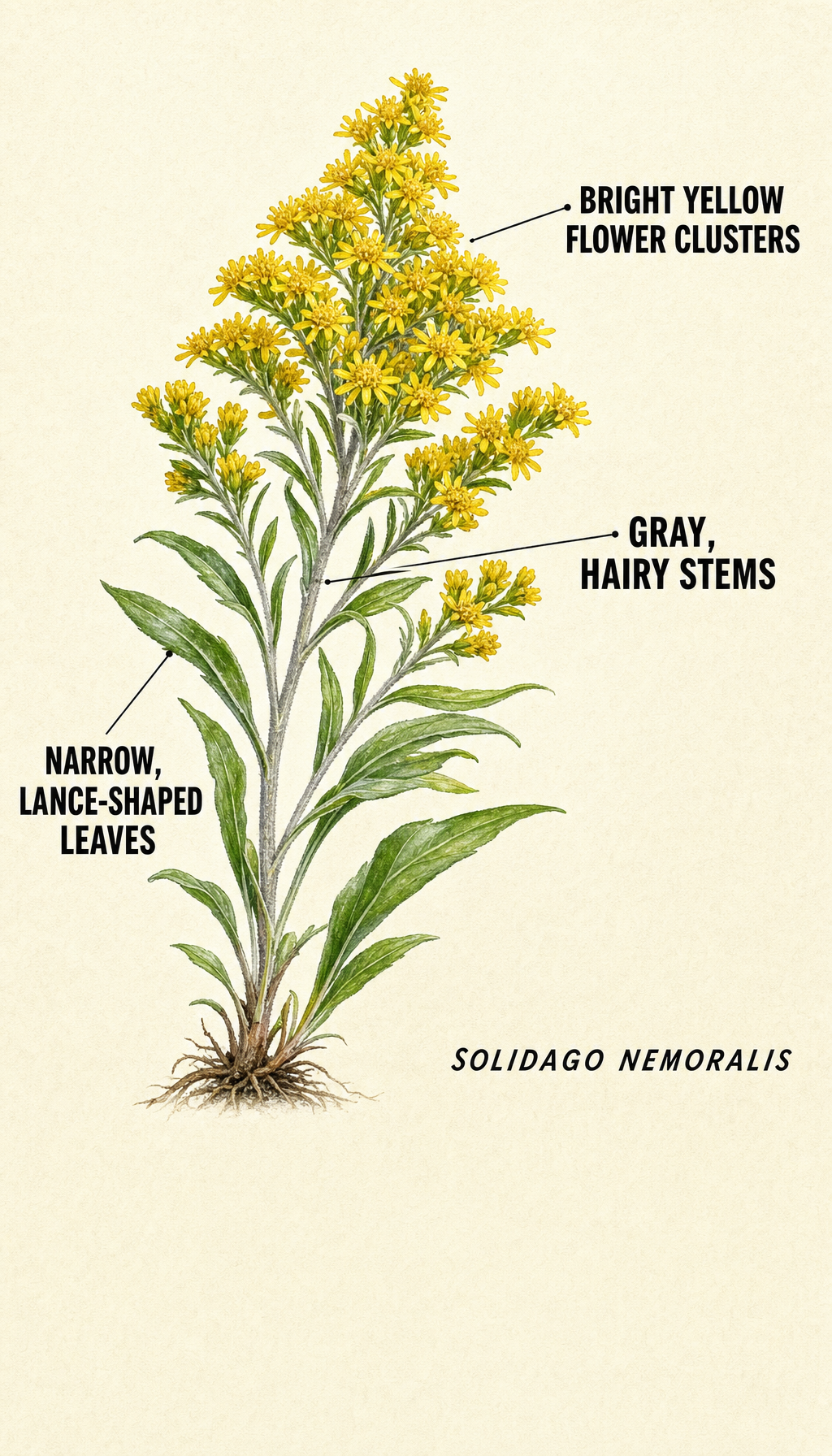
A compact, yellow‑flowered perennial goldenrod with a somewhat “gray” appearance on the stems and foliage. Key identifying features:
- Growth form: a perennial herb that is typically short to medium in stature (usually less than a meter tall), often forming clumps or small stands. - Stems: often grayish or lightly woolly-hairy, which contributes to the common name “gray” goldenrod. - Leaves: alternate, typically lanceolate to elliptic in shape; leaves may be toothed or entire and are borne along the stem (cauline). Basal leaves, when present, are generally smaller and may wither by flowering. - Inflorescence: an open cluster (paniclelike array) of many small yellow composite flower heads (the characteristic goldenrod “sprays”). - Flower heads: each head is a composite of a few short ray florets surrounding multiple tubular disc florets — together producing the bright yellow appearance during bloom. - Bloom time: typically in late summer into fall (late-season flowering is typical of many goldenrods). nemoralis from some taller or more densely leaved Solidago species. **Habitat & Range**
- Geographic distribution: Native to North America. It is reported from Canada (every province except Newfoundland and Labrador) and is found in the United States in states wholly or partially east of the Rocky Mountains. - Preferred habitats: Solidago nemoralis is typically found in open, well‑drained sites. It often occurs in places such as old fields, prairies, dry open woods, roadsides, and other sunny, dry to mesic habitats. The species tolerates relatively dry soils compared with some other goldenrods. - Microhabitat notes: It thrives where there is good sun exposure and is commonly part of early- to mid-successional plant communities in open landscapes. **Ecological Role**
- Pollinators and nectar: Gray goldenrod produces abundant late‑season flowers that provide nectar and pollen to a wide array of insects. It is an important late-season resource for pollinators such as bees, butterflies, and other flower-visiting insects. - Insect associations: Like many goldenrods, S. nemoralis supports diverse insect communities; it commonly hosts flower visitors and is often associated with insects that form galls on goldenrods (gall-forming insects are frequently found on Solidago species). - Wildlife value: The flowers and subsequent seed crop may be used by foraging insects and, indirectly, by birds or small mammals that feed on insects or seeds, but specific consumer species vary by region. - Ecosystem function: By flowering late in the season, S. nemoralis helps extend the availability of floral resources into late summer and fall, supporting pollinator populations when fewer nectar sources remain. **Human Uses & Cultural Significance**
- Well-documented specific uses of Solidago nemoralis are limited in the literature. While various Solidago species have historical uses in traditional herbalism and some have been used for dyes (the common name “dyersweed” hints at such possible uses), specific, well-documented cultural or medicinal applications tied uniquely to S. nemoralis are not well-established. - Modern horticulture: Goldenrods in general are appreciated for late-season color and pollinator support; S. nemoralis may be used in native plant gardens or prairie restorations where a shorter goldenrod is desired. Exact horticultural popularity can vary regionally. **Interesting Facts**
- Gray stems, not asthma: The “gray” in the common name comes from the stem/foliar hairs that give a slightly grayish cast — not from any disease or dust. - Not the hayfever villain: Despite popular belief, goldenrods are usually insect-pollinated (their pollen is heavy and not adapted for long-distance wind dispersal). Ragweed and other wind-pollinated plants are more common causes of late-summer hay fever. - Late-season lifeline: Goldenrods, including S. nemoralis, are valuable nectar sources late in the growing season, helping sustain pollinators preparing for migration or overwintering. - Name variety: The many common names (old-field, prairie, field, dwarf, dyersweed) reflect the species’ presence in open, often disturbed habitats and its variable stature across different sites. - Galls and guilds: Goldenrods are famously associated with a rich suite of gall-making insects and other specialized herbivores — an ecological microcosm on a single plant type. nemoralis to commonly confused Solidago species to help with identification in the field.
From Instagram