showy goldenrod
Solidago erecta
BloomEDU
Identify it today. Know it next time.
Add showy goldenrod to BloomEDU and a short quiz tomorrow will check if the name stuck.
Get BloomEDU — add showy goldenrodFree · iOS · Android
From Instagram
Identity & Classification
Scientific name: Solidago erecta
Common names: showy goldenrod (verified)
Family: Asteraceae
Genus: Solidago
Taxonomic notes: Solidago is a large genus of primarily North American perennials; relationships within the genus are complex but Solidago erecta is treated as a distinct species in regional floras.
Visual Description
Form and size: A perennial, erect herbaceous plant that typically produces one or more upright stems from a persistent rootstock. Plants often reach heights in the low-to-moderate range for goldenrods, with a generally upright, clump-forming habit.
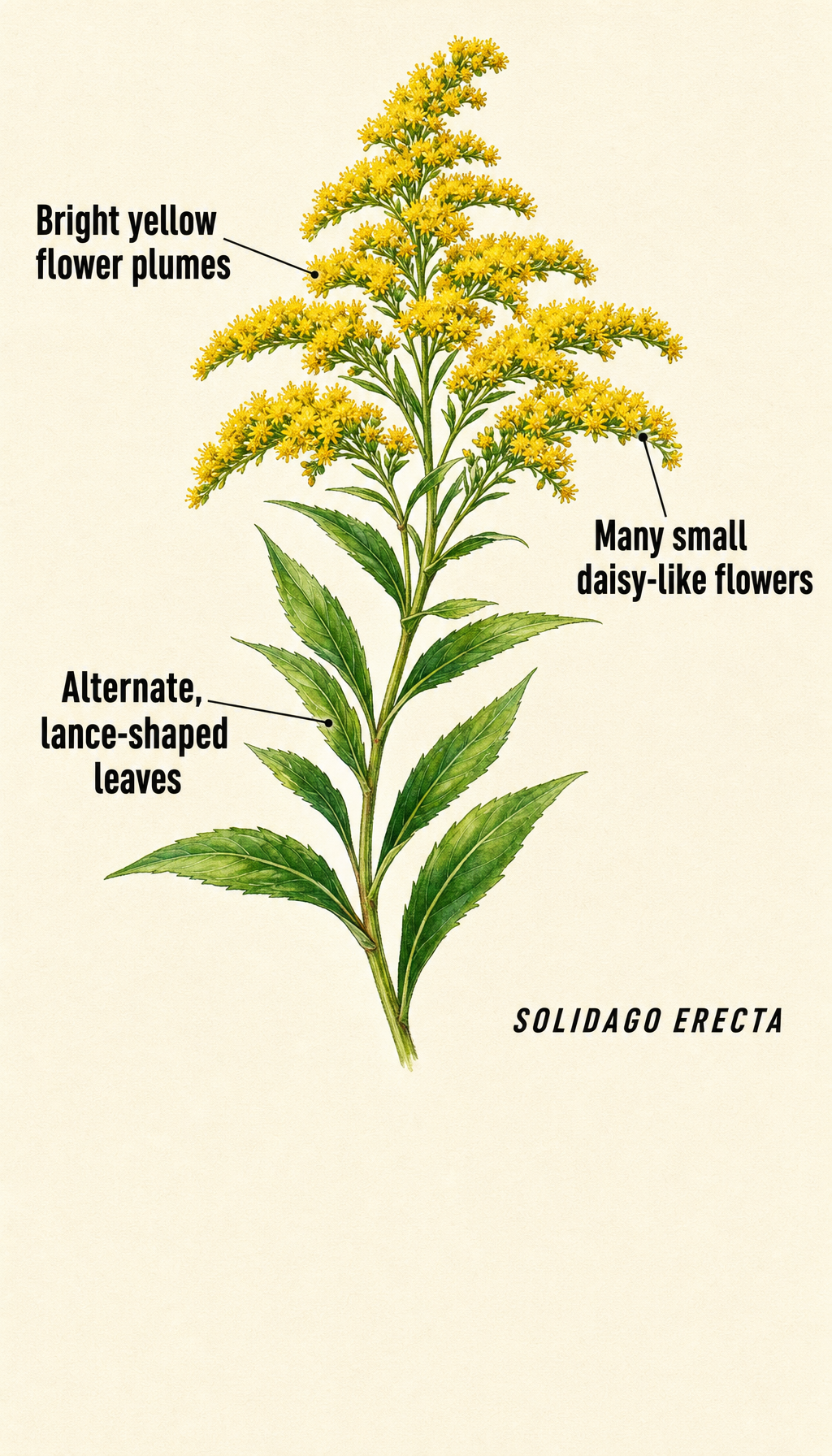
Flowers: Inflorescences are conspicuous sprays of small yellow composite flower heads, forming loose to somewhat dense panicles that can appear “showy” from a distance. Each flower head is a composite of tubular disc florets surrounded by a few small ray florets; overall floral display is a bright yellow mass when in full bloom.
Leaves: Leaves are alternate on the stem, generally lance-shaped to oblong, and typically have toothed or serrated margins. Leaves usually become smaller toward the top of the stem; lower leaves may be petiolated while upper leaves can be more sessile.
Distinctive features: The species is often recognized by its erect stems bearing numerous small yellow heads arranged in broad, branching clusters that are more open and showy compared with some species that form narrow, plume-like inflorescences.
Seasonal variation: Plants typically produce foliage through the growing season and bloom in the late summer to fall period, when the yellow inflorescences are most evident.
Habitat & Distribution
Growing conditions and ecosystems: Often found in open sites such as meadows, fields, roadsides, and open wood margins. Tolerates a range of light from full sun to partial shade and is commonly associated with well-drained to mesic soils.
Moisture and soil preferences: Typically adaptable to a variety of soil types and moisture regimes, often occurring in moderately dry to mesic conditions.
Geographic distribution: Reported from multiple states across the eastern United States, including AL, CT, DE, GA, IN and several others; generally distributed through portions of the eastern and midwestern U.S.
Ecological Role
Pollinators: An important late-season nectar and pollen source, attracting a wide spectrum of insects including native bees, wasps, flies, and butterflies.
Wildlife interactions: Serves as host or nectar source for many insects; goldenrod stems and seed heads may provide cover or food resources for small wildlife species.
Ecological niche: Functions as a late-season flowering native perennial that helps sustain pollinator communities when other floral resources decline.
Conservation & Interesting Facts
Conservation: No single, widely recognized conservation status is asserted here; many goldenrod species are common in suitable habitats.
Interesting facts: Goldenrods are a keystone late-season nectar source for pollinators. Members of the genus commonly host insect herbivores and gall-makers (for example, goldenrod gall flies), interactions that have been studied in ecology and insect–plant dynamics. Many Solidago species also spread clonally and can form dense colonies, helping stabilize soils and provide persistent habitat structure.