Canada goldenrod
Solidago canadensis
BloomEDU
Identify it today. Know it next time.
Add Canada goldenrod to BloomEDU and a short quiz tomorrow will check if the name stuck.
Get BloomEDU — add Canada goldenrodFree · iOS · Android
From Instagram
Identity & Classification
Solidago canadensis L. — commonly called Canada goldenrod or Canadian goldenrod (the name "Rough Canada Goldenrod" is sometimes used but is not universally applied).
Family: Asteraceae (the daisy or composite family)
Genus: Solidago (the goldenrods) — a genus of roughly a hundred or so species of mostly North American herbs
Species: S. canadensis
Taxonomic notes: Solidago canadensis is part of a complex of closely related goldenrod taxa; different authors recognize varieties or subspecies within the S. canadensis group. Because taxonomy in this group has been treated in several ways, you may see different varietal names in floras and databases.
Physical Description
A tall, rhizomatous perennial that produces conspicuous sprays of small yellow composite flowers in late summer and fall. Key characteristics:
Growth form: Upright, clonal perennial forming colonies via underground rhizomes; single plants often arise in dense stands.
Height: Often reaches roughly 0.5–1.5 m (about 1.5–5 ft) in many habitats; height can vary with site conditions.
Stems: Erect, usually unbranched or sparingly branched below the inflorescence; stems may feel somewhat coarse or rough to the touch.
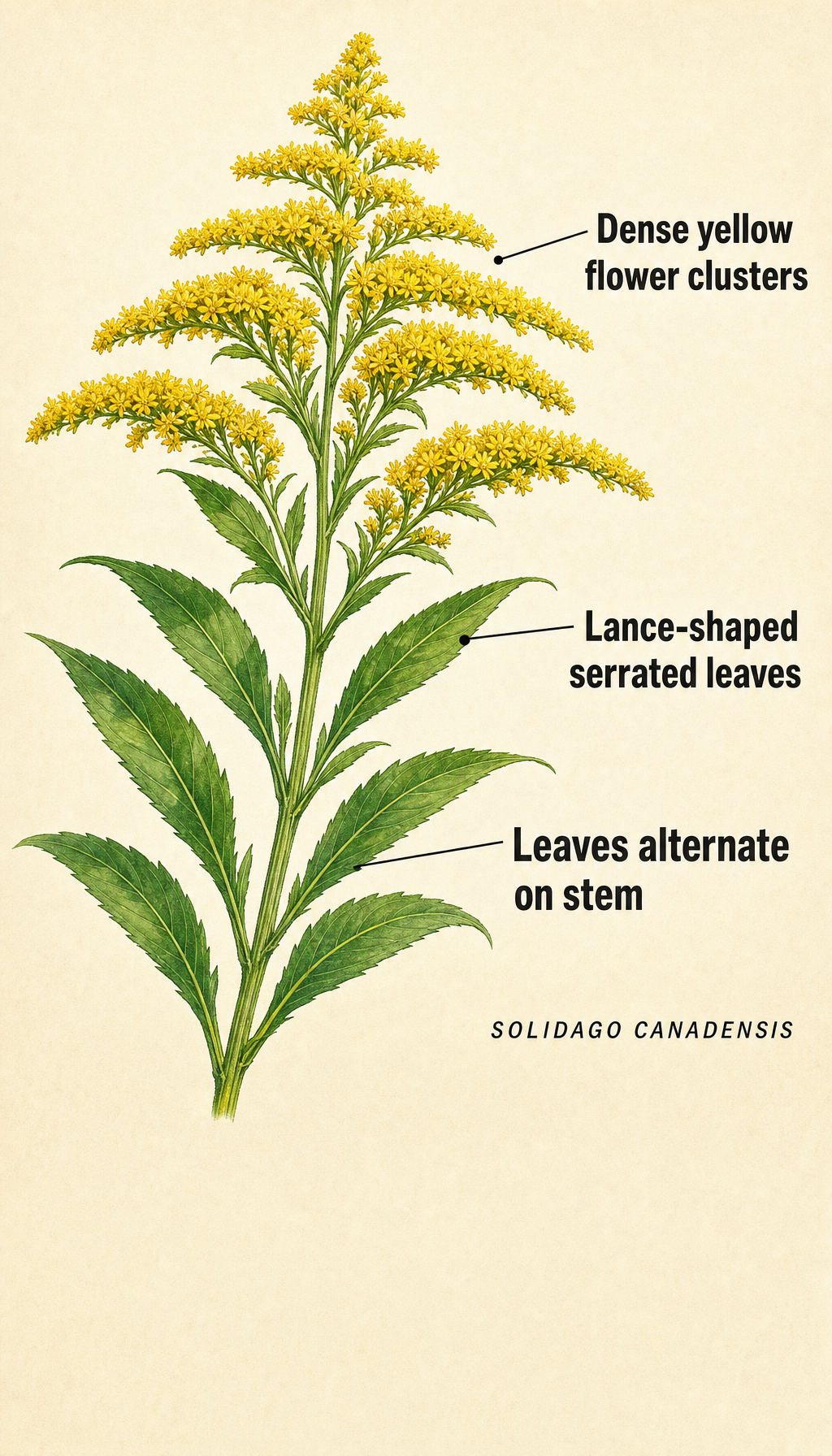
Leaves: Alternate along the stem, typically lance-shaped (lanceolate) to oblong with serrated margins; lower leaves usually petiolate, upper leaves more sessile and sometimes clasping the stem.
Inflorescence: Large, branched panicles or sprays of many small yellow flower heads held above the foliage; the overall effect is a plume-like mass of tiny flowers.
Flower heads: Each head is a composite of several tiny yellow ray and disc florets (the classic Asteraceae arrangement), collectively producing abundant nectar.
Fruit: Small single-seeded achenes (cypselae) with a tufted pappus of hairs that aids in wind dispersal.
Habitat & Range
Native distribution: S. canadensis is native to much of northeastern and north‑central North America (it is commonly described as a species of eastern and central parts of the continent).
Introduced/invasive: It has been introduced beyond its native range and is considered invasive in parts of western North America and in several regions worldwide, including parts of Eurasia.
Typical habitats: Often found in open, sunny to partly sunny sites — roadsides, fields, meadows, disturbed ground, prairies, and edges of woodlands. It tolerates a range of soil types but frequently occurs in mesic to moist soils.
Ecological amplitude: It is a disturbance-tolerant species that readily colonizes open or disturbed areas and can form dense stands through rhizomatous spread.
Ecological Role
Pollinators: A significant late-season nectar and pollen source. It attracts a broad suite of pollinators — native bees, bumblebees, solitary bees, butterflies, moths, and various flies and wasps — making it important for pollinator communities when fewer flowers are available.
Insect relationships: Hosts many herbivorous insects and their natural enemies; certain gall-making insects (for example, flies in the genus Eurosta) form characteristic stem galls on Solidago species.
Wildlife: Dense stands can provide cover for small animals; seeds may be taken by some small birds and seed-eating insects, though the plant’s main ecological importance is as a floral resource.
Ecosystem function: By colonizing disturbed soils and forming rhizomatous colonies, it can stabilize soil and contribute to successional vegetation dynamics. In regions where it is invasive, it can outcompete native species and alter plant community composition.
Interesting Facts
Misplaced blame: Goldenrod is often blamed for fall hay fever, but its pollen is relatively heavy and primarily insect‑pollinated. Ragweed (Ambrosia spp.), which blooms at the same time and produces lightweight windborne pollen, is the more common cause of seasonal allergic rhinitis.
Late-season nectar factory: Because it blooms in late summer and autumn, Solidago canadensis provides critical nectar for migrating butterflies and late-season bees.
Clonal strategy: It spreads by underground rhizomes as well as by seed, which helps it form dense monospecific stands in favorable conditions.
Galls and science: The galls induced by gall-making insects (e.g., Eurosta species) on goldenrods have been the subject of ecological and physiological research, including studies on insect cold tolerance.
Name origin: The genus name Solidago is traditionally linked to Latin roots meaning “to make whole,” an etymological nod to the genus’s long association with folk uses; this etymology is why you’ll sometimes see goldenrod connected with old herbal traditions.