annual bush-sunflower
Simsia lagasceiformis
BloomEDU
Identify it today. Know it next time.
Add annual bush-sunflower to BloomEDU and a short quiz tomorrow will check if the name stuck.
Get BloomEDU — add annual bush-sunflowerFree · iOS · Android
Identity & Classification
Scientific name: Simsia lagasceiformis
Common names: annual bush-sunflower, bush-sunflower
Family: Asteraceae
Genus: Simsia
Taxonomic note: Simsia is placed in the sunflower tribe Heliantheae and is therefore related to the true sunflowers (Helianthus).
Visual Description
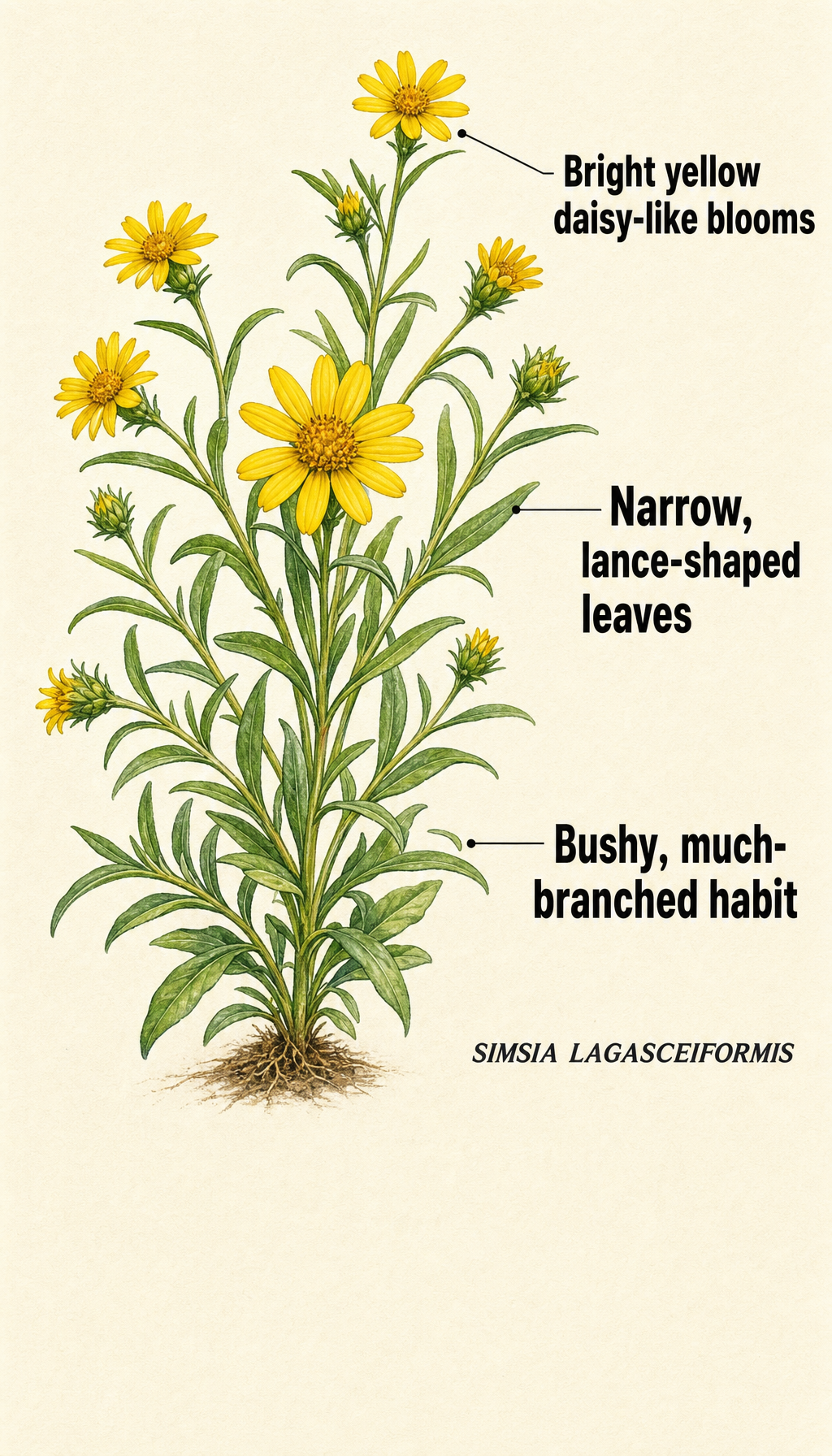
Simsia lagasceiformis is an annual, erect, bushy herb that typically forms branched clumps rather than a single unbranched stalk. Plants often bear multiple flowering stems arising from a base and may vary in overall height depending on growing conditions. Flower heads are composite: a ring of yellow ray florets encircles a central disk of tubular florets that is often darker in color, producing the familiar “sunflower” look; ray florets commonly occur in small even numbers per head. Leaves are generally simple and lanceolate to ovate with toothed or serrated margins and are typically arranged oppositely on the stem. Stems and foliage may bear short hairs. Distinctive identifying features include the bushy branching habit, multiple yellow radiate heads on terminal and axillary branch tips, and the opposite leaf arrangement, which help separate it from similar-looking annual asters. Seasonal variation: flowering is most conspicuous in warm months when plants produce numerous showy heads; foliage and overall vigor decline after seed set as an annual lifecycle completes.
Habitat & Distribution
Simsia lagasceiformis is often found in open, sunny sites that include disturbed ground, roadsides, fields, and open scrub or grassland. The species typically prefers full sun and well-drained soils and can tolerate dry to moderately mesic conditions. It commonly occurs in soils ranging from sandy to rocky substrates where competition is reduced. Geographic distribution in the United States includes records from Arizona, Maryland, New Mexico, and Texas; populations in this range may be native in some areas and introduced or localized in others.
Ecological Role
Like many Asteraceae, Simsia lagasceiformis is attractive to a broad suite of insect pollinators, often including native bees and butterflies that visit the conspicuous yellow rays and nectar-producing disk florets. The composite seed heads may provide small seeds used opportunistically by seed-eating insects and birds. As an annual that readily colonizes open ground, it can act as a pioneer species in disturbed plant communities.
Human Uses & Cultural Significance
Documented traditional or widespread uses for this species are limited in the botanical literature; it is primarily noted for its ornamental, wildflower value in informal plantings and naturalistic gardens rather than established medicinal or economic uses.
Conservation & Interesting Facts
No global conservation status is included here. Interesting fact: the composite “flower” of Simsia lagasceiformis is actually an inflorescence of many florets, a hallmark of Asteraceae that increases pollination efficiency by presenting many small flowers as a single large target. The species’ tolerance of open, disturbed sites is an adaptive trait that facilitates rapid establishment where competition is reduced.
From Instagram