bloodroot
Sanguinaria canadensis
BloomEDU
Identify it today. Know it next time.
Add bloodroot to BloomEDU and a short quiz tomorrow will check if the name stuck.
Get BloomEDU — add bloodrootFree · iOS · Android
From Instagram
Identity & Classification
Scientific name: Sanguinaria canadensis. Verified common names: bloodroot, redroot. Family: Papaveraceae. Genus: Sanguinaria (a monotypic genus containing this single, widely recognized species).
Visual Description
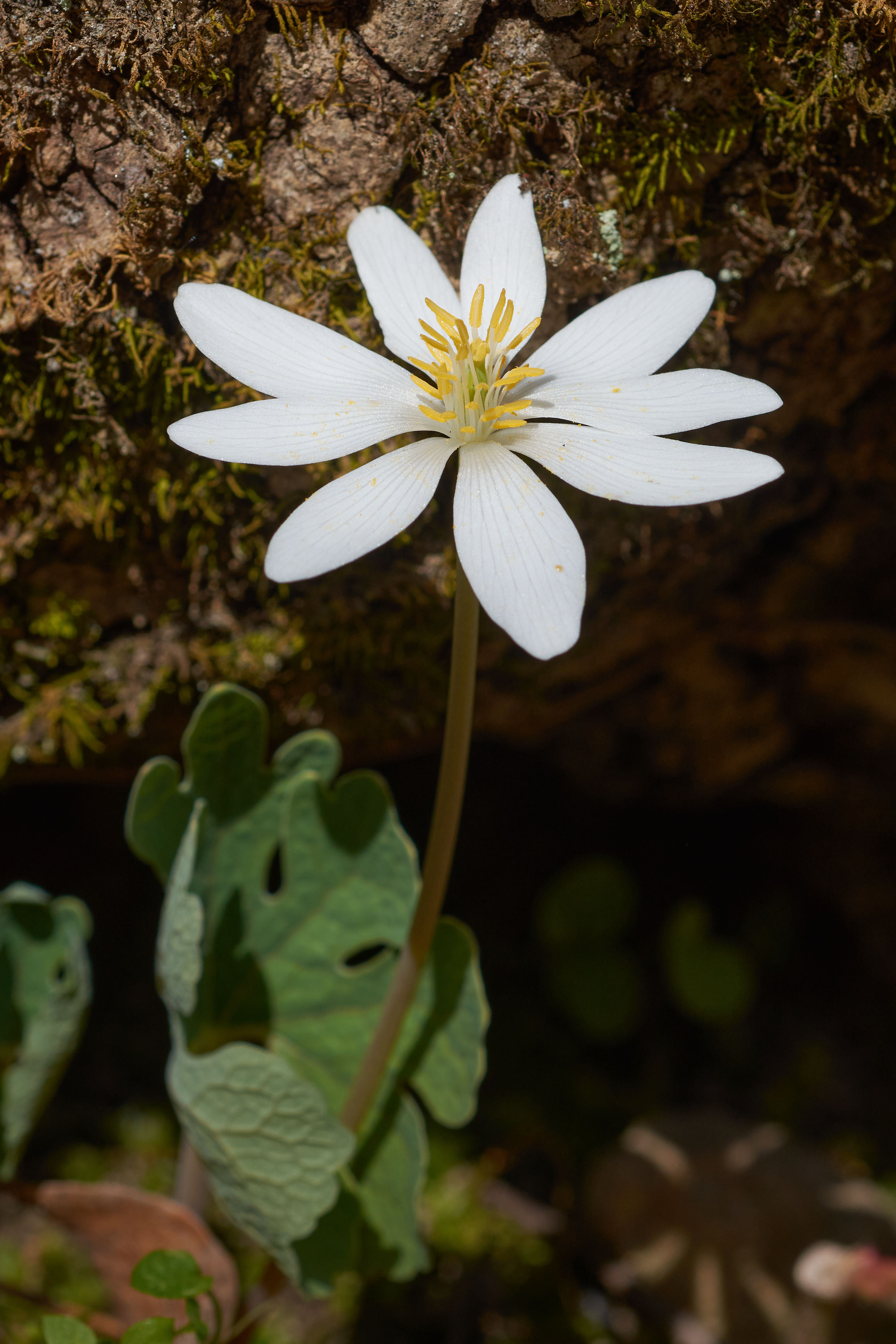
Bloodroot is a perennial spring ephemeral arising from a creeping rhizome that contains a distinctive orange‑red sap. Plants are generally low-growing and typically appear in early spring before the forest canopy fills in. Flowers are solitary and showy, appearing above or within the leaf in spring; petals are typically white and commonly number in the range of 8–12, surrounding a central cluster of yellow stamens. Flowers open on sunny days and often close or wilt in dull weather. Leaves are single and basal, often peltate (with the petiole attached near the center of the blade), circular to kidney-shaped with shallow lobes or crenate margins; leaves usually develop at or shortly after flowering and may partially fold over the flower in bud. Distinctive identifying features include the red-orange root/rhizome sap and the combination of a solitary white spring flower with a single round peltate basal leaf. After the spring growth, aboveground parts die back and the plant remains dormant through summer.
Habitat & Distribution
Bloodroot typically grows in deciduous woodlands and shaded slopes in rich, mesic soils with ample leaf litter. It is most often found in partial to full shade and in moist, well-drained, humus-rich substrates. Geographic distribution is eastern North America, occurring across many U.S. states — including AL, AR, CT, DE, FL and numerous others — generally from the Gulf Coast northward into the northeastern and midwestern states.
Ecological Role
Flowers provide early-season pollen and nectar resources for a variety of spring pollinators, including solitary bees and other generalist bees. Seeds possess fleshy elaiosomes and are commonly dispersed by ants (myrmecochory), a well-documented mutualism that helps move seeds into sheltered microsites in the leaf litter. As an early ephemeral, bloodroot occupies a niche of exploiting high light levels on the forest floor before canopy leaf-out.
Conservation & Interesting Facts
Bloodroot is generally common in suitable habitats across much of its range rather than widely rare. Notable adaptations include its red, latex‑bearing rhizome and ant‑mediated seed dispersal. The bright red sap was traditionally used as a dye and gives the plant its common name.