black elderberry
Sambucus nigra
BloomEDU
Identify it today. Know it next time.
Add black elderberry to BloomEDU and a short quiz tomorrow will check if the name stuck.
Get BloomEDU — add black elderberryFree · iOS · Android
From Instagram
Identity & Classification
Sambucus nigra L. — commonly called elder, elderberry, black elder or European elder — belongs to the genus Sambucus, which is currently placed in the family Adoxaceae (older treatments sometimes placed Sambucus in Caprifoliaceae or related groups). Taxonomy in this group is messy: what botanists call “Sambucus nigra” is best thought of as a species complex. North American populations are often treated as Sambucus nigra subsp. canadensis or as the separate species Sambucus canadensis and are commonly called American elder or American black elderberry. Because different floras and authors use different circumscriptions, you will see several synonyms and subspecific names in the literature.
Physical Description
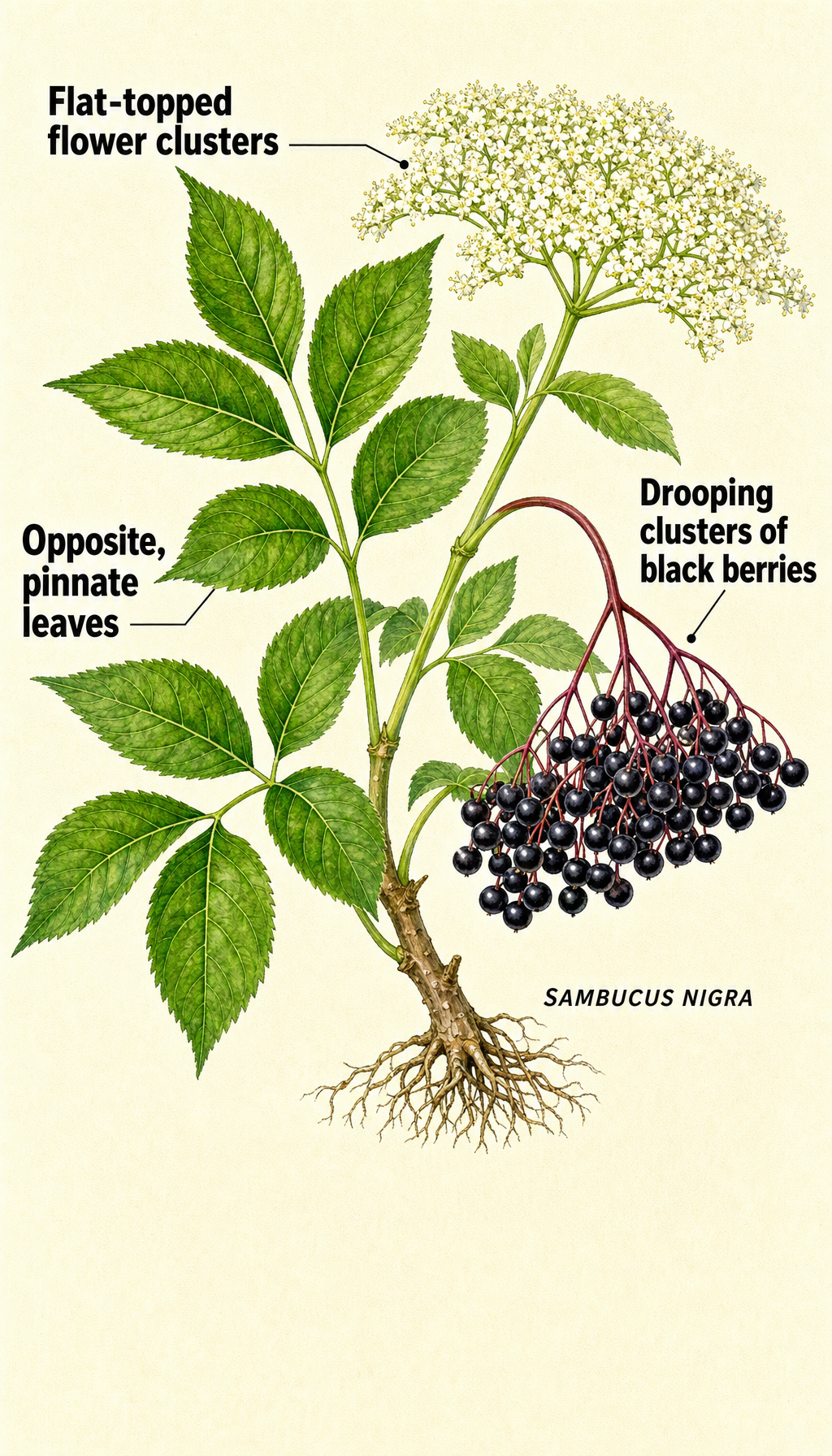
A charismatic, fast-growing deciduous shrub or small tree with these characteristic features:
Growth form: multi-stemmed shrub to a small tree; commonly reaches a few meters tall (often 2–6 m in cultivation and the wild), but size can vary with site and taxon.
Leaves: opposite, pinnately compound leaves with typically 5–9 lanceolate leaflets; leaflets have serrated margins and a pointed tip.
Stems & pith: stems have a soft, spongy pith (easy to hollow out), a trait long noted by people who make whistles or small pipes from elder wood.
Inflorescences: large, flat-topped clusters (corymbs or cymes) of many small, creamy-white to pale-yellow flowers; flowers typically have five petals and are produced in late spring to early summer.
Fruit: clusters of small, glossy, dark purple to black berries (technically drupes) when ripe; each berry usually contains several small seeds.
Bark & winter appearance: younger stems smooth; older stems may develop shallow fissuring. Plants are deciduous, dropping leaves in winter.
Habitat & Range
General habitat preferences: often found in sunny locations and tolerates a wide range of soils from moist to reasonably dry, typically favoring fertile, well-drained to seasonally wet sites; often seen on woodland edges, hedgerows, streambanks, disturbed ground and in cultivated landscapes.
Geographic notes: Sambucus nigra sensu stricto is native to much of Europe. North American elder populations are commonly treated as S. nigra subsp. canadensis (or S. canadensis) and are native to parts of North America. Because taxonomy and names vary among sources, exact range statements depend on which taxonomic treatment is used.
Cultivation: widely grown as an ornamental and for fruit production; escaped and naturalized populations occur outside native ranges in some regions.
Ecological Role
Flowers: the open, nectar-rich flower clusters attract a variety of insect visitors (for example, many kinds of generalist pollinators such as bees and flies), making the plant a useful nectar source in late spring/early summer.
Fruits: ripe berry clusters are a food resource for many birds and some mammals; those animals in turn act as seed dispersers.
Community function: often a pioneer or early-successional shrub that establishes in edge habitats and disturbed ground, helping create structure and habitat complexity in developing stands. Note: specific interactions with particular animal species or detailed pollinator networks vary regionally and by taxon; precise ecological partners are not exhaustively documented here.
Interesting Facts
The soft pith inside elder shoots made them ideal for making whistles and small pipes; this practical use ties into the genus name — “Sambucus” is linked etymologically to an ancient stringed instrument called a sambuca that was sometimes made from hollowed wood. - The showy flat flower clusters are botanically cymes or corymbs — elegant little landing platforms for a wide range of pollinating insects. - Botanically, the fruit is a cluster of drupes (each “berry” is a small drupe containing seeds), not a true berry in the strictest botanical sense. - Because the group is a species complex with multiple subspecies and regional forms, gardeners and naturalists often see variation in size, fruit color and timing; that taxonomic fuzziness makes elderberries a lively topic for field botanists. nigra sensu stricto and North American elder taxa.