Pursh's wild petunia
Ruellia purshiana
BloomEDU
Identify it today. Know it next time.
Add Pursh's wild petunia to BloomEDU and a short quiz tomorrow will check if the name stuck.
Get BloomEDU — add Pursh's wild petuniaFree · iOS · Android
Identity & Classification
Scientific name: Ruellia purshiana
Verified common names: Pursh’s wild petunia (also seen as Pursh’s ruellia)
Family: Acanthaceae
Genus: Ruellia
Note: Ruellia is a member of the Acanthaceae and is not closely related to true petunias (family Solanaceae); the common name “wild petunia” reflects a superficial resemblance rather than close taxonomy.
Visual Description
Form and size: Typically a herbaceous perennial (occasionally appearing subshrubby), forming loose clumps of slender, often branched stems. Plants generally grow from low groundcover height to about knee-height in favorable sites.
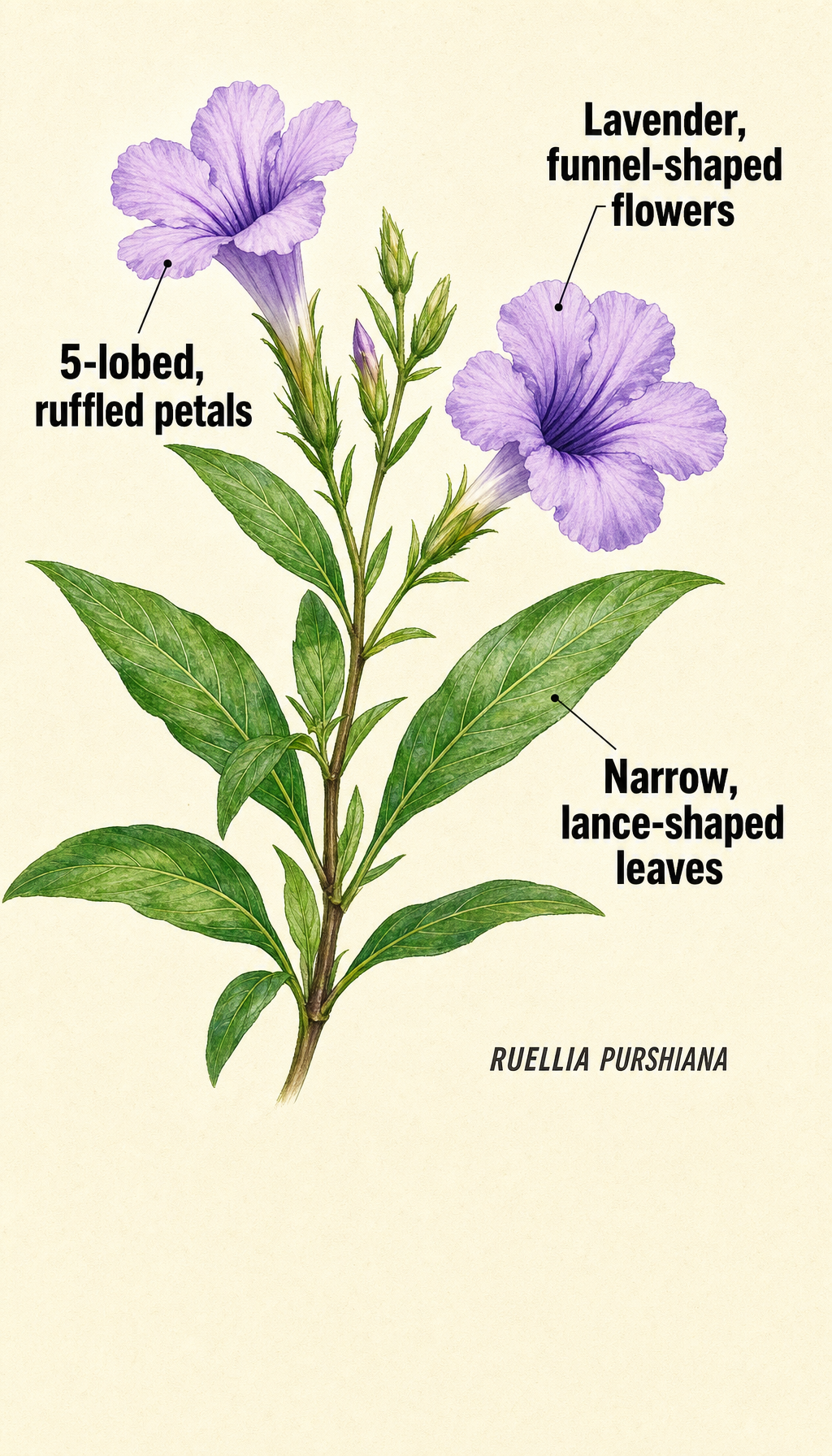
Flowers: Funnel-shaped corolla with five lobes (appearing as a single, five-lobed “petal”), the limb flaring from a tubular throat. Flower color is most often shades of lavender to purple and can sometimes be pale or white. Flowers are showy, borne singly or in small clusters from leaf axils.
Leaves: Leaves are opposite, simple, and typically lanceolate to elliptic in outline; margins are entire to lightly toothed. Leaves may be textured with visible veins and a slightly coarse surface.
Distinctive features: The combination of opposite leaves, tubular five-lobed flowers in purple hues, and an herbaceous habit helps distinguish this Ruellia. Mature fruit are dehiscent capsules typical of Acanthaceae, which may forcibly release seeds.
Seasonal variation: Flowering typically occurs during the warmer months and may persist into late summer or fall where conditions permit; foliage vigor and flowering can decline in cooler seasons.
Habitat & Distribution
Growing conditions and ecosystems: Pursh’s wild petunia is typically found in open woodlands, edges, thickets, and disturbed sites such as roadsides. It is often associated with mesic to somewhat moist soils and can tolerate partial shade to full sun, depending on local conditions.
Soil and moisture preferences: Often found on soils that retain moderate moisture; tolerates a range from loamy to sandy substrates where moisture is adequate.
Geographic distribution: Recorded from several states in the eastern and southeastern United States, including Alabama, Georgia, Louisiana, Maryland, North Carolina, and additional nearby states.
Ecological Role
Pollinators: The tubular, showy flowers are attractive to a variety of pollinators; bees and butterflies are commonly observed visitors. The flower shape suggests adaptation to pollinators with moderate proboscis length.
Wildlife interactions: Flower nectar provides a food resource for insect pollinators; seed capsules contribute to localized seed rain after dehiscence.
Ecological niche: Functions as a flowering understory or edge species in warm-season plant communities, contributing seasonal nectar resources and modest structural cover.
Human Uses & Cultural Significance
No widely documented traditional or modern uses are clearly established in mainstream botanical sources for this specific species; no prominent toxicity concerns are routinely reported in general floras.
Conservation & Interesting Facts
- The seed capsules of Ruellia species commonly dehisce and can eject seeds, a mechanism that aids short-distance dispersal.
- Although called a “wild petunia,” Ruellia purshiana belongs to the Acanthaceae, illustrating that common names can reflect resemblance rather than close botanical relationships.
From Instagram