Great Britain blackberry
Rubus thyrsoides
BloomEDU
Identify it today. Know it next time.
Add Great Britain blackberry to BloomEDU and a short quiz tomorrow will check if the name stuck.
Get BloomEDU — add Great Britain blackberryFree · iOS · Android
Identity & Classification
Scientific name: Rubus thyrsoides
Verified common name(s): Great Britain blackberry
Family: Rosaceae
Genus: Rubus — a large genus of brambles that includes blackberries, raspberries, and many closely related taxa. Rubus thyrsoides is treated as a bramble within this genus; broader taxonomic relationships in Rubus are complex and often involve hybrids and apomictic microspecies.
Visual Description
Overall form: A woody bramble typically forming arching or erect canes arising from a perennial rootstock. Many Rubus species exhibit a biennial cane habit (first-year vegetative canes, second-year flowering canes), and R. thyrsoides may follow this pattern.
Size: Can form low thickets or elongated canes; cane and shrub height can vary widely depending on site and growth habit.
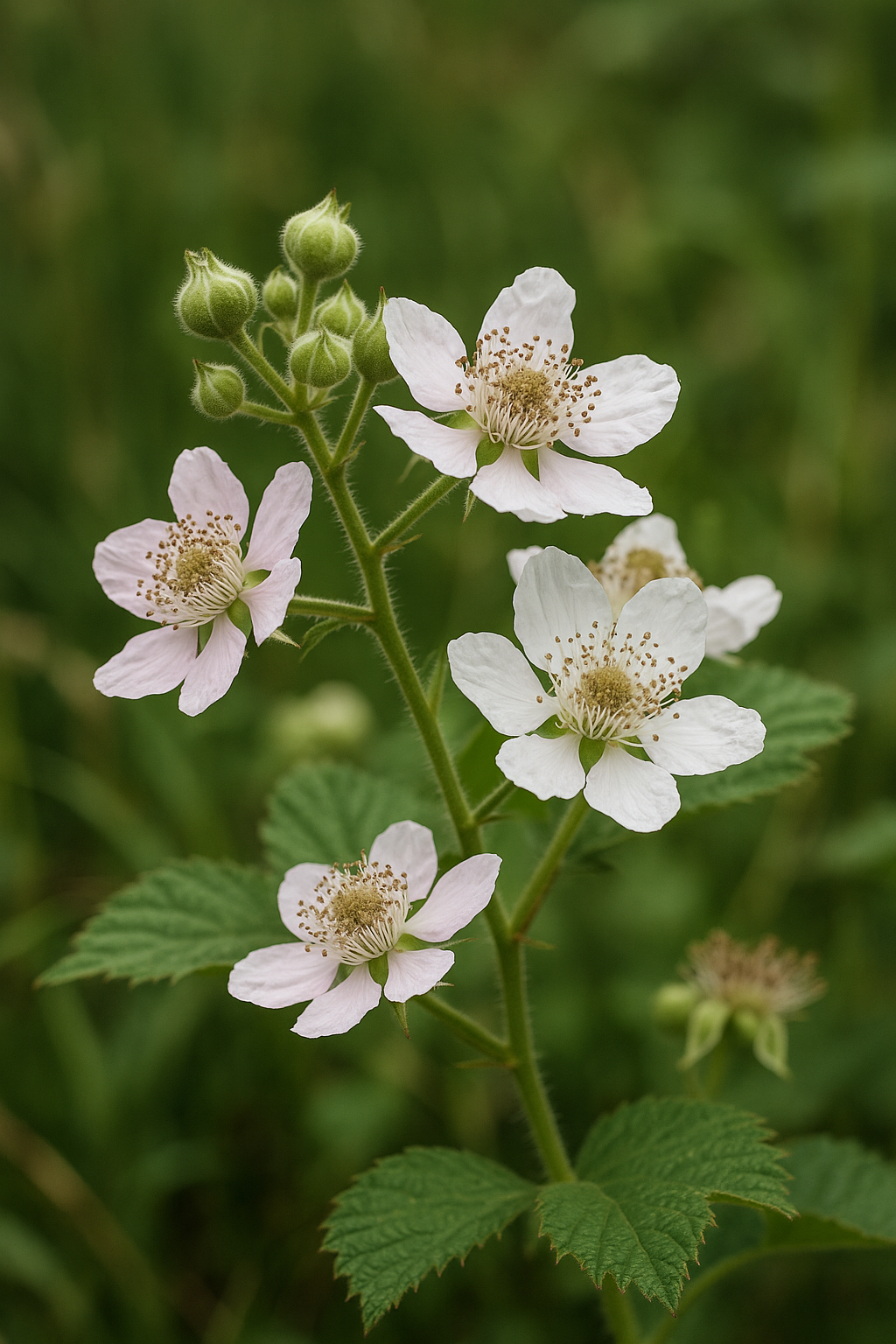
Flowers: Inflorescences often in small clusters; flowers typically with 4–6 (commonly 5) petals that are white to pale pink. Stamens and pistils are exposed at anthesis, attracting insect visitors.
Leaves: Compound, usually with 3–5 leaflets that are alternately arranged on the cane; leaflets often toothed and textured, sometimes with a paler underside. Leaves may change appearance between first-year (more pinnate) and flowering canes.
Distinctive features: Presence of prickles or bristles on canes and petioles; aggregate fruit composed of many drupelets that generally ripen to a dark color. Texture of canes, leaflet shape and prickle density are useful field characters.
Seasonal variation: Produces flowers in the growing season with fruit following in summer; leaves are deciduous and can senesce in autumn.
Habitat & Distribution
Typical habitats: Often found in disturbed sites, hedgerows, woodland edges, clearings and other early-successional habitats where light is moderate to high. Can tolerate a range of settings from open fields to shaded edges.
Moisture, light, soil: Generally prefers well-drained soils and full sun to partial shade; tolerates a variety of soil types and moisture regimes but often does best where soils are not waterlogged.
Geographic distribution (U.S. records): Documented occurrences include Georgia (GA), Maine (ME), New Hampshire (NH) and Vermont (VT). Local abundance and exact native/introduced status may vary by region.
Ecological Role
Flowers are visited by generalist pollinators, especially bees and other insects that forage on nectar and pollen. Fruits provide a food source for birds and mammals, which also act as seed dispersers. As a bramble, it commonly occupies an early-successional niche, stabilizing soils and creating protective cover for wildlife.
Human Uses & Cultural Significance
Many Rubus species produce edible aggregate fruits and have a long history of culinary use; however, specific documented uses for R. thyrsoides are limited. Caution is advised: correct species identification is important before consuming wild berries.
Conservation & Interesting Facts
Rubus species are notable for frequent hybridization and apomictic reproduction, resulting in many localized microspecies and taxonomic complexity. Some brambles spread vegetatively by tip-rooting or by forming dense thickets that influence succession and wildlife habitat.
From Instagram