Hawai'i blackberry
Rubus hawaiensis
BloomEDU
Identify it today. Know it next time.
Add Hawai'i blackberry to BloomEDU and a short quiz tomorrow will check if the name stuck.
Get BloomEDU — add Hawai'i blackberryFree · iOS · Android
Identity & Classification
Scientific name: Rubus hawaiensis. Verified common names: Hawaiian raspberry, ʻakala (Hawaiian). Family: Rosaceae. Genus: Rubus. Taxonomic placement: a member of the Rubus lineage of brambles and raspberries; relationships to other Pacific Rubus species are recognized within the genus.
Visual Description
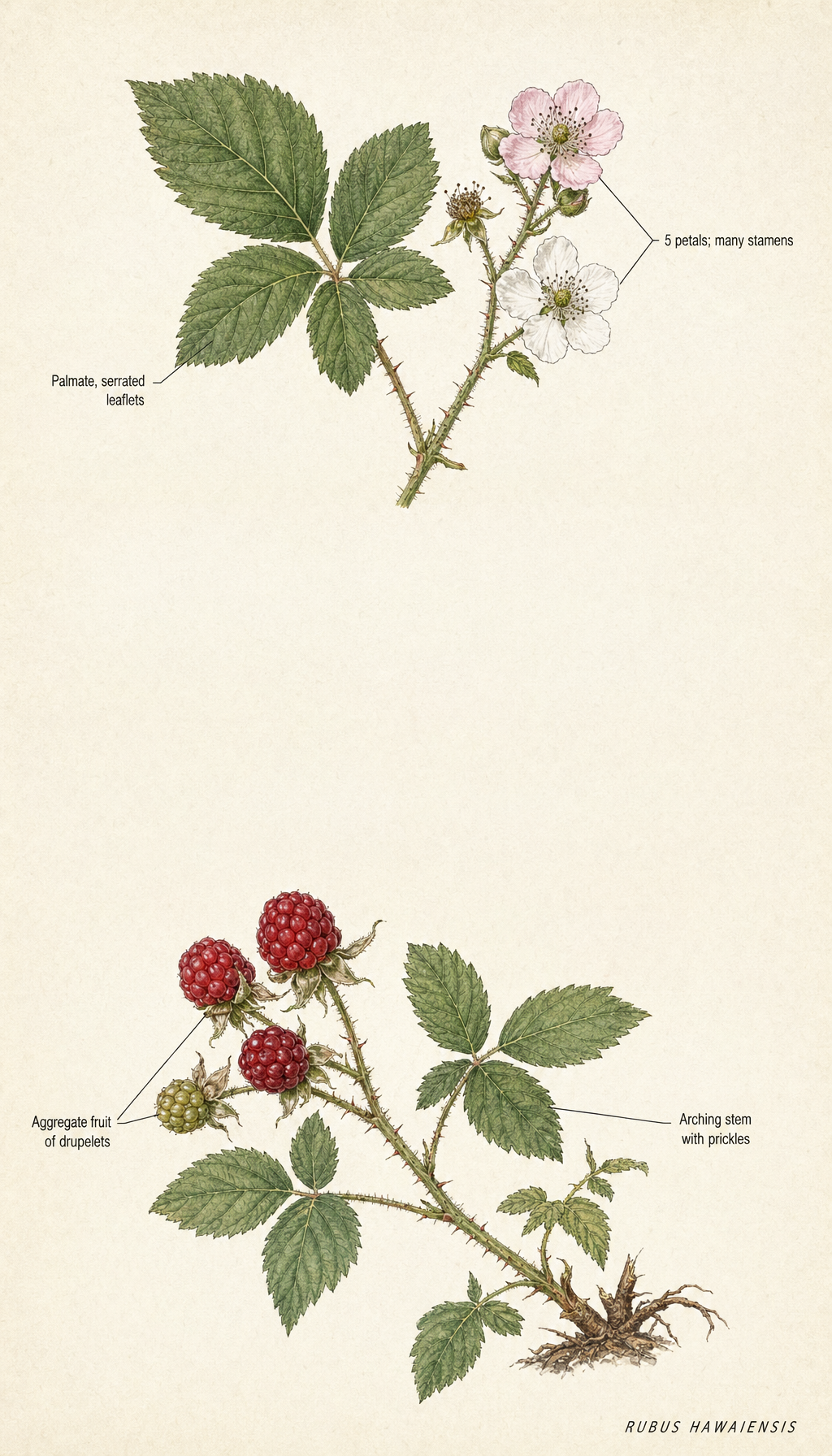
Overall form: A shrublike bramble that typically grows as erect or arching canes and may form thickets or scattered shrubs in suitable habitats. Size can vary with site conditions.
Flowers: Inflorescences often bear several showy flowers with typically 4–6 petals (most commonly 5). Petals are usually white to pale pink; centers show numerous stamens. Flowers are borne singly or in small clusters.
Leaves: Leaves are alternate and typically compound, often with three leaflets (trifoliate) that have serrated margins and a textured surface. Leaf color is generally green and may vary with sun exposure and elevation.
Fruit and reproductive structures: Fruit is an aggregate of drupelets (a raspberry-type fruit) that is commonly red to orange-red when ripe and may be attractive to frugivores. Canes may be unarmed or bear few prickles; prickliness can vary among populations.
Distinctive features: Island endemic Rubus with trifoliate leaves, white-to-pink flowers, and red aggregate fruits; many populations show reduced thorniness relative to continental brambles.
Seasonal variation: Flowering and fruiting times can vary with elevation and local climate; in suitable Hawaiian sites flowering and fruiting may occur seasonally or intermittently rather than strictly annual.
Habitat & Distribution
General growing conditions: Typically found in mesic to wet forest habitats, forest edges, clearings, and disturbed sites. Often associated with montane and submontane vegetation zones.
Moisture, light, soil: Prefers moist, well-drained soils and is commonly found in areas with regular rainfall. Tolerates partial shade to open sunlight, depending on site.
Geographic distribution: Endemic to the Hawaiian Islands (U.S. state: HI), occurring on multiple islands in native habitats.
Ecological Role
Pollination: Flowers are insect-pollinated, often by bees and other generalist flower-visitors attracted to open, nectar- and pollen-producing blossoms.
Wildlife interactions: Fruits are eaten by birds and other frugivores, which can disperse seeds. Plants can provide structural cover and foraging resources within native forest edges and openings.
Ecological niche: Functions as a fruit-bearing understory to midstory shrub in native Hawaiian forest ecosystems, contributing to food webs and habitat complexity.
Human Uses & Cultural Significance
Traditionally valued as an edible fruit (known in Hawaiian as ʻakala); fruits have been used historically as a food resource. Fruits are generally considered edible and non-toxic.
Conservation & Interesting Facts
Rubus hawaiensis is an island endemic with ecological and cultural significance in Hawaiʻi. A notable trait of many island Rubus species, including R. hawaiensis, is reduced thorniness compared with continental relatives—an example of adaptive change in island plant lineages.
From Instagram