prairie rose
Rosa arkansana
BloomEDU
Identify it today. Know it next time.
Add prairie rose to BloomEDU and a short quiz tomorrow will check if the name stuck.
Get BloomEDU — add prairie roseFree · iOS · Android
From Instagram
Identity & Classification
Rosa arkansana — common name: prairie rose or wild prairie rose — is a species in the rose family, Rosaceae (order Rosales). Two varieties are commonly recognized:
Rosa arkansana var. arkansana
Rosa arkansana var. suffulta (Greene) Cockerell
Taxonomic notes: the species has a wide distribution across central North America and consequently an extensive synonymy (many historical names and treatments). The common name “prairie rose” is sometimes also applied to Rosa blanda (meadow or smooth rose), which can lead to confusion in common-language usage. The species name arkansana is derived from the Arkansas River (in Colorado).
Physical Description
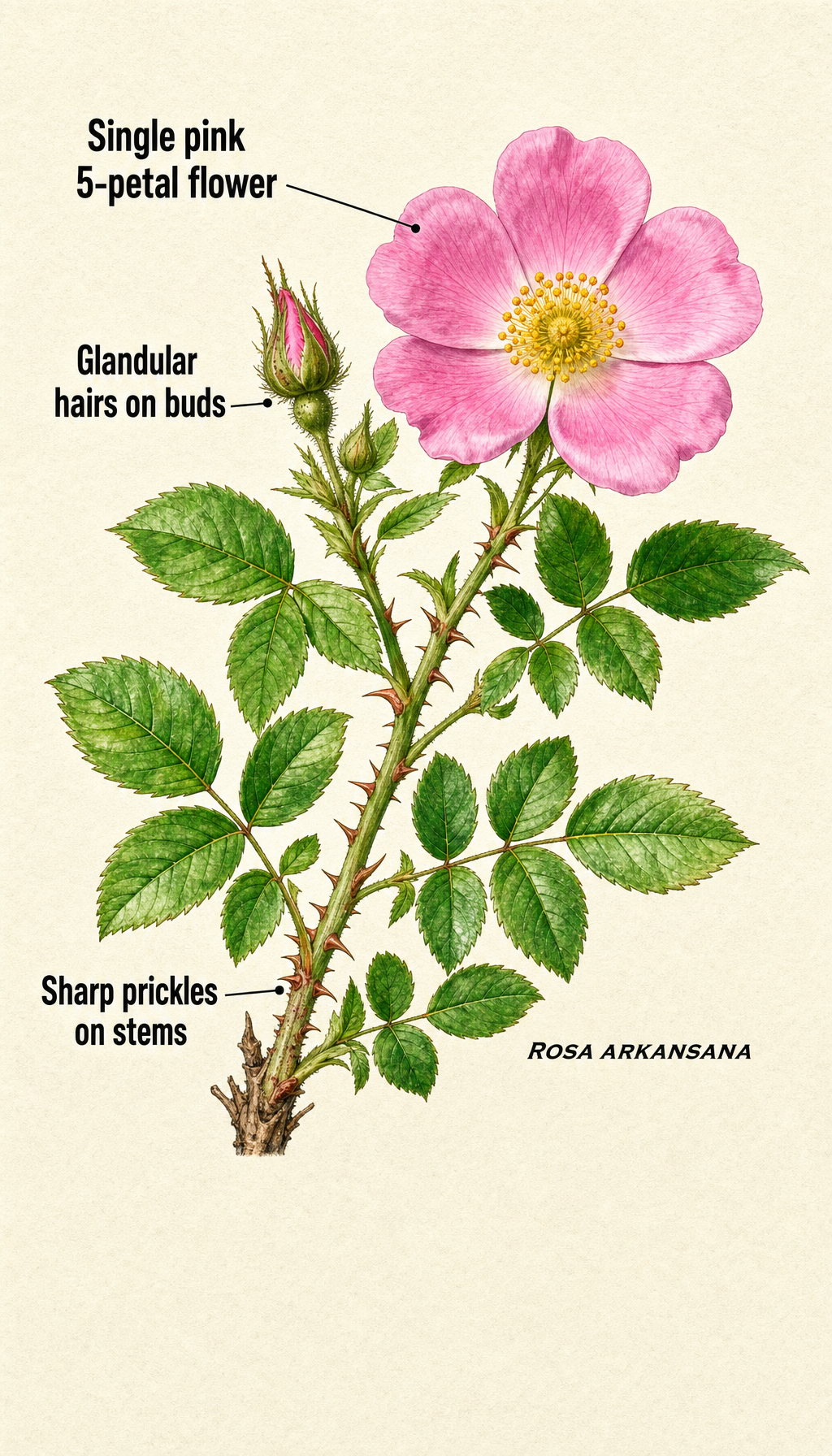
A charming, low-growing wild rose with the classic “wild rose” look. Key identifying features:
Growth form: a perennial subshrub that typically forms clumps or low mounds; stems may be arching or somewhat prostrate.
Stems: woody canes that commonly bear scattered prickles (not always dense or hooked).
Leaves: alternate, pinnately compound (typically several leaflets), each leaflet toothed (serrate) along the margin.
Flowers: single (not double), five petals, usually pink (shade can vary), with a conspicuous cluster of yellow stamens in the center — the archetypal wild-rose bloom. Flowers are often showy and may be lightly fragrant.
Fruit: after flowering the plant produces round to ovoid hips (the rose “fruit”), typically red to orange when mature in late summer–fall.
General size: a relatively low shrub (often remaining well under a meter in height), adapted to open prairie conditions.
Habitat & Range
Geographic distribution: native to a broad swath of central North America — reported from parts of Canada (including Alberta, Manitoba, Saskatchewan) southward into the United States as far as New Mexico, Texas and Indiana. Sources describe its presence between the Appalachian and Rocky Mountain regions of the continent.
Typical habitats: open prairies, roadsides, ditch margins and other sunny, open or semi-disturbed sites.
Site preferences: commonly found in sunny locations typical of prairie communities; it tolerates a range of soils and is frequently encountered in well-drained prairie soils and other open, drier spots. Note: because of its wide distribution and local variation, exact northern/southern/eastern limits may be reported differently by various regional floras.
Ecological Role
Pollination: flowers are insect-pollinated — they attract a variety of pollinators, including bees and butterflies (butterflies are commonly noted visitors).
Wildlife value: the hips provide a food resource for birds and small mammals and are part of the seasonal diet of many prairie-edge species.
Habitat function: as a low shrub in prairie and edge habitats, it contributes structural diversity — offering cover and foraging sites for insects, birds and small mammals — and can help stabilize soils in open sites.
Community interactions: because it flowers in spring–early summer, it provides nectar and pollen during an important season for many pollinators in prairie ecosystems. Specific ecological relationships (e.g., specialized pollinators, herbivores, or pathogens unique to R. arkansana) are not comprehensively documented here and can vary regionally.