smooth sumac
Rhus glabra
BloomEDU
Identify it today. Know it next time.
Add smooth sumac to BloomEDU and a short quiz tomorrow will check if the name stuck.
Get BloomEDU — add smooth sumacFree · iOS · Android
**Identity & Classification**
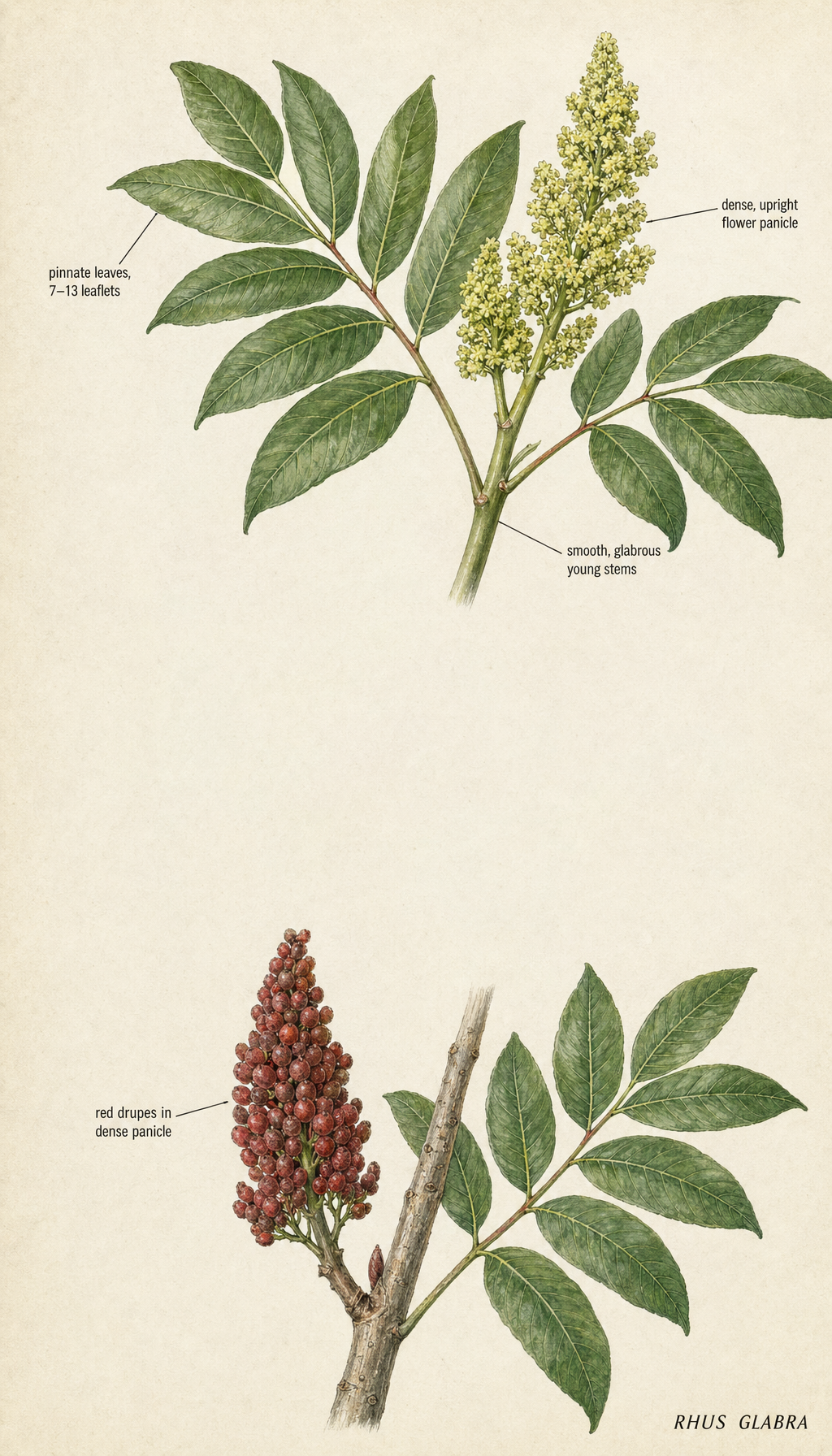
Rhus glabra — common name Smooth sumac (also called white sumac, upland sumac, or scarlet sumac) is a woody species in the cashew/poison-ivy family Anacardiaceae. It is placed in the genus Rhus, which contains the familiar sumacs. Taxonomic note: some older and alternative treatments rearrange species in this group, but Rhus glabra is widely treated in the genus Rhus in contemporary floras. **Physical Description**
A multi-stemmed shrub or small tree with several distinctive, easy-to-see features:
- Growth form: Typically a clumping shrub or small tree, often forming thickets by root suckering. Plants commonly range from roughly shrub height to small tree size (often under a few meters, occasionally taller in favorable sites). - Leaves: Alternate, pinnately compound leaves (a central stalk bearing many leaflets). Leaflets are serrated along the margins and relatively smooth (glabrous) — this smoothness helps separate it from hairier species of sumac. - Leaflets per leaf: Multiple leaflet pairs plus a terminal leaflet (sumacs often have many leaflets on each leaf). - Flowers: Small, inconspicuous greenish-yellow flowers borne in dense terminal clusters (panicles) that appear in late spring to early summer. - Fruit: Tight clusters of small red drupes (commonly called “sumac berries” or “sumac fruit”) that form where the flower clusters were; these clusters are conspicuous in late summer and often persist into fall and winter. - Bark/stems: Stems and younger twigs are relatively smooth compared with some other sumac species that have fuzzy (tomentose) twigs. (If you want measurements—leaf length, leaflet counts, or height—consult a local flora for exact regional ranges; these traits show some variation with site and climate.)
**Habitat & Range**
- Habitat preferences: Smooth sumac typically occurs in open, sunny to partly sunny sites with well-drained soils. It is commonly found on disturbed ground, roadsides, prairies, open woodlands, and rocky slopes where it can take advantage of full or patchy sun. It is adapted to a range of soil types and often tolerates dry, poor soils. - Geographic distribution: Rhus glabra is native to broad parts of North America (including both the United States and Canada). For precise provincial/state-level occurrence, consult regional floras or distribution maps — I’m not listing specific political-range boundaries here to avoid overstatement. **Ecological Role**
- Food source: The dense clusters of red drupes are an important late-season food for wildlife; birds and mammals commonly feed on the persistent fruit into autumn and winter. - Pollination: The small flowers attract insects that visit for nectar and pollen, so smooth sumac contributes to supporting insect communities in bloom season. - Landscape/ecosystem function: By forming colonies through root suckering, smooth sumac can stabilize soils and form dense protective cover that provides nesting and shelter for wildlife. Its ability to colonize open and disturbed areas makes it an early woody component in successional habitats. - Interactions note: Like many shrubs, it participates in general food-web dynamics (nectar/pollen for insects; fruit for birds/mammals). Specific one-to-one relationships (e.g., an obligate pollinator species) are not well-documented here. **Human Uses & Cultural Significance**
- Culinary/traditional use: The tart red drupes of North American sumacs, including smooth sumac, have been used historically in North America as a souring agent and to make a tart beverage often referred to as “sumac-ade.” This use is documented in various regional and indigenous traditions. (The lemony spice called “sumac” used in Middle Eastern cuisine is primarily from Rhus coriaria, a different species.)
- Landscaping and practical uses: Smooth sumac is used as an ornamental shrub for its dramatic fall color and persistent red fruit, and it can be used in wildlife plantings or for erosion control because it colonizes and stabilizes open soils. - Cautions: Smooth sumac is in the same plant family (Anacardiaceae) that includes species capable of causing contact dermatitis (for example, poison ivy and poison sumac in related genera). Rhus glabra itself is distinct from the highly allergenic Toxicodendron species, but sensitivity varies by individual; handle unknown plants with care. - Cultural/historical notes: Specific cultural or medicinal uses beyond the documented culinary uses vary by community and are not exhaustively detailed here. **Interesting Facts**
- Name clue: The species name glabra means “smooth” or hairless — a handy field clue because this species’ stems and leaf undersides are relatively smooth compared with some fuzzy sumac relatives. - Fall fireworks: Smooth sumac is a fall-color standout — its compound leaves often turn bright reds and oranges, adding big visual impact to landscapes. - Winter architecture: Even after leaves drop, the tight, upright red fruit clusters can persist well into winter, providing color and food for birds when little else remains. - Colony-maker: Thanks to root suckers, a single plant can expand into a thicket over time — great for wildlife cover, not always great if you want a tidy garden border. - Don’t confuse the spice: The crimson clusters might make you think of the Middle Eastern spice “sumac,” but that culinary spice comes mainly from a different Rhus species (Rhus coriaria); however, the tart flavor principle is similar. similar sumacs (e.g., staghorn sumac) or suggest kid-friendly activities for observing its fruits and fall color.
From Instagram