spinyfruit buttercup
Ranunculus muricatus
BloomEDU
Identify it today. Know it next time.
Add spinyfruit buttercup to BloomEDU and a short quiz tomorrow will check if the name stuck.
Get BloomEDU — add spinyfruit buttercupFree · iOS · Android
**Identity & Classification**
Scientific name: Ranunculus muricatus
Common names: spinyfruit buttercup, rough-fruited buttercup (verified common names)
Family: Ranunculaceae
Genus: Ranunculus
Taxonomic relationships: Member of the buttercup genus Ranunculus; treated as a distinct species within that genus.
**Visual Description**
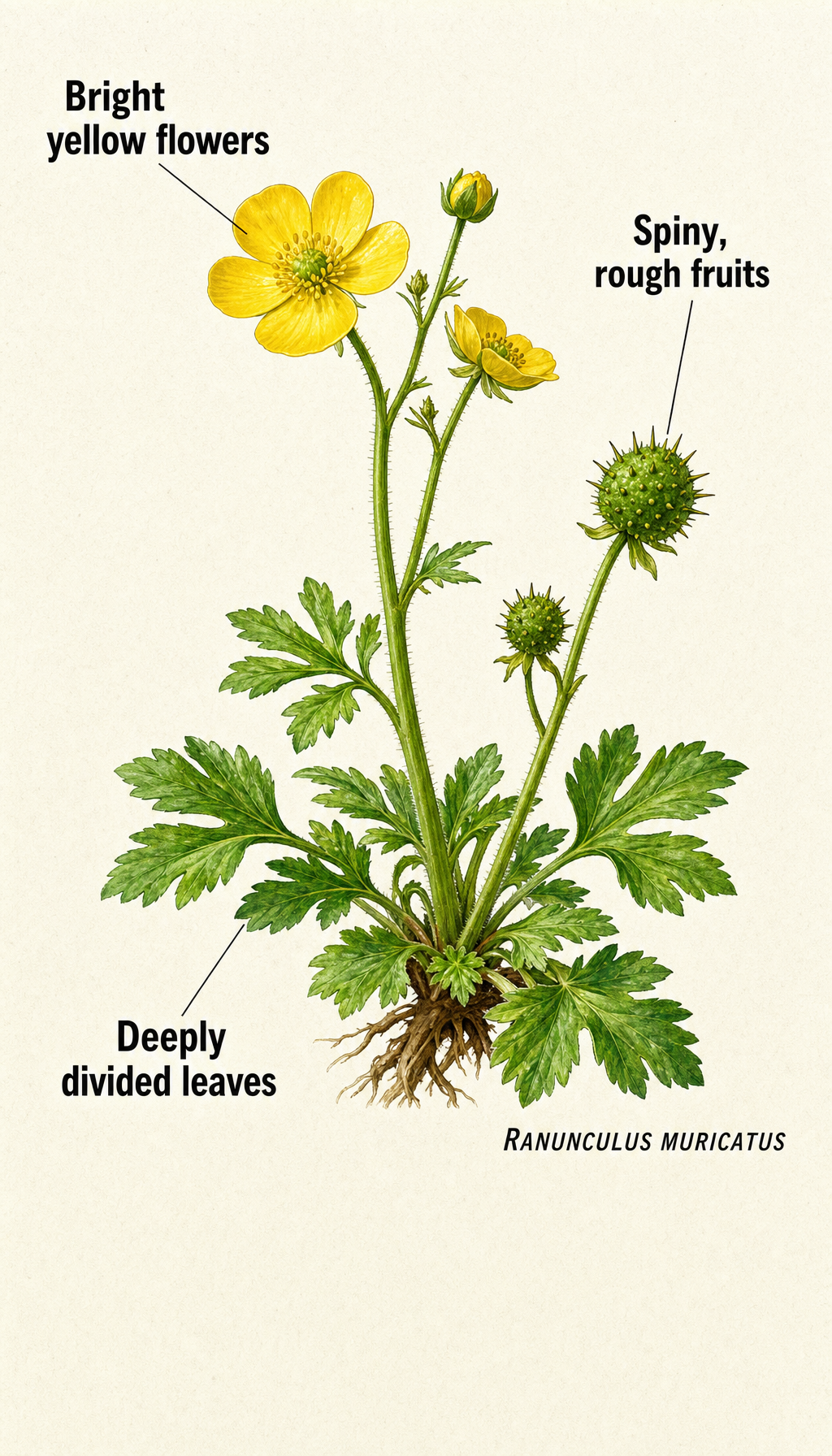
Ranunculus muricatus is typically an annual herb with prostrate to ascending stems that can form low mats in favorable conditions. Plants often appear sprawling and may root at lower nodes. Overall size is variable and typically compact, forming patches rather than tall clumps.
Flowers are generally small and showy with glossy yellow petals—usually around 4–6 petals—surrounding numerous stamens and small green sepals. Petals often have a reflective, waxy sheen characteristic of many buttercups. Flowers may occur singly or in small clusters.
Leaves are alternate and typically divided; basal leaves often have long petioles with rounded or lobed leaflets, while stem leaves are more reduced and pinnately lobed or toothed. Leaf surfaces may be slightly hairy to smooth depending on local conditions.
The most distinctive identifying feature is the fruit: a dense head of achenes that are rough, spiny, or hooked, giving the plant its common name. Fruiting heads are clustered and conspicuously prickly. Seasonal appearance often shows flowers in the growing season followed by the development of the spiny fruiting heads.
**Habitat & Distribution**
Spinyfruit buttercup typically grows in moist to seasonally wet, disturbed sites such as ditches, irrigated fields, stream margins, seasonal pools, and roadside verges. It is commonly found in open, sunlit to partly shaded situations and tends to favor clayey to loamy soils that retain moisture.
Geographic distribution in the United States includes Alabama (AL), Arkansas (AR), California (CA), Florida (FL), Georgia (GA) and seven additional states, where it is often recorded as an introduced or weedy species. It is commonly established in regions with temperate to Mediterranean climates.
**Ecological Role**
Flowers are generally visited by a variety of small insects—bees, flies and other generalist pollinators—which are attracted to the bright, glossy petals. The spiny achenes may aid local dispersal by catching on fur or clothing and can persist in the seedbank in disturbed soils. The species typically occupies the ecological niche of a pioneer or ruderal plant in moist, disturbed habitats.
**Human Uses & Cultural Significance**
Ranunculus muricatus is not widely used for food or medicine; members of the genus Ranunculus contain irritant compounds (protoanemonin) and can cause skin irritation and toxicity if ingested when fresh, so handling and ingestion should be avoided.
**Conservation & Interesting Facts**
No widespread conservation concerns are generally associated with this species in its introduced range; it is often regarded as a weed in agricultural and disturbed settings. Notable adaptations include the spiny achenes that facilitate attachment and local dispersal and the glossy petal surface that enhances visual attraction to pollinators.
From Instagram