Japanese knotweed
Polygonum cuspidatum
BloomEDU
Identify it today. Know it next time.
Add Japanese knotweed to BloomEDU and a short quiz tomorrow will check if the name stuck.
Get BloomEDU — add Japanese knotweedFree · iOS · Android
**Identity & Classification**
Polygonum cuspidatum is a scientific name that appears in older botanical literature for the plant most commonly called Japanese knotweed. Modern treatments often place this species in the genera Reynoutria or Fallopia (for example Reynoutria japonica or Fallopia japonica), and the group has a somewhat complex taxonomic history. It belongs to the buckwheat family, Polygonaceae. Key taxonomic notes:
- Family: Polygonaceae (the buckwheat or knotweed family)
- Accepted names vary in the literature: Polygonum cuspidatum (older usage) is synonymous with names more commonly used today (e.g., Reynoutria japonica / Fallopia japonica). - The species participates in hybridization with related knotweeds, which has taxonomic and ecological significance. **Physical Description**
A charismatic (and sometimes notorious) perennial with a mix of herbaceous and woody traits — think “bamboo look-alike that’s actually a buckwheat.”
Distinctive features:
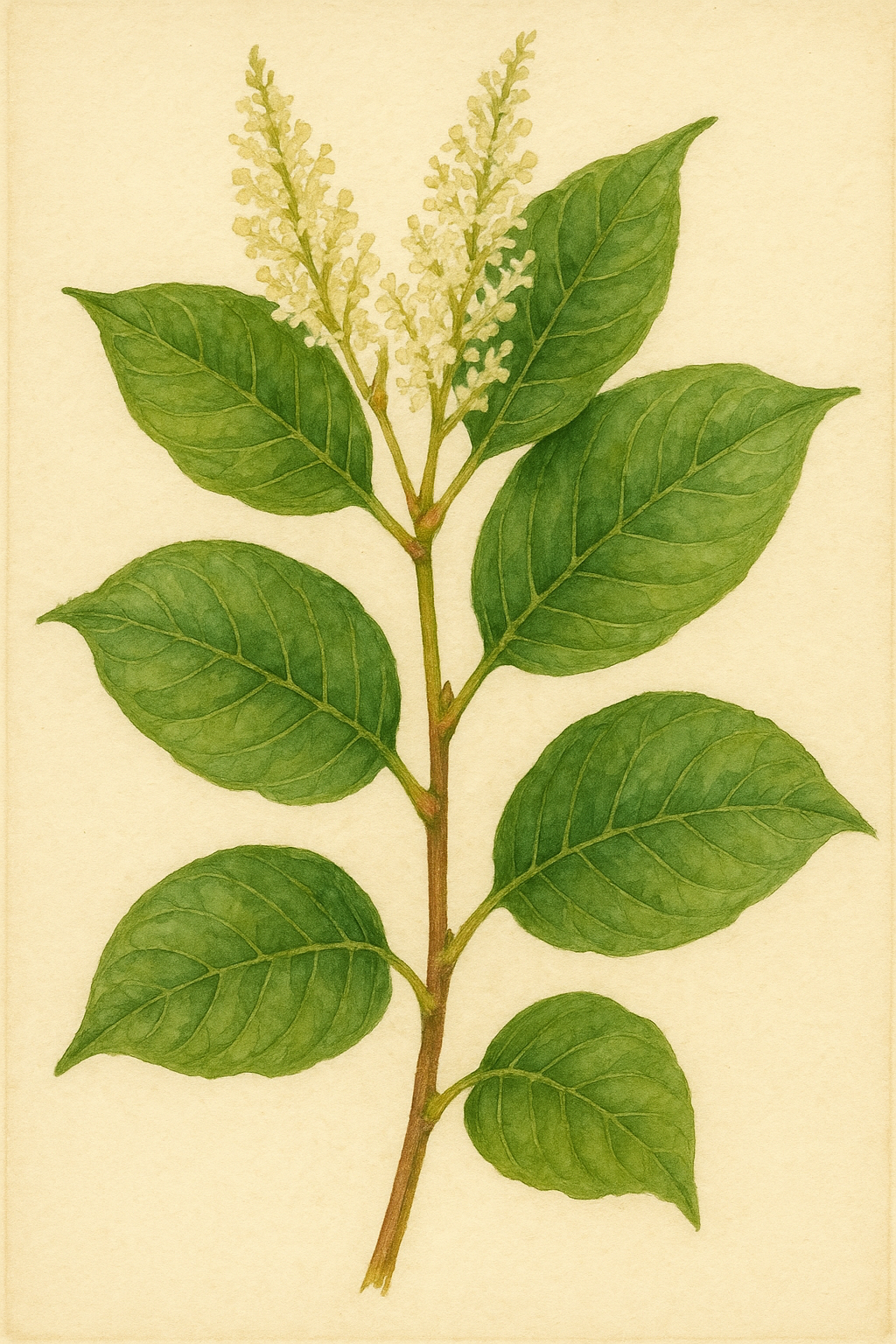
- Growth form: Robust perennial arising from an extensive underground rhizome system; shoots grow as stout, cane-like stems. - Height: Often forms stands with stems typically around 1–3 m tall in favorable conditions. - Stems: Terete (round) and hollow with distinct nodes; stems are often reddish-brown or green with speckling and have papery sheath remnants at the nodes (an ochrea — a classic Polygonaceae feature). - Leaves: Alternate, simple, broadly triangular to broadly ovate with a pointed tip (the species epithet cuspidatum refers to the pointed or cuspidate leaf apex); leaves are relatively large compared with many herbaceous plants. - Flowers: Small, creamy-white to greenish-white, produced in clusters (panicles or racemes) typically in late summer to autumn; flowers are not showy individually but can be abundant. - Fruit: A small, three-sided achene (a dry, one-seeded fruit typical of the family). - Roots/rhizomes: Thick, woody rhizomes that store energy and allow vegetative spread; fragments of rhizome can regenerate new plants. **Habitat & Range**
- Native origin: The species is native to parts of East Asia (including Japan). - Introduced range: It has been introduced widely to temperate regions beyond its native area and is notable for establishing in many non-native locations. - Typical habitats: Thrives in disturbed and open sites — riverbanks, roadsides, rail corridors, waste places, construction sites, and other disturbed or edge habitats. - Environmental preferences: Usually favors full sun to partial shade and tolerates a range of soil types, often colonizing compacted or poor soils where other plants struggle. It commonly forms dense, monospecific stands. (Note: exact country-by-country distributions and legal status vary by region; the plant is considered invasive in many temperate regions where it has been introduced.)
**Ecological Role**
- Vegetative dominance: The extensive rhizome network and rapid shoot production allow it to form dense thickets that can outcompete native vegetation and reduce plant diversity in invaded areas. - Pollinators: The flowers are visited by a variety of insects and can provide a late-summer nectar source; bees and other insect pollinators commonly visit the flower clusters (specific pollinator assemblages vary by region). - Habitat effects: Dense stands alter light, soil and understory conditions, which can cascade to affect invertebrates, ground-nesting birds, and native plant regeneration. - Reproduction and spread: While the species can produce seed, much of its spread in many landscapes is by vegetative means — rhizome fragments carried by floodwater, soil movement, or human activity can establish new plants. - Soil and bank stabilization: In some situations colonization can stabilize bare soil temporarily (for example on disturbed banks), but long-term replacement of native vegetation often reduces overall ecosystem resilience. **Human Uses & Cultural Significance**
- Horticultural history: The species was introduced into garden and horticultural trade outside its native range in the 19th century and was valued as an ornamental for its bold, bamboo-like canes and rapid growth. - Edible uses: Young shoots of Japanese knotweed have been eaten as a spring vegetable in some traditions and are often compared to rhubarb in flavor and use; specific culinary practices vary regionally. - Phytochemistry and traditional use: The plant contains biologically active compounds (for example, stilbenes such as resveratrol are reported from this group). The species has appeared in traditional herbal contexts in parts of East Asia, but specific medicinal claims and therapeutic uses should be consulted from reliable ethnobotanical and pharmacological sources rather than assumed. - Cultural note: In regions where it was introduced and later naturalized, the plant’s striking appearance and hardiness initially made it attractive as an ornamental; later its invasiveness prompted widespread concern and regulation. **Interesting Facts**
- Not bamboo, but convincing: Its hollow, cane-like stems give it a bamboo-like look, which often misleads casual observers. - Resilient regenerator: Small fragments of rhizome — even a few centimeters — can produce new plants, which is one reason it is so hard to eradicate. - Knotweed meets ochrea: The papery sheath at stem nodes (ochrea) is a neat diagnostic trait of the buckwheat family you can look for up close. - Hybrid vigor: Hybridization with related knotweeds produces vigorous hybrids that are often even more invasive than the parent species in some regions. - Late-season nectar: Its clusters of small flowers bloom relatively late in the season, offering a nectar resource when some other sources have faded. - Management notoriety: Because of its persistence and ability to colonize disturbed sites, it’s the subject of ongoing control and regulatory efforts in many places — a plant that sparks both botanical curiosity and practical headaches.
From Instagram