rosemary mint
Poliomintha incana
BloomEDU
Identify it today. Know it next time.
Add rosemary mint to BloomEDU and a short quiz tomorrow will check if the name stuck.
Get BloomEDU — add rosemary mintFree · iOS · Android
**Identity & Classification**
Poliomintha incana — common name: frosted mint — is a flowering shrub in the mint family, Lamiaceae. - Higher-level placement: Angiosperms → Eudicots → Lamiales → Lamiaceae → Poliomintha → P. incana. - Taxonomic note: the specific epithet incana means “hoary” or “grayish,” a reference to the dense, pale hairs on the plant that give it a frosted appearance. - Common names: “frosted mint” is widely used; other local or historic common names may exist but are not comprehensively documented here. **Physical Description**
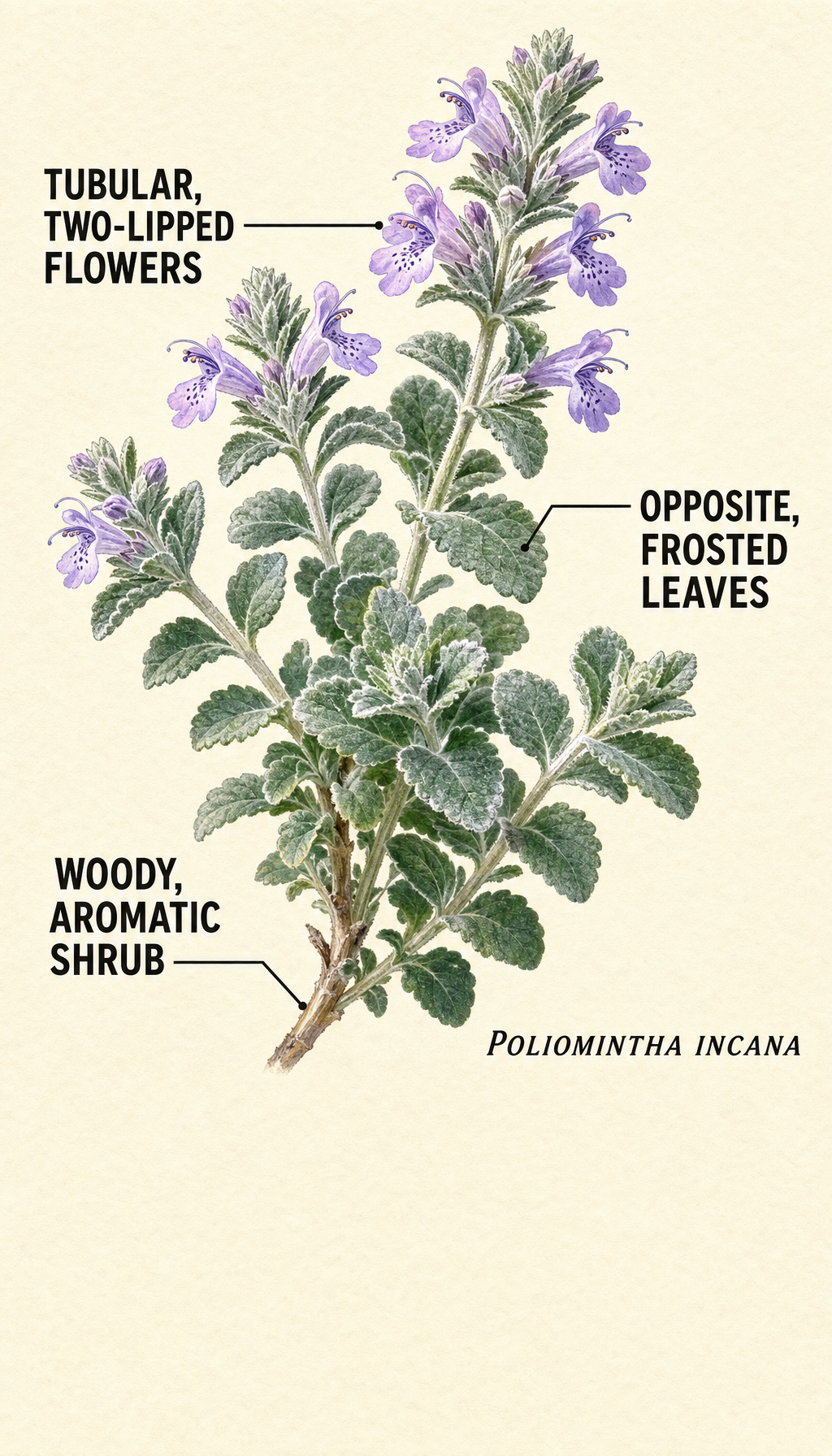
Poliomintha incana is a compact, aromatic shrub with a distinctive frosted look. Key characteristics:
- Habit: a low to moderately low shrub — typically compact in form (plants are generally under about 1 m tall, though size can vary with site conditions). - Stems: stems that are, as in many mints, characteristically angled or roughly square in cross-section. - Leaves: opposite leaf arrangement (a mint family trait); leaves are relatively small, dark green beneath a covering of short white hairs (a tomentose or “hoary” indumentum), giving the foliage a gray-green or frosted cast. - Scent: strongly aromatic foliage when crushed or brushed; the scent is characteristic of many Lamiaceae species (volatile essential oils). - Flowers: tubular, two-lipped (bilabiate) corollas typical of the mint family; colors are usually in the pale purple to blue range with small purple spots or markings. Flowers are somewhat fuzzy in appearance due to hairs on the calyx and corolla. Flowers are borne in small clusters among the foliage. - Fruit/seed: like other Lamiaceae, it produces small nutlets (four-part schizocarpic nutlets), though detailed seed morphology and dispersal are not covered here. **Habitat & Range**
- General distribution: native to dry and desert regions of the southwestern United States and northern Mexico. - Typical habitats: often found in arid and semi-arid sites — places with well-drained, often rocky or sandy soils and full sun exposure. It is adapted to dry conditions typical of desert and desert-adjacent ecosystems. - Site variation: local occurrence, abundance, and exact habitat associations can vary by locale and elevation; specific range maps or state-level occurrences should be consulted for detailed distribution. **Ecological Role**
- Pollination: the tubular, spotted flowers are structured to attract nectar-seeking pollinators. Plants in Poliomintha and other mint relatives commonly draw native bees and other insects that can access tubular corollas; specific pollinator species for P. incana are not comprehensively documented here. - Wildlife interactions: the aromatic foliage and flowers likely contribute nectar resources to local pollinator communities. Detailed records of herbivores, seed dispersers, or specialized ecological partners for P. incana are limited in the sources used here. - Ecosystem function: as a drought-adapted shrub, it can contribute to soil stabilization on rocky slopes and add structure and nectar resources in dry plant communities. The presence of aromatic oils — common in Lamiaceae — often plays multiple ecological roles (e.g., deterring some herbivores, mediating insect interactions), but specific defensive or facilitative roles for P. incana are not fully documented here. **Human Uses & Cultural Significance**
- Documented traditional use: Frosted mint has been used as a flavoring and eaten fresh or dried by certain Native American groups. Ethnobotanical records note use by peoples including the Tewa and Hopi as a culinary herb or flavoring. - Caution on medicinal claims: specific medicinal uses, preparations, efficacy, or toxicity are not comprehensively documented here and should not be inferred. If medicinal or other practical applications are of interest, consult primary ethnobotanical sources or tribal knowledge holders and avoid unverified health claims. - Modern uses: the plant’s aromatic qualities make it an obvious candidate for local flavoring or ornamental use in xeric gardens; documented modern commercial uses are limited in the sources available here. **Interesting Facts**
- “Frosted” comes from the tiny white hairs on leaves and stems that give the plant a hoary, silvery appearance — a handy camouflage against sun and water loss in dry habitats. - The two-lipped (bilabiate) tubular flowers are a classic mint-family design — a floral architecture evolved to guide pollinators to nectar while brushing against reproductive parts for pollen transfer. - The genus name Poliomintha and the species’ furry appearance place it among the desert-adapted members of the mint family that trade lush, soft leaves for small, protected, aromatic foliage — a neat example of how the mint blueprint is modified for arid life. - Botanical shorthand: if you see opposite leaves, square-ish stems, aromatic foliage, and bilabiate flowers in a shrub growing in a dry place, you’re likely looking at a member of Lamiaceae — and Poliomintha incana fits that pattern very nicely.
From Instagram