obedient plant
Physostegia virginiana
BloomEDU
Identify it today. Know it next time.
Add obedient plant to BloomEDU and a short quiz tomorrow will check if the name stuck.
Get BloomEDU — add obedient plantFree · iOS · Android
From Instagram
Identity & Classification
Scientific name: Physostegia virginiana. Verified common names: obedient plant, false dragonhead. Family: Lamiaceae (mint family). Genus: Physostegia. Taxonomically it is a member of the mint family and is closely allied with other labiates that have bilabiate (two-lipped) corollas and opposite leaves.
Visual Description
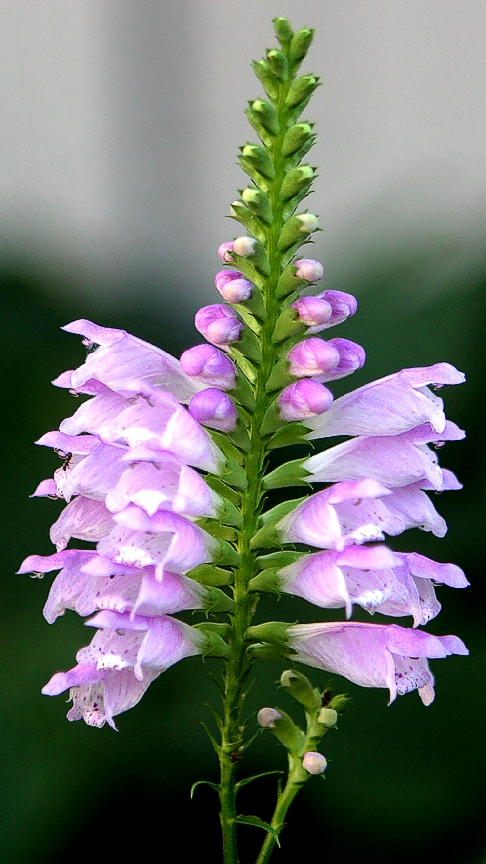
Physostegia virginiana is a perennial herb that typically grows as an upright clump arising from creeping rhizomes, often forming dense colonies. Plants commonly reach about 1–4 feet in height, though size can vary with site conditions. Stems are generally square in cross-section, a characteristic of the mint family.
Flowers are tubular and distinctly two-lipped (bilabiate), arranged in terminal spike-like racemes. The corolla is lobed and often appears hooded or gaping at the throat; inflorescences may carry many individual blooms producing a showy spike. Flower colors commonly include shades of pink, rose, white, and purple; some cultivars show deeper magenta or mauve tones. Leaves are opposite, simple, typically lanceolate to ovate with toothed margins and a short petiole or sessile attachment. A distinctive identifying feature is the “obedient” nature of the flower stems: individual blossoms can be pushed to one side and often remain in the new position. Seasonal variation includes summer to early-fall flowering in most areas, with foliage dying back after the first hard frosts in colder climates.
Habitat & Distribution
Physostegia virginiana typically grows in moist to mesic settings and is often found in meadows, streambanks, wet thickets, ditches, roadsides, and open woodlands. It generally prefers full sun to partial shade and soils that range from loamy to clayey but with consistent moisture; it can tolerate periodically wet sites. Geographically it is native across much of eastern and central North America and is documented in Alabama, Arkansas, Connecticut, Delaware, Florida, and many additional U.S. states (totaling 45 states as noted), where it is commonly encountered in appropriate habitats.
Ecological Role
Obedient plant is a nectar source that commonly attracts a range of pollinators, especially bees (including bumblebees) and butterflies; its tubular, two-lipped flowers are well suited to bee pollination and can also accommodate long-tongued visitors. The species often occupies riparian and meadow niches where its rhizomatous growth helps stabilize soils and maintain vegetative cover.
Conservation & Interesting Facts
Physostegia virginiana is generally common and not of major conservation concern across much of its range. A notable and verifiable fact: the common name “obedient plant” refers to the flower’s tendency to stay where it is moved, a trait historically noted by gardeners. Its combination of bilabiate flowers and square stems underscores its membership in the mint family.