flowery phlox
Phlox multiflora
BloomEDU
Identify it today. Know it next time.
Add flowery phlox to BloomEDU and a short quiz tomorrow will check if the name stuck.
Get BloomEDU — add flowery phloxFree · iOS · Android
From Instagram
Identity & Classification
Phlox multiflora — common name given here as “Flowery Phlox” — is presented as a member of the genus Phlox in the family Polemoniaceae. The genus name Phlox comes from Ancient Greek φλόξ (phlóx) meaning “flame” (plural phlox or phloxes, Ancient Greek φλόγες phlóges). The genus contains about 60–70 species of annual and perennial herbaceous plants. Important taxonomic note: I could not find reliable, widely accepted taxonomic sources confirming Phlox multiflora as an accepted, well-documented species name in major plant databases (e.g., Plants of the World Online, IPNI, USDA PLANTS). “Flowery Phlox” and the binomial P. multiflora may be an obscure name, a synonym, or an unpublished/rare usage.
Physical Description
Because species-level information for Phlox multiflora is not well-documented in the sources available to me, the following describes common, diagnostic features of Phlox species in general. Where applicability to P. multiflora is unknown, I flag it. Key characteristics common to many Phlox species:
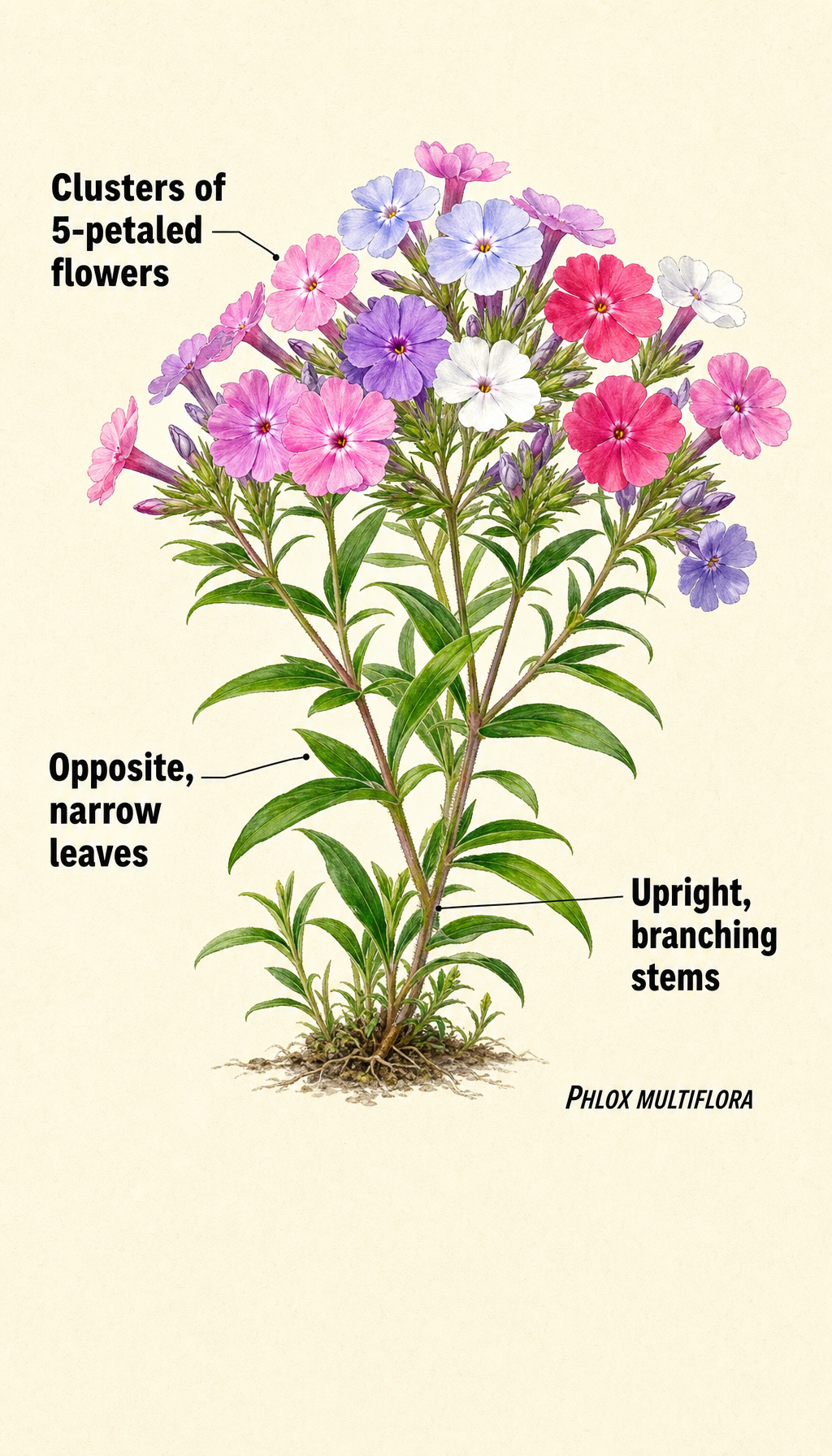
Growth form: generally herbaceous; species range from low, mat-forming groundcovers (e.g., P. subulata) to upright clump-forming perennials (e.g., P. paniculata). (Unknown whether P. multiflora is mat-forming or erect.)
Leaves: usually opposite (paired) on the stem, simple, entire margins; leaf shape varies by species from narrow and needle-like to broader lanceolate.
Stems: can be creeping, prostrate, or erect; often smooth to slightly hairy.
Flowers: tubular corolla with five lobes forming a flat, often star-shaped or pinwheel face; petals may be fused into a short tube at the base with free lobes at the top.
Flower color: phloxes commonly show pale blue, violet, pink, red, or white flowers; many species are fragrant, especially in the evening or morning.
Inflorescence: varies—some species produce loose cymes, others dense terminal clusters (panicles).
Size: highly variable across the genus—from a few centimeters tall for alpine/groundcover species to 1 m or more for tall garden phlox (species-specific size for P. multiflora is not documented here). multiflora, I can extract and present a species-specific physical description.
Habitat & Range
General genus-level facts (well-documented):
Distribution: Phlox species are found mostly in North America, with one species native to Siberia. They occupy a wide array of habitats from alpine tundra to open woodlands, prairies, and rocky outcrops.
Preferred conditions: habitat preferences vary by species; some favor well-drained, sandy soils and full sun (e.g., mat-forming species), while others prefer moist, rich soils and partial shade (e.g., certain woodland phloxes). Therefore, I cannot state a precise natural range or preferred microhabitat for P. multiflora with confidence.
Ecological Role
Generalities about Phlox ecology (applicable to many species; applicability to P. multiflora is not specifically documented here):
Pollination: Many phlox species are nectar-rich and attract a variety of pollinators—bees, butterflies, moths, and (for long-tubed flowers) hummingbirds. Some fragrant species are especially attractive to night-flying moths.
Nectar and pollen: Phlox flowers often provide nectar; their floral morphology (tubular corollas) can favor pollinators with appropriate tongue or proboscis lengths.
Habitat function: In rock gardens, prairies, and meadow settings, Phlox species can serve as groundcover, help stabilize soils, and add floral resources for pollinators during their bloom period.
Trophic interactions: Specific host relationships with insect larvae are species-dependent and not universally documented across the genus. Species-specific note: I do not have documented, reliable information about particular ecological interactions unique to Phlox multiflora (specific pollinators, herbivores, or mutualists). Use of “often” and “many” above reflects genus-level patterns rather than confirmed facts for this binomial.
Interesting Facts
Name trivia: The Greek root phlox (“flame”) nods to the vivid, flame-like colors of many species’ flowers—very dramatic in a pollinator-friendly garden.
Floral architecture: The typical five-lobed corolla formed from fused petals is a classic Polemoniaceae trait and makes phlox flowers easy to recognize to genus level.
Seasonal variety: Different Phlox species bloom at different times—some in spring, some in summer, some extending into fall—so the genus as a whole provides staggered floral resources across seasons.
Cultivated diversity: Gardeners have bred many Phlox hybrids and cultivars for color range, fragrance, mildew resistance, and growth habit; these cultivated forms have greatly expanded the genus’s horticultural presence.
Identification tip: Opposite leaves and a five-lobed, tubular corolla are quick clues that a plant could belong to Phlox or a closely related genus in Polemoniaceae. Otherwise, I can prepare a garden-care summary or ID guide based on well-documented Phlox species (e.g., P. paniculata or P. subulata) as a practical proxy. Which would you prefer?