catnip
Nepeta cataria
BloomEDU
Identify it today. Know it next time.
BloomEDU can suggest a name from a plant photo, and later ask if you still know it.
Get BloomEDUiOS · Android
From Instagram
Do you know catnip?
Three questions from BloomEDU's question library for this plant. Pick an answer, or open Show the answer, to see why.
What distinctive stem feature helps identify catnip in the field?
Show the answer
Answer: Square stems often with fine hairs
Why: Look for a stem with four distinct sides rather than a round one; catnip’s square, often hairy stems are a useful mint-family clue.
When you crush a catnip leaf, what scent are you most likely to notice?
Show the answer
Answer: A strong, minty aroma
Why: Crushing a leaf releases a strong minty smell, making the plant easier to recognize by scent as well as appearance.
This plant is notable for producing nectar that attracts which visitors?
Show the answer
Answer: Bees (including bumblebees) and various butterflies
Why: Its nectar draws bees, including bumblebees, along with a variety of butterflies, so a flowering patch can be busy with pollinators.
Identity & Classification
Nepeta cataria L. — commonly called catnip (also catmint, catswort).
Family: Lamiaceae (the mint family).
Genus: Nepeta.
Species: cataria.
Taxonomic notes: Nepeta is a genus of aromatic, square‑stemmed herbs in Lamiaceae. Nepeta cataria is the species most famously associated with the feline response; it is distinct from commonly grown ornamental Nepeta hybrids (e.g., Nepeta × faassenii), which are often called “catmints.”
Physical Description
A friendly, aromatic herb with several mint‑family hallmarks. Key characteristics:
Growth form: Herbaceous perennial or short-lived perennial/subshrub, typically forming upright, branching stems.
Size: Often reaches roughly 30–100 cm tall (about 1–3 ft), depending on site conditions.
Stems: Square in cross‑section (a classic Lamiaceae trait) and usually covered with fine hairs.
Leaves: Opposite arrangement; simple, ovate to cordate (heart‑shaped) with serrated margins; gray‑green and often softly hairy, emitting a strong, minty aroma when crushed.
Inflorescence & flowers: Small, tubular, two‑lipped (bilabiate) flowers arranged in axillary clusters or false whorls (verticillasters). Flower color ranges from white to pale lavender, often with darker spots or streaks. Blooming commonly occurs from late spring into summer.
Fruit: Typical of the mint family — four small nutlets (seedlets) per flower.
Habitat & Range
Native range: Native to parts of Europe and temperate Asia.
Introduced & naturalized: Widely naturalized in North America and other temperate regions (now commonly found beyond its native range).
Preferred conditions: Tolerant of a range of soils but typically favors well‑drained sites, full sun to partial shade, and open, disturbed places such as roadsides, waste ground, field edges, and open woodlands. It often establishes easily in dry or poor soils once established.
Note on specificity: Exact country‑level distributions vary regionally; for local occurrence consult regional floras or plant atlases.
Ecological Role
Pollinators: Produces nectar and is attractive to many pollinators, especially bees (including bumblebees) and various butterflies and hoverflies. The tubular, two‑lipped flowers are adapted to insect visitors that can access nectar.
Herbivores & interactions: The aromatic compounds influence interactions with animals — most notably, a strong behavioral response in many domestic cats (see below). Some insects are repelled or deterred by Nepeta’s volatile compounds, while others are attracted for pollination.
Ecosystem function: As a fast‑establishing herb, catnip can colonize disturbed sites and contribute floral resources to pollinator communities during its bloom period.
Interesting Facts
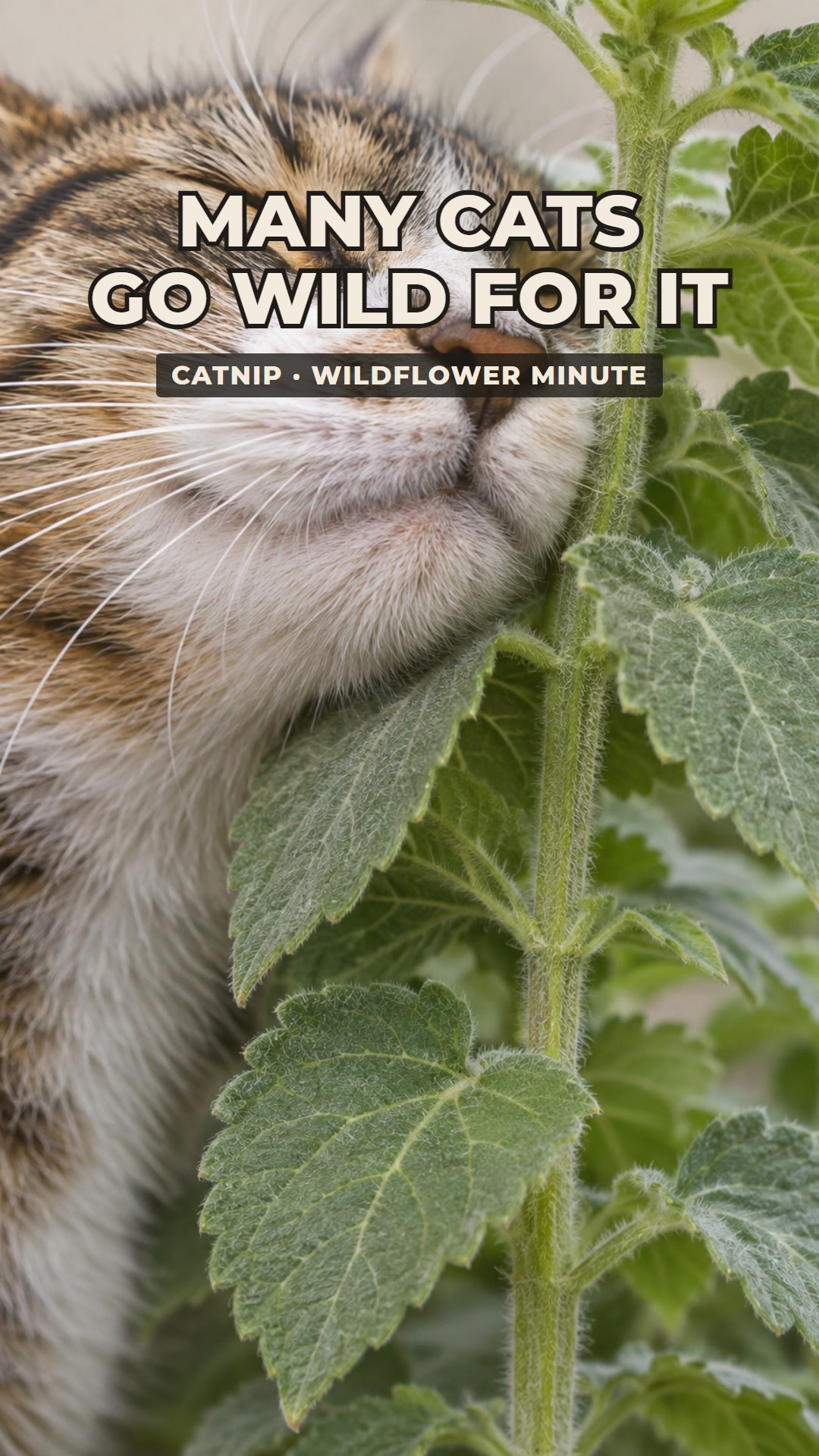
The active fragrant compound most associated with the cat response is nepetalactone, a bicyclic monoterpenoid found in the leaves and stems. It evaporates readily, which is why dried catnip or crushed fresh leaves are effective in cat toys.
Not all cats react: sensitivity is hereditary and age‑related — many kittens and some older cats show little or no response.
The botanical show: look for the mint family signatures — square stems, opposite leaves, bilabiate (two‑lipped) flowers, and the four‑nutlet fruit. These make Nepeta cataria a textbook example of a Lamiaceae herb. - People sometimes confuse catnip with ornamental “catmints” — horticultural Nepeta hybrids — which were bred for different flower colors, growth habits, and garden performance.
Dual personality: to pollinators it’s a nectar source; to felines it’s a playful stimulant; to some insects it can be a repellent — chemistry drives ecology here.