Hawai'i desert-thorn
Lycium sandwicense
BloomEDU
Identify it today. Know it next time.
Add Hawai'i desert-thorn to BloomEDU and a short quiz tomorrow will check if the name stuck.
Get BloomEDU — add Hawai'i desert-thornFree · iOS · Android
Identity & Classification
Scientific name: Lycium sandwicense
Common name(s): Hawai‘i desert-thorn
Family: Solanaceae
Genus: Lycium
Taxonomic notes: A member of the Lycium genus (the wolfberries/desert-thorns), it is related to other Lycium species worldwide and falls within the nightshade family, Solanaceae.
Visual Description
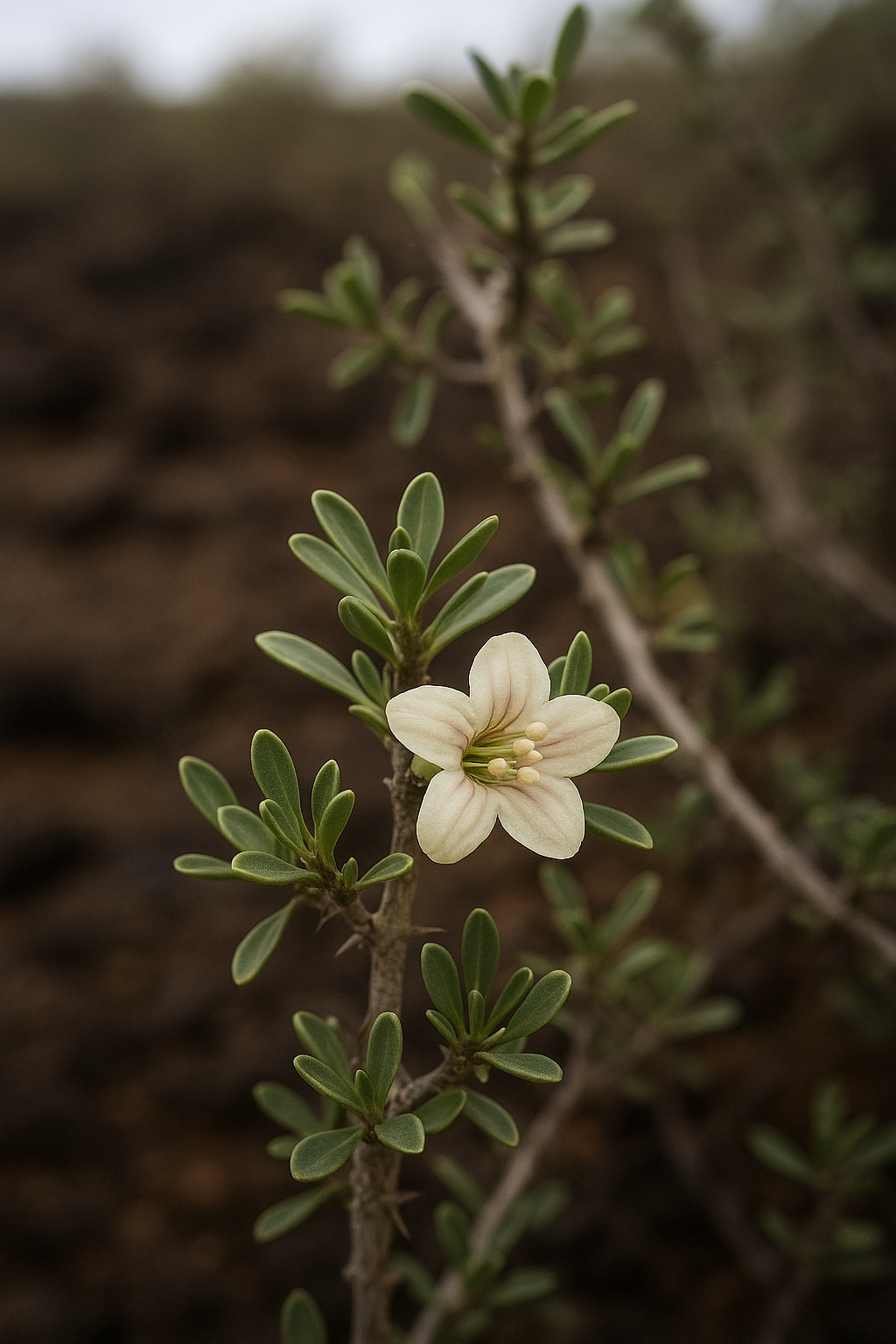
Lycium sandwicense is a woody, thorny shrub that typically forms a spreading, multi-branched habit. Plants often grow as low to medium shrubs in exposed sites. Stems are generally woody and may bear sharp spines where short lateral shoots occur. Leaves are simple, entire and usually small and somewhat succulent or leathery, commonly arranged alternately along the stems and sometimes appearing clustered on short shoots. Flowers arise singly or in small clusters from leaf axils; the corolla is tubular to funnel-shaped with a typically five-lobed rim and a fused petal tube, and the visible floral parts include several stamens extending from the corolla. Flowers are often pale to whitish or lightly colored. Fruit is a fleshy berry, commonly orange to red when mature, containing multiple seeds. Seasonal variation: in favorable tropical conditions L. sandwicense may flower and fruit intermittently through much of the year, with intensity varying by local rainfall and season.
Habitat & Distribution
Lycium sandwicense is endemic to the Hawaiian Islands and is typically found in dry to mesic coastal and lowland habitats. It often grows on well-drained, rocky or sandy soils, including lava flows and coastal benches, and commonly tolerates exposure to sun and salt spray. The species is adapted to sites with limited freshwater availability and generally occupies open, sunlit vegetation communities rather than shaded forest understories.
Ecological Role
Flowers are visited by a variety of insect pollinators, particularly bees and other generalist flower visitors. The fleshy berries are eaten by birds and likely by other frugivores, which can act as seed dispersers; the plant’s thorny branching also provides shelter or protective nesting sites for small animals. As a drought- and salt-tolerant shrub, it occupies a niche in stabilizing soils in exposed coastal and lava-derived landscapes.
Human Uses & Cultural Significance
Documented traditional or modern uses specific to Lycium sandwicense are not well established here; other Lycium species are known elsewhere for edible berries, but specific ethnobotanical records for this Hawaiian species are not cited in this account.
Conservation & Interesting Facts
Lycium sandwicense is a Hawaiian endemic adapted to harsh coastal conditions; its tolerance of saline, sun-exposed, well-drained soils and its thorny habit are notable adaptations for survival in exposed island environments. It belongs to a genus that includes species used elsewhere as “wolfberries” or goji relatives.
From Instagram