riverbank lupine
Lupinus rivularis
BloomEDU
Identify it today. Know it next time.
Add riverbank lupine to BloomEDU and a short quiz tomorrow will check if the name stuck.
Get BloomEDU — add riverbank lupineFree · iOS · Android
From Instagram
Identity & Classification
Scientific name: Lupinus rivularis
Common name(s): riverbank lupine
Family: Fabaceae
Genus: Lupinus
Taxonomic notes: A member of the lupine group within Fabaceae; relationships to other lupines follow the standard genus-level circumscription in temperate North America.
Visual Description
Overall form: A perennial herbaceous lupine that typically grows as an erect to bushy clump. Stems and habit can vary with site conditions, often more compact in exposed coastal or riparian sites.
Size: Plant height and clump size can vary with habitat; plants are often low to medium in stature for lupines.
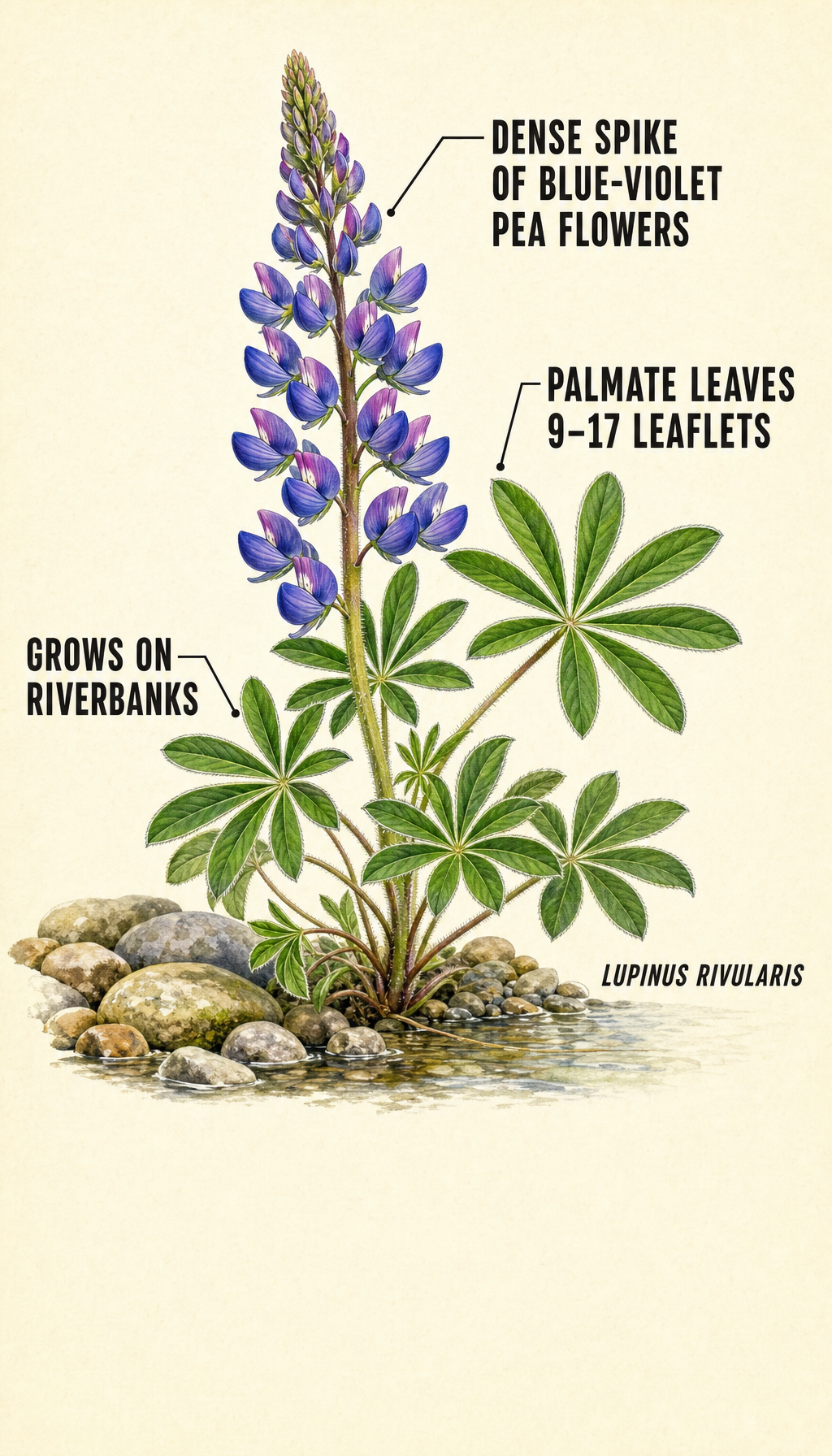
Flowers: Inflorescences are racemes bearing numerous pea-type flowers. Individual flowers have a papilionaceous corolla of 4–6 petals (typically five: a banner, two wings, and two keel elements). Flower color is generally in the blue to violet range and may include paler or contrasting spots on the banner.
Leaves: Leaves are palmately compound, typically with multiple narrow leaflets radiating from a central point; leaflets are usually lanceolate to narrowly oblong. Leaves arise alternately along the stem and often form a basal clump.
Fruit/seed: Like other legumes, fruit is a pod that matures to release several seeds; pods typically dehisce (split open) when mature.
Distinctive features: Palmately divided leaves, erect racemes of blue-violet pea-flowers, and a tendency to grow in riparian or coastal sandy substrates help distinguish this species from other lupines. Plants may bear hairs on stems and foliage, varying by population.
Seasonal variation: Plants typically flower in the spring to early summer season in their range, with foliage persisting through the growing season; seed pods appear after flowering.
Habitat & Distribution
Growing conditions: Often found in open, well-lit sites associated with moist but well-drained substrates. Common habitats include riverbanks, streamside terraces, coastal bluffs, dunes, and other disturbed sandy or gravelly soils.
Moisture, light, soil: Typically favors full sun to partial sun and soils that are sandy to rocky and fairly well-drained though often near moisture sources.
Geographic distribution: Occurs in the Pacific coastal region of the United States including California, Oregon, and Washington.
Ecological Role
Pollinators: Flowers are adapted to bee pollination; bumblebees and other native bees commonly visit lupines and are effective pollinators.
Nitrogen fixation: As a member of Fabaceae, it associates with nitrogen-fixing bacteria and can contribute to soil nitrogen enrichment, aiding colonization of poor substrates.
Wildlife interactions: Flowers provide nectar and pollen to bees; seeds and foliage interactions with herbivores vary and may be limited by secondary compounds produced by the plant.
Conservation & Interesting Facts
Adaptation: Riverbank lupine is well adapted to colonizing open, disturbed sandy soils and can improve soil fertility through nitrogen fixation.
Interesting fact: The characteristic pea-type flower architecture requires a pollinator with enough strength to access nectar, making bumblebees especially important for effective pollination.