Columbia lily
Lilium columbianum
BloomEDU
Identify it today. Know it next time.
Add Columbia lily to BloomEDU and a short quiz tomorrow will check if the name stuck.
Get BloomEDU — add Columbia lilyFree · iOS · Android
From Instagram
Identity & Classification
Scientific name: Lilium columbianum
Verified common names: Columbia lily, Columbia tiger lily
Family: Liliaceae
Genus: Lilium
Taxonomic notes: A member of the true lilies (Lilium), closely related to other North American orange and red-flowered lilies within the genus.
Visual Description
Overall form: A perennial, bulb-forming herb with an erect flowering stem that typically bears a cluster or raceme of nodding, showy flowers. Plants arise from scaly underground bulbs and persist year to year.
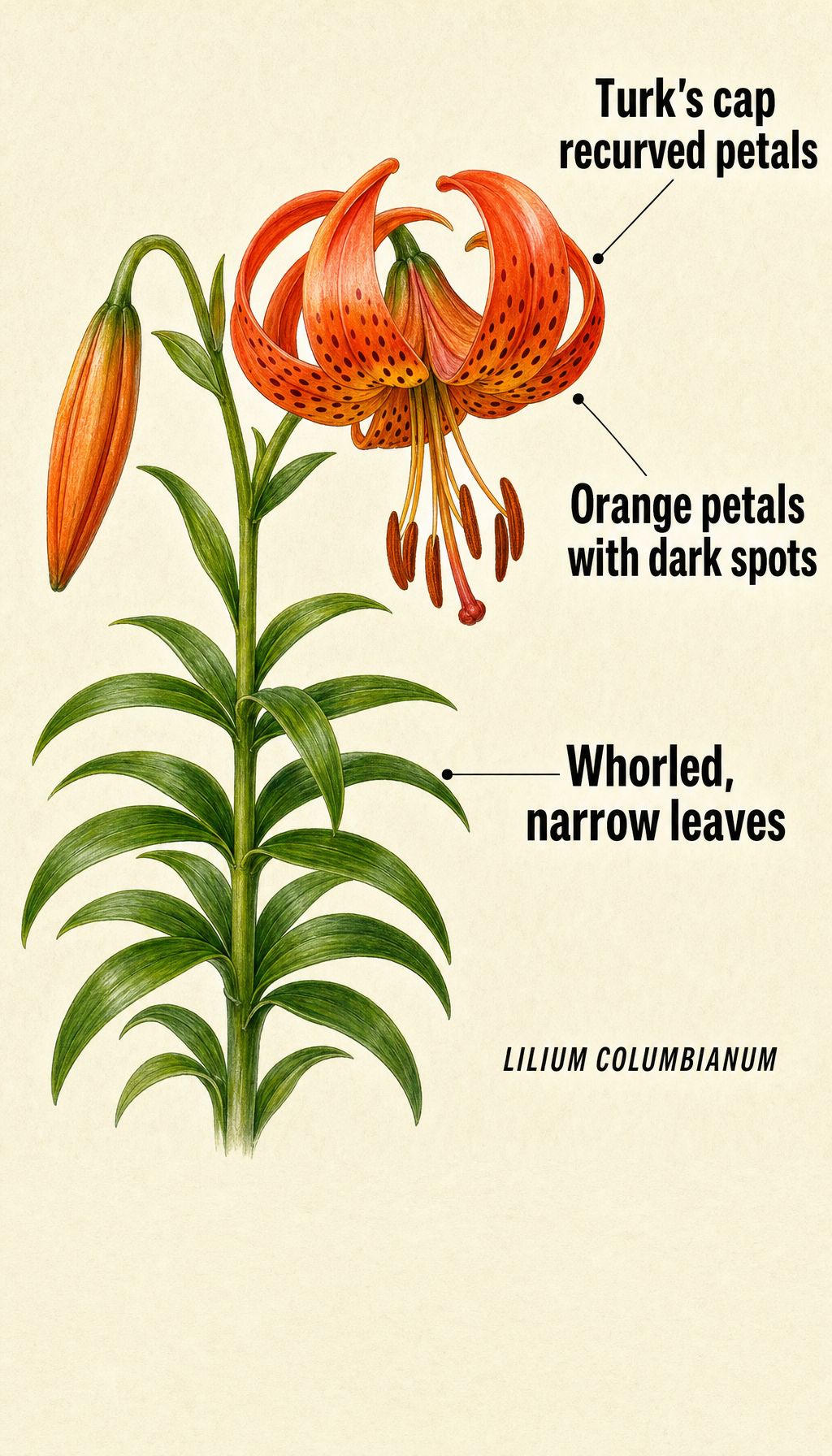
Flower characteristics: Flowers generally have six tepals (often strongly reflexed, producing a "turk’s-cap" appearance) and six prominent stamens. Color is typically orange to reddish-orange with darker spots or freckling toward the throat. Flowers are usually nodding or pendant and may occur in loose clusters along the upper stem.
Leaf structure and arrangement: Leaves are typically lanceolate and may be borne in several whorls or alternately along the stem, forming leafy sections beneath the inflorescence. Lower leaves may be reduced or absent during flowering.
Distinctive features: Bright orange, spotted, reflexed (turk’s-cap) flowers combined with a scaly bulb and whorled leaves distinguish this species from many other woodland wildflowers. The pendant, spotted blooms are a reliable field character.
Seasonal variation: Leaves die back after the growing season; flowering generally occurs in the warm season (summer) when plants produce their conspicuous blooms.
Habitat & Distribution
Growing conditions and ecosystems: Typically found in open forests, forest edges, meadows, grassy slopes, and similar habitats where light ranges from partial shade to sun. Often associated with well-drained soils and sites that retain moderate moisture during the growing season.
Moisture, light, soil preferences: Often prefers moderate moisture and well-drained substrates; tolerates a range from semi-shaded woodland openings to sunnier meadows.
Geographic distribution: Native to the Pacific Northwest of the United States, commonly reported from California, Idaho, Montana, Oregon, and Washington.
Ecological Role
Pollination: The nodding, nectar-producing flowers are attractive to nectar feeders; they may attract hummingbirds and a variety of insect visitors, providing nectar and pollen resources.
Wildlife interactions: Flowers and nectar contribute to local pollinator networks; bulbs and foliage may be part of herbivore food webs in some habitats.
Ecological niche: Functions as a summer-blooming, bulbous wildflower in montane and lowland plant communities of the Pacific Northwest, adding visual and ecological diversity to meadow and open-forest understories.
Conservation & Interesting Facts
Conservation: Regional conservation status can vary; populations are influenced by habitat change and land management practices.
Interesting facts and adaptations: The strongly reflexed (turk’s-cap) flower form exposes reproductive parts for efficient contact with pollinators, and the scaly bulb is an adaptation for seasonal survival and regrowth. The vibrant spotted orange flowers make Lilium columbianum one of the more conspicuous native lilies in the Pacific Northwest.