dense blazing star
Liatris spicata
BloomEDU
Identify it today. Know it next time.
Add dense blazing star to BloomEDU and a short quiz tomorrow will check if the name stuck.
Get BloomEDU — add dense blazing starFree · iOS · Android
Identity & Classification
Scientific name: Liatris spicata
Common names: dense blazing star, gayfeather
Family: Asteraceae
Genus: Liatris
Taxonomic relationships: Member of the genus Liatris (the blazing stars/gayfeathers), a group of herbaceous perennials in the Asteraceae known for spike-like inflorescences.
Visual Description
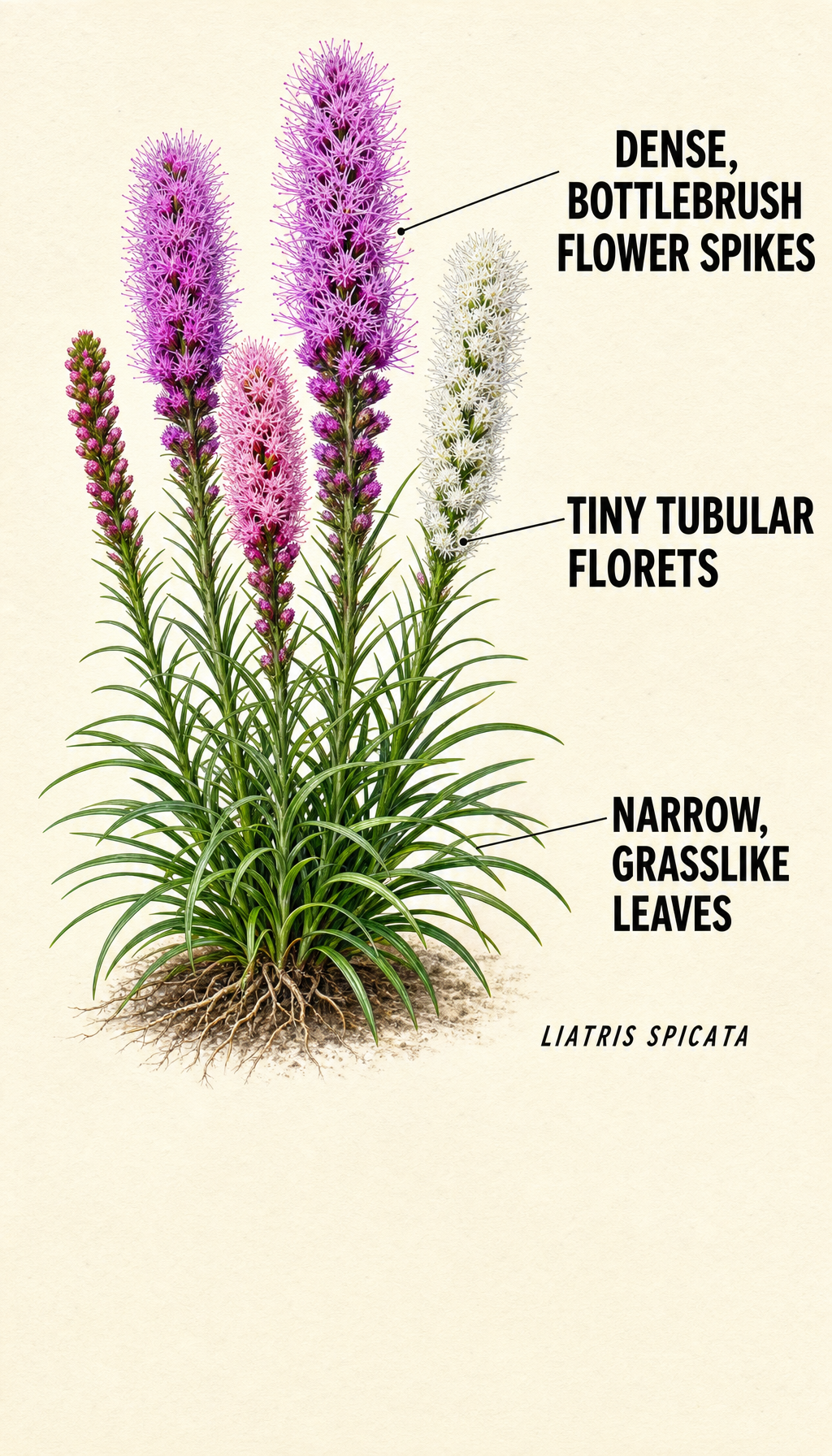
Dense blazing star is an erect, herbaceous perennial typically arising from a corm-like storage organ. Plants commonly form single or few unbranched stems that can reach about 0.5–1.2 m (roughly 1.5–4 ft) in height under favorable conditions. Inflorescences are distinctive: dense, elongated spikes of many compact flower heads usually showing vivid purplish-magenta to pinkish hues; white-flowered cultivars occasionally occur. Individual flower heads are discoid (composed only of tubular disk florets, lacking ray florets) with a five-lobed corolla typical of Asteraceae disk florets. Flowers often open progressively from the top of the spike downward, creating a long, showy bloom period. Leaves are alternate along the stem, generally narrow and lanceolate to linear, with a clasping or sessile base on lower stems and becoming smaller toward the top. Plants die back to the corm in winter in most of their range. Seasonal variation includes peak flowering in mid-to-late summer and into autumn in many locations.
Habitat & Distribution
Dense blazing star is typically found in moist prairies, meadows, marsh edges, roadside ditches and open fields, and is commonly planted in gardens and restored prairie plantings. It generally prefers full sun and tolerates a range from moist to well-drained soils; it often does well in soils that retain some moisture and can tolerate periodically wet conditions. Geographic distribution is centered in eastern and central North America; it occurs across many U.S. states, including the provided list (AL, AR, CT, DE, FL and about 20 others) and into parts of adjacent regions. It is often associated with grassland and open-wetland plant communities.
Ecological Role
Dense blazing star is a well-established nectar source for a variety of pollinators, frequently visited by bees and butterflies and sometimes by hummingbirds. Its long-lasting, nectar-rich flower spikes are attractive to migrating and resident butterflies. Mature seedheads may provide small seeds that are used by birds and other wildlife. The cormous rootstock enables the plant to resprout annually and persist in prairie and meadow ecosystems.
Human Uses & Cultural Significance
Liatris spicata is widely used as an ornamental in perennial borders, prairie restorations, and cut-flower and dried-flower arrangements due to its upright form and vivid flower spikes. Historical medicinal uses are reported for some Liatris species in ethnobotanical literature, but such uses vary and should be referenced through specialized sources.
Conservation & Interesting Facts
Dense blazing star is generally common across much of its range rather than being of broad conservation concern. Notable adaptations include the cormous rootstock that supports regrowth after disturbance (including fire) and the discoid, upwardly clustered flowerheads that provide concentrated nectar for pollinators. The species’ striking, long-lasting vertical flower spikes make it a useful indicator of late-summer meadow bloom.
From Instagram