dotted blazing star
Liatris punctata
BloomEDU
Identify it today. Know it next time.
Add dotted blazing star to BloomEDU and a short quiz tomorrow will check if the name stuck.
Get BloomEDU — add dotted blazing starFree · iOS · Android
**Identity & Classification**
Liatris punctata — common names: dotted gayfeather, dotted blazingstar, narrow-leaved blazingstar. - Kingdom: Plantae; clade: Angiosperms → Eudicots → Asterids; order: Asterales; family: Asteraceae; genus: Liatris; species: L. punctata. - Taxonomic notes: Liatris is a New World genus of perennial herbs commonly called blazingstars or gayfeathers. The specific epithet punctata (Latin for “dotted” or “spotted”) likely refers to small glandular dots or spots on stems or leaves. Varieties and local forms of Liatris punctata are recognized in some floras, and the genus contains many closely related species; exact infraspecific taxonomy can vary among sources. **Physical Description**
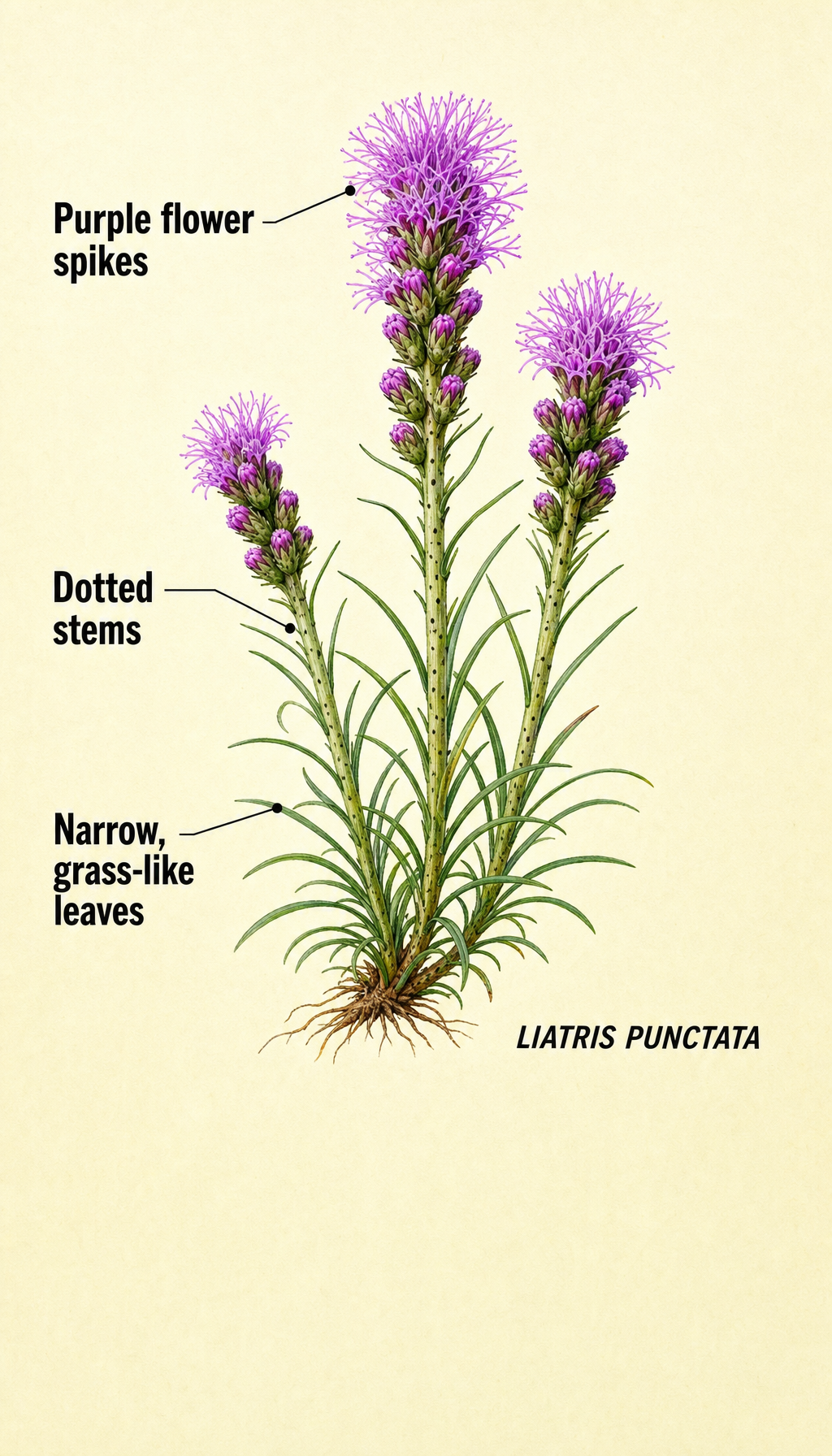
A striking, perennial prairie plant built for sun and wind — small corms, upright spikes, and a plume of purple flowers. Key characteristics:
- Growth form: Perennial herb arising from a corm (a compact underground storage stem), producing one or more erect flowering stems. - Height: Stems commonly reach a medium height for prairie forbs; plants often form clumps. (Height can vary with site conditions.)
- Leaves: Narrow, grasslike to lanceolate leaves — hence the common name “narrow-leaved blazingstar.” Leaves are typically alternate along the stem and may be reduced higher on the stem. - Inflorescence: Dense, erect spike composed of many small flower heads (capitula) packed along the stem; the overall effect is a column or plume of flowers. - Flowers: Individual heads are composed of tubular disc florets (Asteraceae family members) and lack conspicuous ray florets; flower color is commonly shades of lavender to deep purple. - Reproductive structures and dispersal: After flowering, seeds are produced as achenes (cypselae) usually equipped with a pappus (a tuft of hairs) that aids wind dispersal. - Distinguishing features: Narrow leaves, cormous growth form, dense purple flower spike, and the “dotted” aspect referenced by the species name (glandular dots or spotting). **Habitat & Range**
- Native range: Liatris punctata is native to North America and is reported across the plains of central Canada, the central United States, and into northern Mexico. - Typical habitats: Often found in open, sunny sites such as prairies, grasslands, rocky slopes, and other well-drained, often dry soils. It tolerates drought and is adapted to the relatively harsh, exposed conditions of plains and dry sites. - Soil and light preferences: Prefers full sun and well-drained soils — sandy, rocky, or gravelly substrates are commonly occupied. It often performs poorly in heavy, waterlogged soils. - Notes on distribution detail: Exact county- or state-level occurrences vary by source; consult regional floras or conservation databases for fine-scale distribution and conservation status in a particular area. **Ecological Role**
- Pollinators: Liatris punctata produces nectar-rich flower heads that attract a variety of pollinators. Bees and butterflies are frequent visitors; many Liatris species are notable pollinator plants in prairie communities. - Food and habitat: As a native prairie forb, it contributes to nectar resources in midsummer through early fall and adds vertical structure to plant communities. The dense seedheads and foliage can provide microhabitat for insects. - Seed dispersal and persistence: Achenes with a pappus facilitate wind dispersal. The cormous growth habit helps the plant survive periods of drought, grazing, or top-kill disturbances and allows resprouting. - Role in disturbance regimes: Liatris species are characteristic of fire-maintained grasslands; L. punctata often persists under prairie disturbance regimes (e.g., grazing, periodic fire), though local responses depend on intensity and frequency. **Human Uses & Cultural Significance**
- Documented modern uses: Liatris species, including L. punctata, are commonly used in native-plant landscaping, prairie restoration, xeriscaping (drought-tolerant gardens), and as cut flowers because of their showy vertical flower spikes. It is often recommended for pollinator gardens. - Traditional or medicinal uses: Specific cultural or medicinal uses for Liatris punctata are not well-documented here. Some Liatris species have been used traditionally by Indigenous peoples, but attribution of uses to L. punctata specifically requires careful, source-based confirmation. - Caution: Do not assume traditional or medicinal uses for L. punctata without consulting authoritative ethnobotanical sources for particular cultural groups. **Interesting Facts**
- “Gayfeather” and “blazingstar” both capture the showy personality: the columnar purple spikes stand out on the prairie like a feathery flame. - Flowering choreography: Many Liatris species characteristically open flowers from the top of the spike downward (a basipetal flowering sequence); this gives the spike a distinctive progression of bloom. (Flowering pattern may vary with environmental conditions.)
- Underground storage: The corm lets the plant withstand drought and recover after aboveground damage — a handy survival trick on fluctuating prairies. - Wind-ready seeds: The pappus on the achenes turns spent flowerheads into little parachutes for wind dispersal — classic Asteraceae engineering. - Pollinator magnet: Because it blooms in mid-to-late summer, Liatris punctata provides nectar and pollen at a time when many other native forbs may be finished flowering, making it especially valuable to late-season pollinators.
From Instagram