tall blazing star
Liatris aspera
BloomEDU
Identify it today. Know it next time.
Add tall blazing star to BloomEDU and a short quiz tomorrow will check if the name stuck.
Get BloomEDU — add tall blazing starFree · iOS · Android
From Instagram
Identity & Classification
Scientific name: Liatris aspera. Verified common names: tall blazing star, rough blazing star, rough gayfeather. Family: Asteraceae. Genus: Liatris. Taxonomically it is a member of the Liatris genus and is closely related to other blazing stars (congeners) such as Liatris spicata.
Visual Description
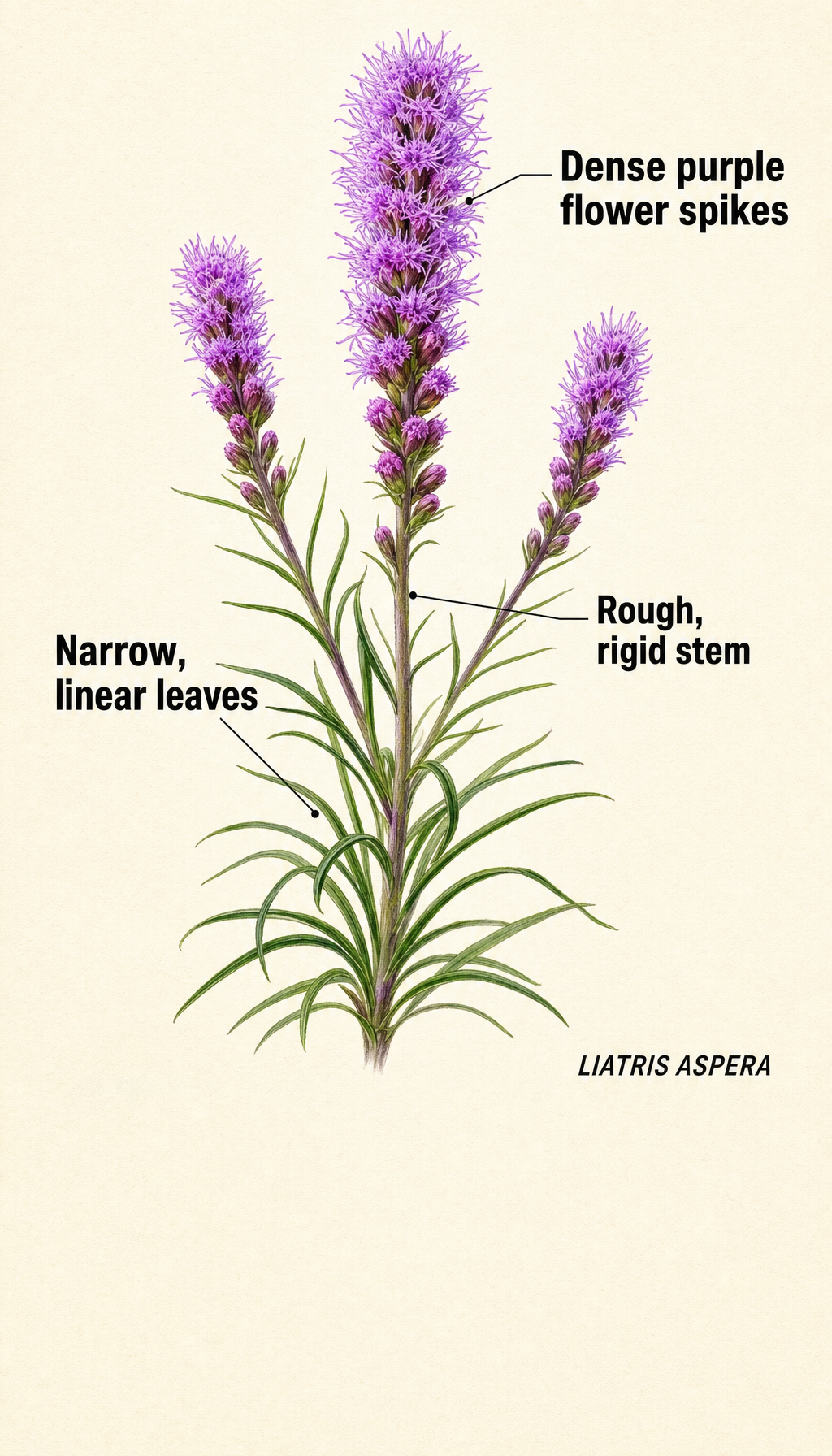
Form: Herbaceous perennial arising from a corm, producing one or more erect, typically unbranched stems. Plants are medium to tall in stature, typically reaching roughly 0.5–1.2 m (about 1.5–4 ft) in height.
Flowers: Inflorescences form dense terminal spikes or clusters of button-like heads that are typically purple to lavender in color. Each head is composed mainly of tubular disc florets (Asteraceae-type), the corollas usually 4–5 lobed; ray florets are absent. Flowering often progresses from the top of the spike downward, creating conspicuous flushed columns of color.
Leaves: Leaves are alternate, generally linear to lanceolate and often tapering; they may be sessile or clasping on the stem. Foliage and stems are typically rough-hairy (aspera = rough), giving a coarse texture to touch. Basal leaves may wither by the time the plant is in full bloom.
Distinctive features: Rough, hairy stems and leaves; dense columnar spikes of button-like purple flower heads that open from the top down; growth from a cormous rootstock. Seasonal variation: Blooms in summer into fall with seedheads persisting into autumn and winter.
Habitat & Distribution
Growing conditions: Typically found in open sun to part-shade in well-drained soils. Often associated with dry to mesic prairies, meadows, open woodlands, roadsides and savannas. Tolerant of sandy or rocky substrates and generally drought-tolerant once established.
Geographic distribution: Native to many central and eastern U.S. states (listed presence includes AL, AR, FL, GA, IA and 22 additional states), occurring across a broad range of temperate habitats in that region.
Ecological Role
Pollination: A reliable nectar source for a variety of native pollinators, often visited by bees, butterflies and other nectar-seeking insects. The dense, nectar-rich flower spikes are attractive to long-tongued bees and many butterfly species.
Wildlife interactions: Seedheads may provide structure and winter interest for seed-eating birds or nesting material, and the plant contributes to pollinator-supporting plantings. Ecological niche: Functions as a prairie and meadow species adapted to open, well-drained sites and as a mid-to-late-season nectar provider.
Conservation & Interesting Facts
Liatris aspera is not generally regarded as rare across its broad range, though local populations can be impacted by habitat loss. Notable adaptations include its cormous rootstock for seasonal dormancy and drought resilience, and the unusual top-down sequence of flower opening along the spike. Seeds bear a pappus of hairs typical of Asteraceae, aiding wind dispersal.