oxeye daisy
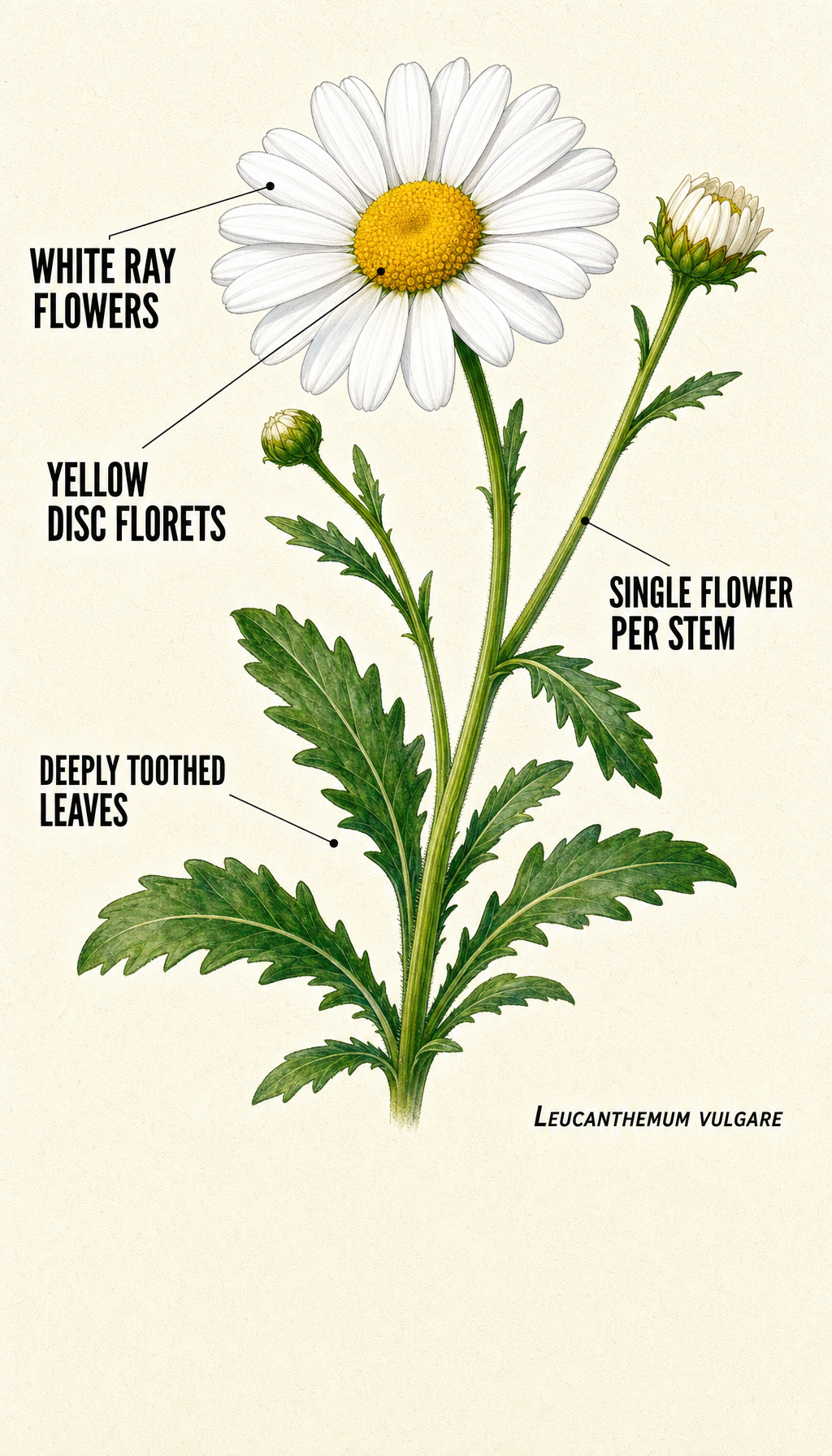
Leucanthemum vulgare
BloomEDU
Identify it today. Know it next time.
Add oxeye daisy to BloomEDU and a short quiz tomorrow will check if the name stuck.
Get BloomEDU — add oxeye daisyFree · iOS · Android
**Identity & Classification**
Leucanthemum vulgare (L.) — common name: oxeye daisy (also called ox-eye daisy, dog daisy, common marguerite). - Family: Asteraceae (the sunflower or aster family), tribe Anthemideae. - Taxonomic notes: Historically placed in Chrysanthemum by some authors; currently treated as Leucanthemum vulgare in many modern floras. The genus name Leucanthemum comes from Greek leukos (white) + anthemon (flower); the specific epithet vulgare means “common.”
- Common-name caution: “Marguerite” and “daisy” are used for many related garden and wild species; use the scientific name for precision. **Physical Description**
A cheerful, composite-flowered herbaceous perennial (often behaving as a short-lived perennial or vigorous perennial with spreading habits). Key identifying features:
- Habit and size: Typically an upright plant forming clumps or loose colonies; flowering stems often about 20–60 cm tall (roughly 8–24 inches), though local plants may be shorter or taller. - Leaves: Basal leaves usually form a rosette and are oblong to lance-shaped with toothed or pinnately lobed margins; stem leaves are smaller, alternate, and may clasp or be sessile. - Inflorescence (flower head): A single daisy-like capitulum (flower head) at the end of each stem. Each head is a composite of two floret types: white ray florets that look like “petals” surrounding a dense central disc of yellow tubular disc florets. Flower heads are commonly a few centimetres across (often around 2–5 cm / ~1–2 in). - Reproduction structures: After flowering the plant produces many small dry fruits (achenes) typical of the Asteraceae; the species spreads by seed and by creeping underground stems or short rhizomes, allowing colony formation. - Other notes: Stems are usually unbranched or sparingly branched and can be slightly hairy. **Habitat & Range**
- Native vs. introduced: Native to much of Europe and parts of temperate Asia. Introduced to and now widespread in regions such as North America, Australia, and New Zealand. - Typical habitats: Open, sunny places — meadows, pastures, roadsides, fields, disturbed ground and grasslands. It commonly establishes in well‑drained soils and tolerates a range of soil types, including poor or compacted soils. - Light and soil preferences: Prefers full sun to light shade; tolerates a variety of soils but does best in moderately fertile, well-drained conditions. - Climate: Suited to temperate climates; in favorable conditions it flowers in late spring to summer and can persist through the growing season. - Range caveat: Specific country-level distributions and exact native range limits vary among floras; consult local floras for precise mapping. **Ecological Role**
- Pollinators: The open, composite flower heads provide accessible nectar and pollen to a variety of insects — commonly visited by bees, flies, butterflies, and other generalist pollinators. - Plant community role: In its native settings it is a regular component of traditional meadows and grasslands; in introduced ranges it can form dense stands and sometimes displace native herbs, altering plant community composition. - Spread and persistence: Reproductive strategy (abundant seed production plus vegetative spread via rhizomes/creeping stems) enables rapid colonization of open or disturbed sites. - Wildlife interactions: Provides floral resources; seeds and foliage may interact with generalist herbivores and seed‑eating insects or animals, but specific specialized relationships are not well‑documented here. **Human Uses & Cultural Significance**
- Ornamental: Leucanthemum vulgare itself and related Leucanthemum species and hybrids have been important in the development of garden daisies. Cultivated “daisy”-type ornamentals (for example the Shasta daisy group, Leucanthemum × superbum) have Leucanthemum species in their ancestry. - Traditional/medicinal uses: Specific, well‑documented traditional medicinal or cultural uses for L. vulgare are not comprehensively documented here; avoid assuming medicinal properties without reliable sources. - Agricultural/management note: In regions where it is introduced and abundant, it is sometimes regarded as a weed in pastures and hayfields because it can reduce pasture quality and form monocultures; land managers may control it for agricultural reasons. **Interesting Facts**
- Classic “composite” trick: What looks like a single daisy flower is actually a head (capitulum) made of many flowers — white ray florets (the showy “petals”) and numerous yellow disc florets in the center. That sunflower-family architecture is both efficient and pollinator‑friendly. - Name story: “Leucanthemum” literally means “white flower,” and “oxeye” likely refers to the bright white ray florets surrounding the yellow “eye” — a very literal common name. - Vigorous colonizer: Its combination of many seeds and vegetative spread allows it to form large colonies; this is part of why it’s beloved in cottage‑style meadows but unwelcome where it outcompetes native prairie species. - Garden ancestry: Many garden daisies trace part of their lineage to wild Leucanthemum species — so next time you see a perfect white garden daisy, you’re looking at a cultivated cousin of the humble oxeye.
From Instagram