Portuguese daisy
Leucanthemum lacustre
BloomEDU
Identify it today. Know it next time.
Add Portuguese daisy to BloomEDU and a short quiz tomorrow will check if the name stuck.
Get BloomEDU — add Portuguese daisyFree · iOS · Android
Identity & Classification
Scientific name: Leucanthemum lacustre (commonly cited as Portuguese daisy)
Family: Asteraceae
Genus: Leucanthemum
Leucanthemum is the genus that includes familiar oxeye- and Shasta-type daisies; taxonomic placement within Asteraceae is well established. Other common names may vary regionally.
Visual Description
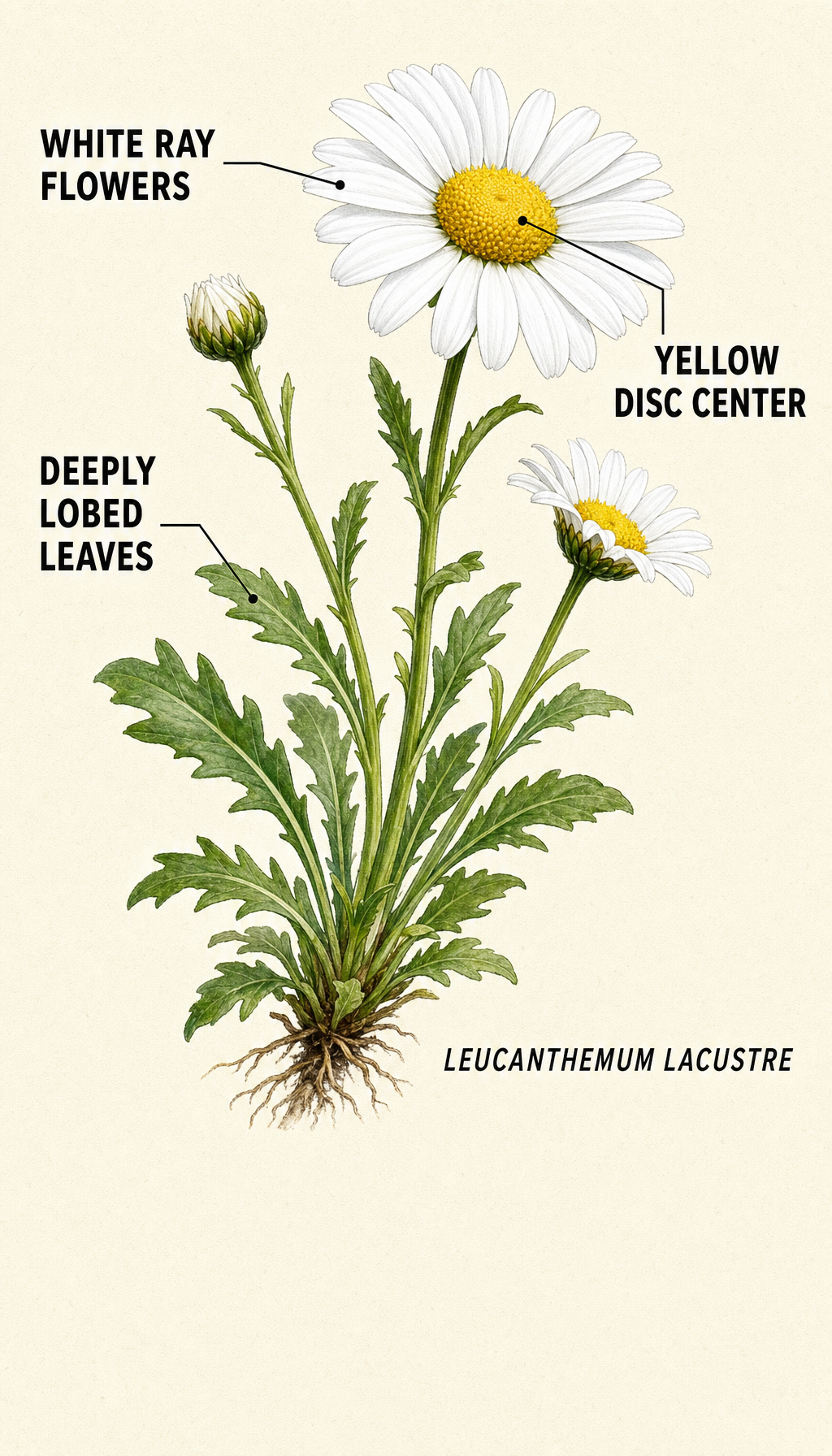
Form: Herbaceous, clump-forming perennial or biennial habit is typical of Leucanthemum species; plants generally produce one or more unbranched to sparingly branched flowering stems arising from a basal leaf rosette.
Size: Plants typically reach moderate heights on upright stems, though overall height can vary with site conditions.
Flowers: Inflorescences are classic composite heads (capitula) that appear as single “daisy” flowers. Each head typically has white ray florets surrounding a central yellow disc of many tubular disc florets. Ray count is variable rather than fixed. Heads are usually borne singly or in small clusters at stem tips.
Leaves: Leaves are generally alternate and may form a basal rosette. Leaf blades are typically simple, often toothed or lobed, with lower leaves more likely to be larger or petiolate and upper leaves reduced on the stem.
Distinctive features: The combination of white rays with a yellow disc, upright stems from a basal rosette, and the overall clump-forming habit help distinguish Leucanthemum species from other daisies. The composite flower head structure (many small florets arranged to mimic a single flower) is diagnostic of the family.
Seasonal variation: Flowering most often occurs from late spring through summer, with foliage and bloom density influenced by moisture and light availability.
Habitat & Distribution
Leucanthemum lacustre is recorded from North Carolina, South Carolina, Virginia and Wyoming. It is typically found in open or semi-open habitats such as meadows, field edges, roadsides and other partly disturbed sites. Plants often prefer full sun to partial shade and soils that are well-drained to moderately moist; tolerance for soil types may vary locally.
Ecological Role
Flower heads provide accessible nectar and pollen and commonly attract a range of generalist pollinators, including bees, hoverflies and butterflies. As with other daisies, the composite arrangement offers a convenient landing platform for insects. Leaves and stems may be used by generalist herbivores and invertebrate communities.
Human Uses & Cultural Significance
Leucanthemum species are frequently used ornamentally; this species may be cultivated in garden settings where its daisy-like blooms are desired. There are no widely documented medicinal or culinary uses specific to this species in mainstream botanical references. No widespread toxicity is reported, though some individuals can be sensitive to members of the Asteraceae family.
Conservation & Interesting Facts
No specific conservation status is asserted here. A notable botanical feature of Leucanthemum (and all Asteraceae) is the capitulum: what looks like a single flower is in fact a cluster of many small florets specialized for efficient pollination. Members of this genus have contributed significantly to ornamental breeding, resulting in a variety of garden forms derived from wild relatives.
From Instagram