mountain laurel
Kalmia latifolia
BloomEDU
Identify it today. Know it next time.
Add mountain laurel to BloomEDU and a short quiz tomorrow will check if the name stuck.
Get BloomEDU — add mountain laurelFree · iOS · Android
From Instagram
Identity & Classification
Scientific name: Kalmia latifolia
Verified common names: mountain laurel, calico-bush, spoonwood
Family: Ericaceae
Genus: Kalmia
Taxonomic note: a member of the heath family (Ericaceae), related to rhododendrons, azaleas and blueberries
Visual Description
Overall form: an evergreen, multi-stemmed shrub that typically forms compact thickets or rounded clumps. Plants commonly reach shrub heights in the low-to-mid-meter range, though size can vary with site conditions.
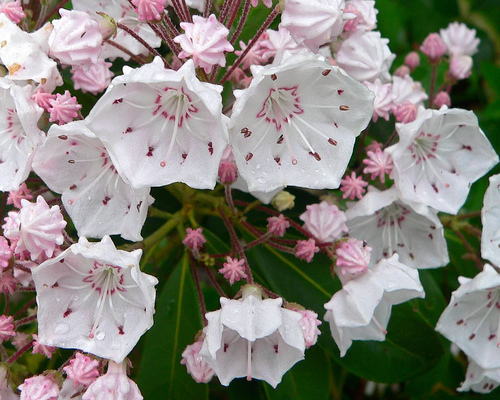
Flowers: showy clusters (corymbs) of shallow, bowl- to saucer-shaped flowers with a 5-lobed corolla. Flowers are typically white to pink or rose-colored and often bear darker spots or bands. Ten stamens are characteristically held in small corolla pockets and are spring-loaded, releasing pollen when triggered.
Leaves: leathery, glossy, simple leaves that are evergreen; blades are generally elliptic to oblong and often cluster toward twig tips. Leaves are usually arranged alternately along stems and retain a firm texture year-round.
Distinctive features: evergreen glossy leaves combined with dense clusters of distinctive shallow, patterned flowers and the spring-loaded stamen mechanism are reliable field marks. Stems are woody and often produce a dense branching habit.
Seasonal variation: typically flowers in late spring to early summer; foliage remains evergreen through seasons, providing year-round structure in the understory.
Habitat & Distribution
Typical ecosystems: commonly found in woodland understories, forest edges, rocky slopes, ridges and heathlands. Often a component of mixed oak-pine and Appalachian forest communities.
Growing conditions: generally prefers acidic, well-drained to moderately moist soils and is often associated with low-fertility, acidic sites. Grows in partial shade to full sun, commonly favoring dappled light in forested settings.
Geographic distribution: native to eastern North America and occurs across numerous states (including AL, CT, DE, FL, GA and many others), most commonly through Appalachian and southeastern to northeastern U.S. regions.
Ecological Role
Pollination: predominantly pollinated by bees; the plant’s spring-loaded stamens effectively transfer pollen onto visiting bees (including bumblebees and solitary bees).
Wildlife interactions: provides dense evergreen cover useful for nesting and shelter. Foliage and other plant parts contain toxins that generally deter mammalian browsing.
Conservation & Interesting Facts
Status: generally widespread and not usually considered threatened across much of its range.
Notable facts: Kalmia’s stamens are mechanically held and spring outward to deposit pollen on pollinators — a striking pollination adaptation. Mountain laurel is also recognized as a state symbol in parts of the eastern United States. Its affinity for acidic, low-nutrient soils is supported by ericoid mycorrhizal associations common to the heath family.