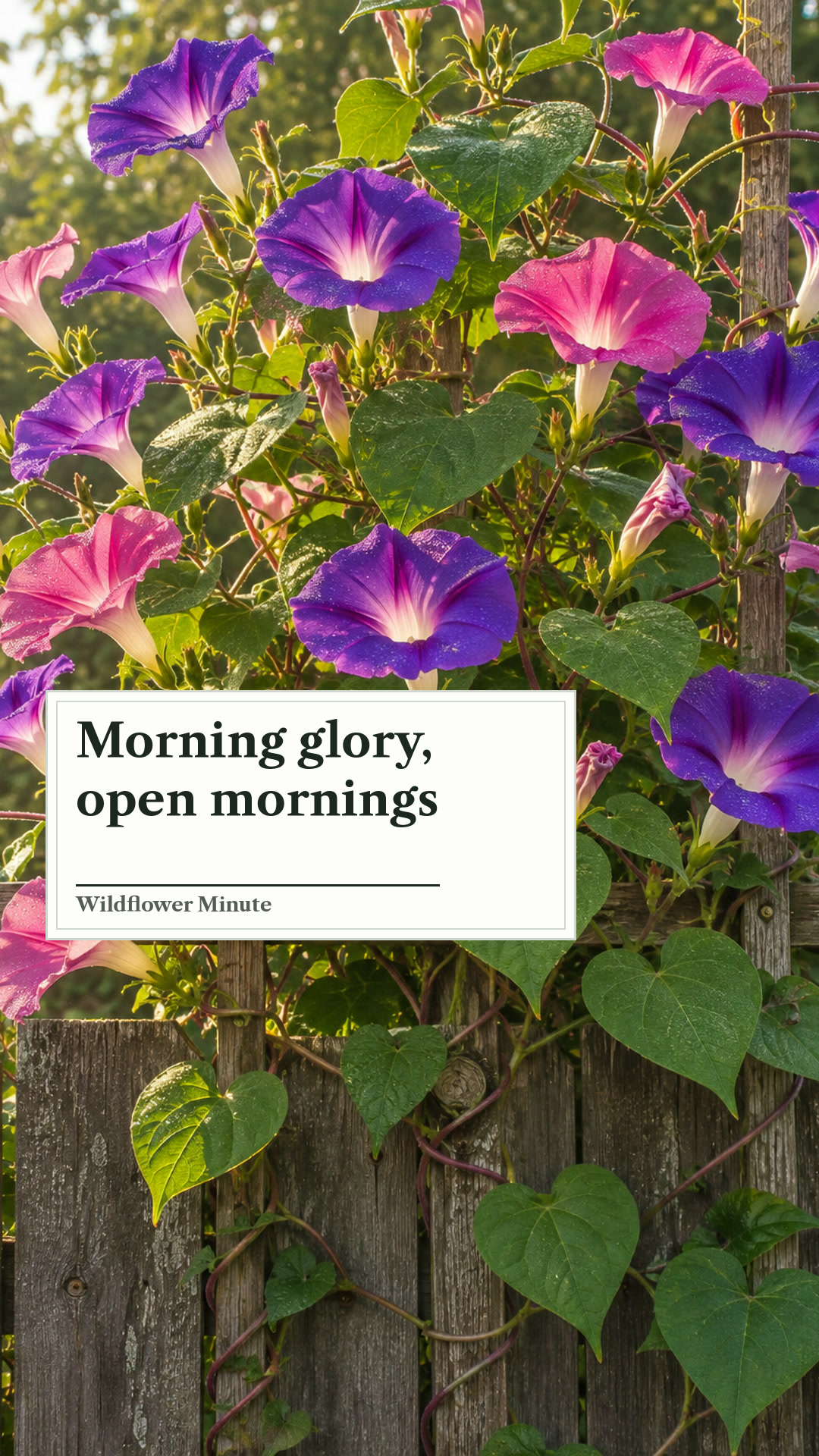
tall morning-glory
Ipomoea purpurea
BloomEDU
Identify it today. Know it next time.
BloomEDU can suggest a name from a plant photo, and later ask if you still know it.
Get BloomEDUiOS · Android
From Instagram
Do you know tall morning-glory?
Three questions from BloomEDU's question library for this plant. Pick an answer, or open Show the answer, to see why.
The flowers of tall morning-glory are typically…?
Show the answer
Answer: funnel- or trumpet-shaped blooms that open in the morning and often close by afternoon or on cloudy days
Why: Its flowers open in the morning and often close by afternoon or on cloudy days.
Where is tall morning-glory most likely to be found or used?
Show the answer
Answer: Gardens, trellises, fences and disturbed sites like roadsides and open fields
Why: Gardeners commonly grow it on trellises, fences, and arbors; it can also self-seed beyond gardens.
Which characteristic best describes the growth form of tall morning-glory?
Show the answer
Answer: A twining/climbing annual vine that uses supports and can reach several meters
Why: It is a fast-growing annual vine that twines around supports rather than standing on its own.
Identity & Classification
Ipomoea purpurea — common morning-glory (also called tall morning-glory, purple morning-glory)
Kingdom: Plantae
Order: Solanales
Family: Convolvulaceae (the morning-glory family)
Genus: Ipomoea; Species: purpurea
Taxonomic notes: Ipomoea purpurea is a member of the large, diverse genus Ipomoea. It is closely related to other ornamental morning-glories (for example, Ipomoea nil) and has been the subject of extensive horticultural selection, so many cultivated forms and color variants exist. The species is native to Mexico and Central America and is commonly grown and naturalized beyond its native range.
Physical Description
A lively, twining annual vine (in many climates) with showy, trumpet-shaped flowers. Key characteristics:
Habit: Twining/climbing vine that uses other plants, trellises or structures for support; often grown as an annual in temperate gardens.
Leaves: Typically alternate, heart-shaped (cordate) to broadly ovate; leaf margins usually entire (smooth). Leaf size and shape can vary among cultivars.
Flowers: Funnel- or trumpet-shaped (sympetalous corolla formed by five fused petals), typically opening in the morning and closing by afternoon or on cloudy days. Flower colors commonly include purples, pinks, white and bi-color or striped forms in cultivated varieties. Flowers are actinomorphic (radially symmetrical).
Reproductive structures: Stamens are attached to the corolla tube (epipetalous), a common trait in the Convolvulaceae.
Fruit and seeds: The fruit is a dry capsule that contains several seeds; seeds are generally hard and dark-colored.
Size: Vines can rapidly reach several meters/tall in favorable conditions, though exact growth depends on support, climate and cultivar.
Habitat & Range
Native range: Mexico and Central America.
Global occurrence: Widely cultivated worldwide as an ornamental; it has naturalized in many regions outside its native range.
Preferred conditions: Typically favors full sun to partial sun, well-drained soils, and warm growing seasons. It tolerates a range of soil types and is often found in gardens, disturbed sites, fences, roadsides and open fields where it can climb.
Life cycle: Often grown as an annual in temperate zones; in warmer climates it may behave as a perennial or self-seeding annual.
Ecological Role
Pollination: Flowers open in the morning and offer nectar and pollen to daytime pollinators. Ipomoea purpurea flowers are often visited by bees and other daytime pollinators; in regions where hummingbirds or other nectar feeders overlap, they may also visit morning-glories.
Habitat and shelter: The dense foliage and climbing habit provide physical structure and microhabitat for insects and other small animals.
Community effects: Because it can climb and form dense growth, I. purpurea can shade lower vegetation and alter competitive dynamics in gardens and disturbed sites.
Notes on interactions: Specific, detailed ecological relationships (specialist herbivores, precise pollinator species lists, seed dispersers) vary regionally and are not exhaustively documented here.
Interesting Facts
Name origin: The genus name Ipomoea comes from Greek roots referring to a worm-like or twining habit — a botanical wink to how these vines coil.
Morning performance: True to the common name, the flowers typically open in the morning and often close later in the day, which makes them a reliable sunrise spectacle in many gardens.
Horticultural diversity: Through selection and breeding, gardeners have produced many color forms and patterns from this single species, making it a staple of summer ornamental plantings.
Fast climber: It’s a vigorous grower — a small seed can produce a vine that quickly reaches supports and puts on a dramatic floral display in a single season.
Weedy tendencies: Its ease of self-seeding and climbing capacity mean it can naturalize and behave as a weed in some regions, especially where the climate suits it.