violet orchid
Ionopsis Kunth
BloomEDU
Identify it today. Know it next time.
Add violet orchid to BloomEDU and a short quiz tomorrow will check if the name stuck.
Get BloomEDU — add violet orchidFree · iOS · Android
From Instagram
Identity & Classification
Scientific name: Ionopsis Kunth (genus)
Common name(s): violet orchid (name applied to members of this genus)
Family: Orchidaceae
Notes: Ionopsis is a small Neotropical genus of orchids; taxonomic placement is within the orchid family but specific subtribal relationships are not detailed here.
Visual Description
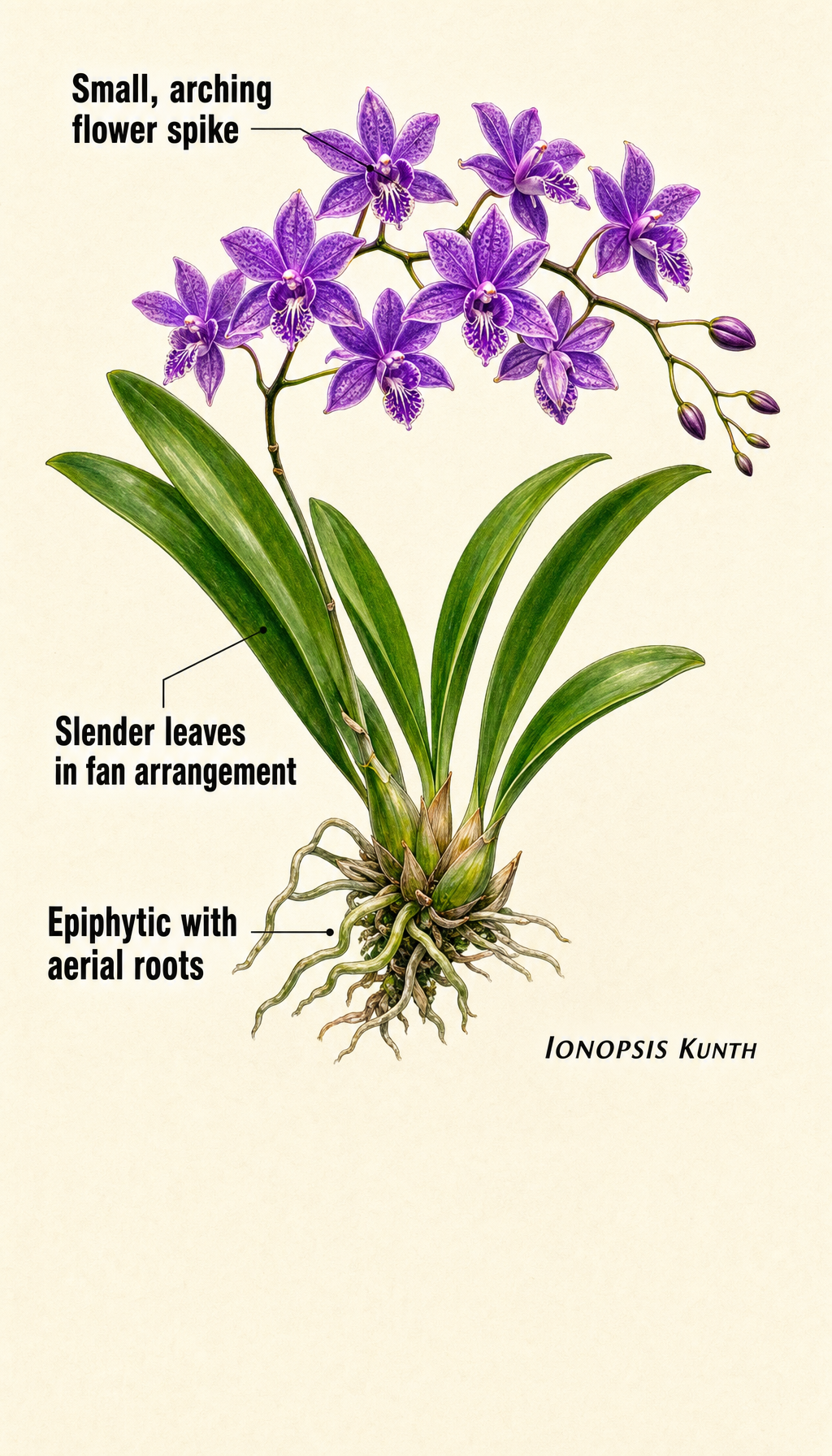
Form and size: Ionopsis species in Florida are typically epiphytic or sometimes lithophytic orchids forming small clumps or tufts on tree trunks and branches. Plants generally produce an upright to arching flowering stem rising above a compact leaf cluster; overall plants are often modest in size compared with many terrestrial orchids.
Flowers: Inflorescences bear multiple small to moderately sized flowers arranged in a raceme or loose panicle. Flowers are typically violet to purple in color, each showing the orchid pattern of three sepals and three petals (one petal modified into a distinctive lip or labellum). Flower color intensity and bloom density can vary among plants.
Leaves: Leaves are generally straplike to lance-shaped, green and somewhat fleshy or coriaceous, arising in a short stem cluster or tuft. Leaves are typically arranged to form a compact base from which the flowering stem emerges.
Distinctive features: The combination of violet-colored flowers in a many-flowered raceme and the epiphytic habit on trees helps distinguish Ionopsis in the field. The prominent labellum and overall purple hue of the inflorescence are characteristic.
Seasonal variation: Blooming may be seasonal or sporadic depending on local climate and moisture; leaf retention is generally evergreen in favorable, warm habitats.
Habitat & Distribution
Growing conditions and ecosystems: Ionopsis is typically found growing as an epiphyte on tree trunks and branches in moist, shaded to partially shaded habitats such as hammock forests and other humid woodland sites. Plants may also occur on rock faces in humid microhabitats.
Moisture, light, and substrate: These orchids often prefer humid conditions with good air movement and filtered light beneath a canopy. As epiphytes, they rely on atmospheric moisture and runoff rather than mineral soil; occasional drying between water inputs is common in their native microhabitats.
Geographic distribution: In the United States Ionopsis is found in Florida, where populations represent the northern edge of the genus’ primarily Caribbean and Central–South American range.
Ecological Role
Pollination and wildlife interactions: Flowers are adapted to attract insect visitors and provide pollen and/or nectar rewards; specific pollinator species may vary regionally. As an epiphyte, Ionopsis contributes to canopy biodiversity and provides microhabitat structure for small invertebrates and other epiphytic organisms.
Ecological niche: Functions as a specialist canopy or trunk-dwelling plant that captures light and moisture in humid forest microhabitats, often at the periphery of subtropical hammocks.
Conservation & Interesting Facts
Conservation: Populations in Florida occur at the northern margin of the genus’ range and may be locally uncommon; conservation attention is often focused on protecting suitable habitat and host trees.
Interesting facts: Ionopsis is part of the rich Neotropical orchid flora and is notable for producing conspicuous violet inflorescences from otherwise compact plants. Typical epiphytic adaptations include specialized, water-absorbing roots that allow survival on bark and in canopy niches.