mountain rosemallow
Hibiscus martianus
BloomEDU
Identify it today. Know it next time.
Add mountain rosemallow to BloomEDU and a short quiz tomorrow will check if the name stuck.
Get BloomEDU — add mountain rosemallowFree · iOS · Android
Identity & Classification
- Scientific name: Hibiscus martianus
- Common name(s): mountain rosemallow
- Family: Malvaceae
- Genus: Hibiscus
- Taxonomic note: placed in the large Hibiscus genus within the mallow family; relationships are those typical of hibiscus species (shrubs and perennial herbs with a characteristic staminal column).
Visual Description
- Overall form: A perennial, often subshrub-like or upright clump-forming plant with erect stems; typically appears as a robust perennial in the landscape rather than a delicate annual.
- Size: Generally grows to shrub-like heights and forms noticeable clumps, with individual plants reaching shrub-scale dimensions in suitable sites.
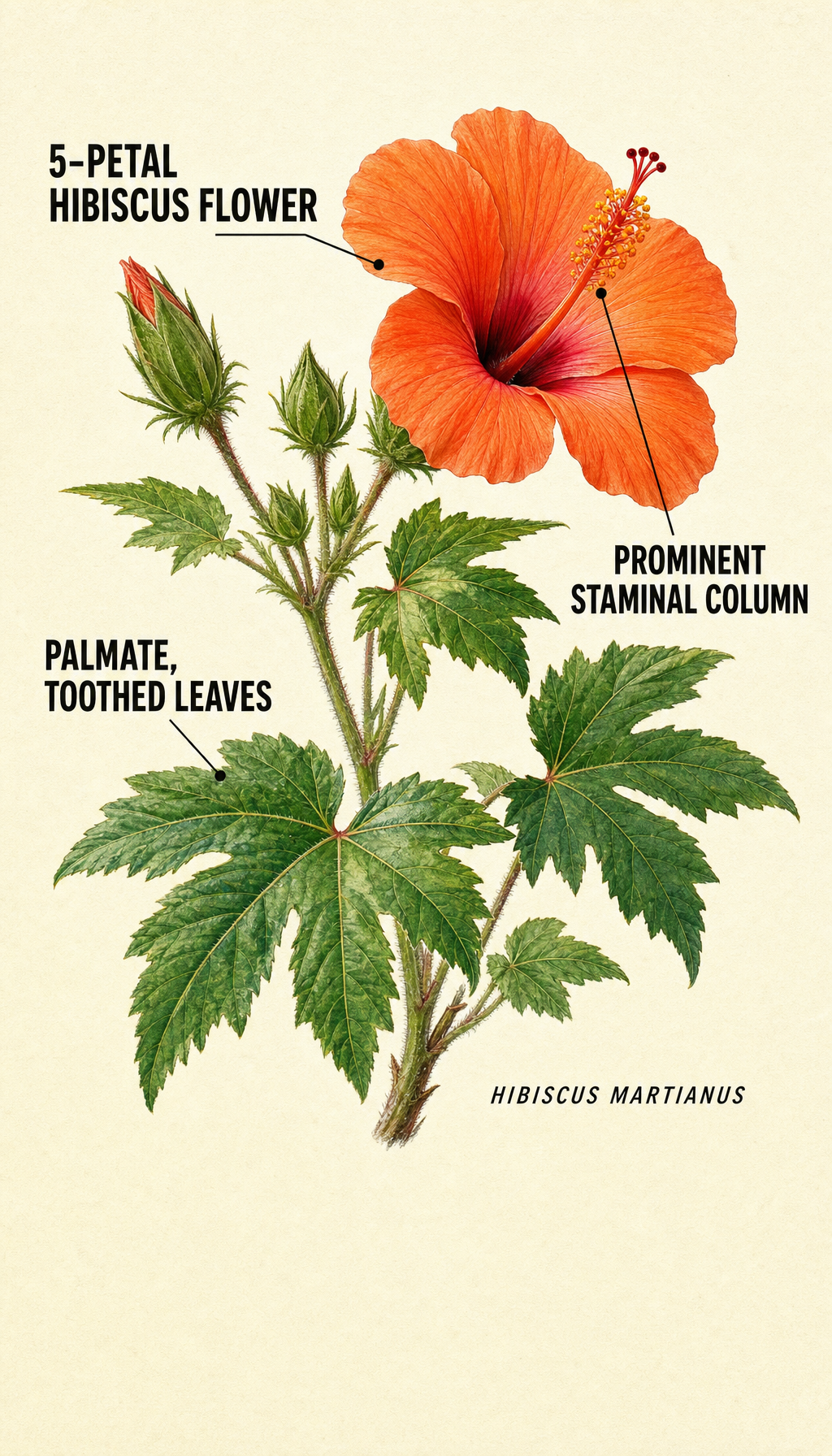
- Flowers: Showy, hibiscus-type funnel-shaped blooms with typically 4–6 petals (often 5). Petal color is most often in the orange-to-red spectrum, sometimes coral or salmon tones. Flowers are borne singly at stem tips or in leaf axils and display the family’s conspicuous central column of fused stamens surrounding the pistil.
- Leaves: Alternate, simple leaves that are often toothed or shallowly lobed; leaf texture may be somewhat coarse and the surfaces can be hairless to lightly pubescent depending on locality.
- Distinctive features: Bright orange–red hibiscus flowers with a prominent staminal column, coarse lobed leaves, and a tendency to occupy rocky, well-drained microsites make the species recognizable in the field.
- Seasonal variation: Blooms primarily in warm months, often peaking in summer with continued flowering into late season where climate allows; individual flowers are generally short-lived as is common in hibiscus.
Habitat & Distribution
- Growing conditions: Typically found on well-drained, often rocky or limestone-derived soils; commonly occupies open slopes, canyons, and other exposed sites where drainage is good.
- Moisture, light, soil: Prefers full sun to part shade and is adapted to drier, well-drained soils—showing drought tolerance compared with many garden hibiscuses.
- Geographic distribution: Documented in Texas; within the state it is often associated with drier, rocky habitats.
Ecological Role
- Pollinators: The bright, nectar-rich flowers commonly attract nectar-feeding pollinators such as hummingbirds and a variety of bees; it functions as a nectar source in its native habitats.
- Wildlife interactions: By providing nectar during warm months it supports pollinator activity; seed capsules typical of Malvaceae may provide seeds that are available to local wildlife, though specific seed predators are not universally documented.
- Ecological niche: Serves as a drought-tolerant, flowering perennial of rocky and open sites, contributing seasonal floral resources in otherwise dry landscapes.
Human Uses & Cultural Significance
- Horticulture: Often used in native-plant and xeric landscaping where a showy, drought-tolerant perennial is desired.
- Traditional/medicinal uses: Not broadly documented in standard botanical literature for this species; avoid assuming unrecorded traditional uses.
- Toxicity: Not widely documented as highly toxic; caution is prudent with any unknown plant material.
Conservation & Interesting Facts
- Interesting facts: Flowers exhibit the classic malvaceous trait of a fused-stamen column, and individual blossoms are typically short-lived, opening and fading quickly while the plant continues to produce new blooms over a season.
- Adaptations: Well adapted to dry, rocky, well-drained soils and open sites, which contributes to its role in xeric native-plant communities.
From Instagram