common sunflower
Helianthus annuus
BloomEDU
Identify it today. Know it next time.
Add common sunflower to BloomEDU and a short quiz tomorrow will check if the name stuck.
Get BloomEDU — add common sunflowerFree · iOS · Android
From Instagram
Identity & Classification
Helianthus annuus L. — the common sunflower — is a flowering plant in the aster (daisy) family, Asteraceae.
Kingdom: Plantae
Clade: Angiosperms → Eudicots → Asterids
Order: Asterales
Family: Asteraceae
Genus: Helianthus
Species: Helianthus annuus
Common names: common sunflower, garden sunflower, annual sunflower. Taxonomic notes: H. annuus is the primary domesticated sunflower species and is typically an annual; the genus Helianthus includes many other (often perennial) species and a large number of cultivated varieties (cultivars) developed for size, flower form, oil content or seed confectionery use.
Physical Description
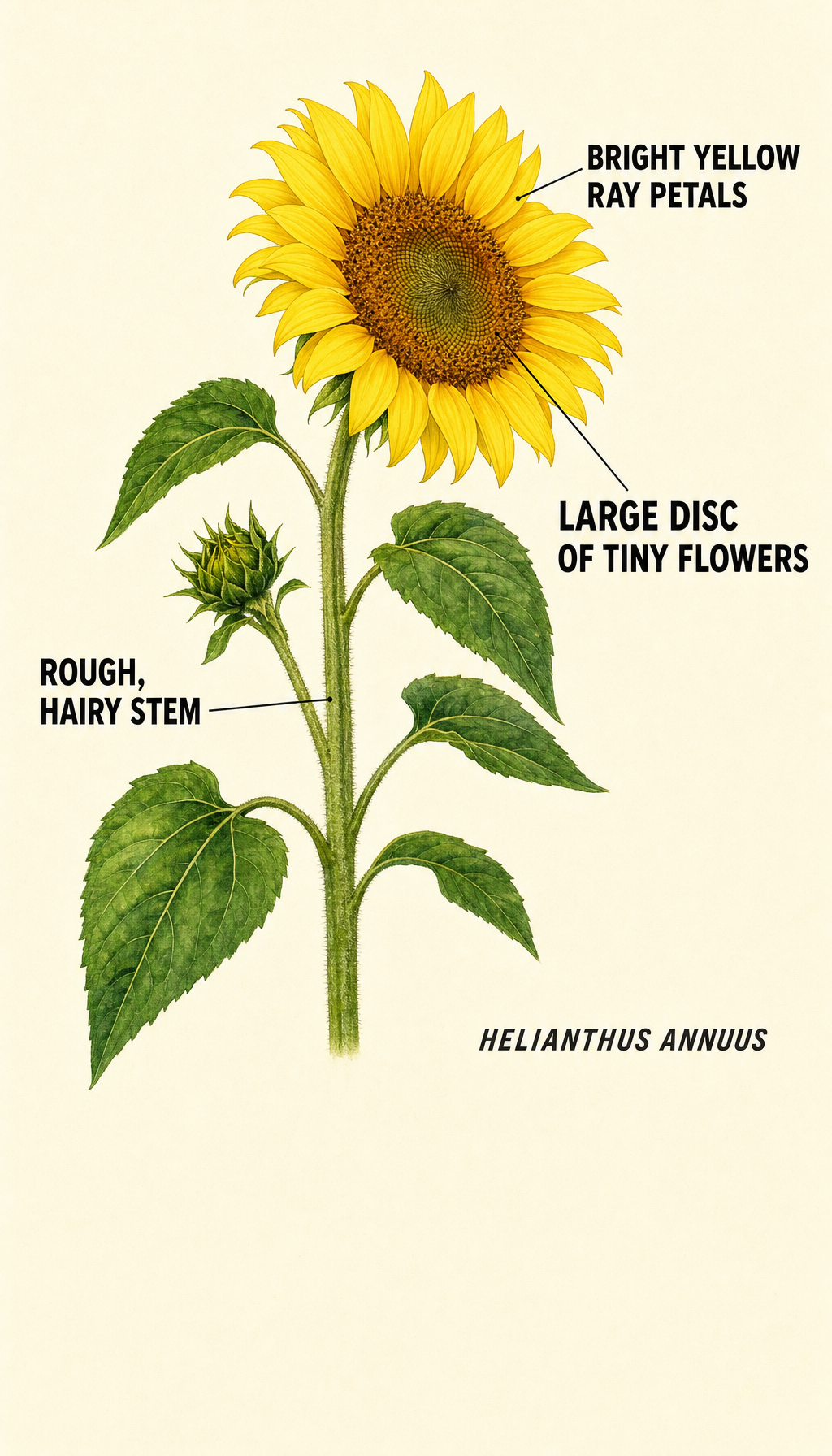
A showy, coarse-textured annual herb with a characteristic composite “flower” (capitulum) made of many small florets. Key features:
Habit: Erect, single-stemmed or branching annual; cultivated forms range from compact bedding types to very tall single-stem “giant” forms.
Height: Common garden and wild types typically reach around 1.5–3 m; some cultivated varieties grow taller.
Leaves: Large, simple, rough-hairy, ovate to heart-shaped with serrated margins; most leaves are borne singly along the stem (generally alternate in arrangement).
Inflorescence: What looks like a single flower is a capitulum — a flattened head composed of an outer ring of strap-shaped ray florets (the showy “petals”) surrounding a dense disk of many tubular disc florets. Ray florets are usually bright yellow (many cultivated colors exist), disc florets are packed into the center and develop into seeds after pollination.
Fruits/seeds: Each disc floret produces a single dry, one-seeded fruit (a cypsela) commonly called a sunflower “seed.” The true seed kernel is enclosed by the hull. Seeds vary in size, shape and stripe pattern among cultivars.
Other structures: The flower head is subtended by an involucre of green bracts (phyllaries); stems and leaves are typically hairy and coarse.
Habitat & Range
Native range: Helianthus annuus is native to North America and was domesticated there.
Current distribution: It is widely cultivated and naturalized in many temperate regions worldwide.
Typical habitat and growing conditions: Prefers full sun (indeed, its name and behavior attest to this), well-drained soils and open sites. It performs well in a range of soil types and is commonly grown in gardens, agricultural fields and disturbed sites. Sunflowers tolerate periods of dryness once established but benefit from regular moisture during active head/seed development.
Ecological Role
Pollinators: The composite heads produce abundant pollen and nectar and attract a broad suite of pollinators — especially bees (native solitary bees and managed honeybees), as well as butterflies and other insects.
Wildlife forage: Mature seeds are an important high-energy food for many bird species and small mammals; cultivated sunflower patches are often frequented by seed-eating birds.
Structural and seasonal resource: Large plants provide perches and structural habitat for insects and birds during the growing season.
Agricultural/ecological uses: Sunflowers are used in crop rotations and pollinator-friendly plantings; they have also been used in phytoremediation experiments to take up certain contaminants from soil or water in specific contexts (this is application-specific and managed experimentally).
Interesting Facts
Composite miracle: Each “sunflower” head is an inflorescence of many individual florets; each floret can set its own seed — so a single large head can yield hundreds to thousands of seeds.
Heliotropism: Young sunflower buds and heads often track the sun from east to west during the day (heliotropism). After the head matures, it commonly becomes fixed facing east, which can warm the head and attract more pollinators in the morning.
Packing genius: The pattern of seeds in the disk commonly follows spiral arrangements related to Fibonacci numbers — a natural solution to packing many seeds efficiently in a circular area.
Fruit terminology: The thing we call a “sunflower seed” is botanically a cypsela (a dry single-seeded fruit typical of the aster family); the edible kernel is the actual seed inside the hull.
Cultivar diversity: Breeders have produced a wide range of sunflower forms — dwarf bedding types, tall single-stem giants, oilseed lines, and large-seeded confectionery varieties for eating and birdseed.
Phytoremediation and research: Sunflowers have been used experimentally to extract certain contaminants from soil and water in controlled remediation projects — a reminder that plants can play roles beyond beauty and food. confectionery vs. oilseed varieties).