Atlantic Ivy
Hedera hibernica
BloomEDU
Identify it today. Know it next time.
Add Atlantic Ivy to BloomEDU and a short quiz tomorrow will check if the name stuck.
Get BloomEDU — add Atlantic IvyFree · iOS · Android
From Instagram
Identity & Classification
Scientific name: Hedera hibernica
Common names: Atlantic ivy, Irish ivy (verified common names)
Family: Araliaceae
Genus: Hedera
Taxonomic note: A member of the genus Hedera and closely related to other true ivies such as Hedera helix.
Visual Description
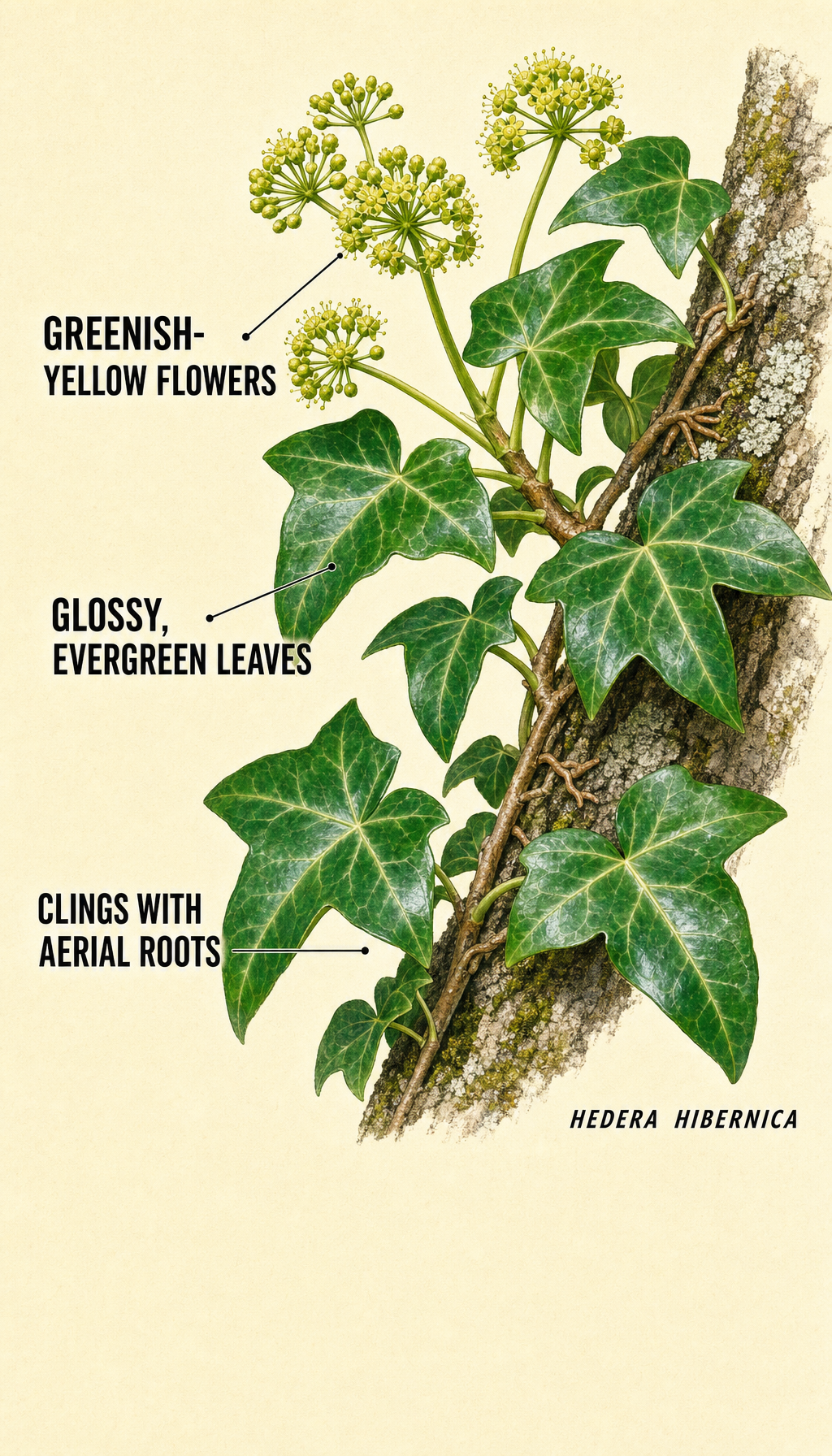
Atlantic ivy is an evergreen climbing or ground‑covering woody vine that typically forms dense mats or climbs trunks, walls, and rock faces using numerous aerial rootlets. Juvenile stems generally bear glossy, leathery, palmately lobed leaves (often 3–5 lobes) arranged alternately along the stem; mature, flowering stems usually have unlobed, more ovate leaves. Flowers are produced on erect flowering shoots rather than the scrambling juvenile shoots; they are small, greenish‑yellow, and borne in umbrella‑like clusters (umbels). Each flower typically has a small number of symmetrical petals (commonly in the range of 4–6). Flowers are followed by fleshy berries that ripen to dark purple or near‑black. Seasonal variation includes the shift from juvenile lobed foliage during the vegetative climbing phase to unlobed leaves on reproductive shoots when the plant flowers and fruits.
Habitat & Distribution
Atlantic ivy commonly grows in temperate, often moist sites where it can climb or sprawl: shaded woodlands, hedgerows, urban walls, and riparian edges are typical habitats. It tolerates a range of soils but generally prefers moist, well‑drained to moderately heavy substrates and often thrives in shade to partial sun (it can persist in sunnier exposures when soil moisture is adequate). In the United States it has been recorded in North Carolina, New York, Oregon, South Carolina, and Washington. Outside the listed states it may be cultivated or naturalized in other temperate regions.
Ecological Role
Flowering Atlantic ivy provides a late‑season source of nectar and pollen that is often valuable to a variety of insects, including bees, wasps, and flies. Its fleshy berries are commonly eaten by birds, which act as seed dispersers. The evergreen, dense foliage can offer shelter and nesting cover for birds and small animals. As a climbing shrub, it can also influence light and microhabitat conditions on the surfaces it covers.
Conservation & Interesting Facts
Atlantic ivy adheres to surfaces with numerous fine aerial rootlets rather than twining, and it exhibits a marked change in form between juvenile (climbing) and adult (flowering) stages—a phenomenon known as heteroblasty. Its late‑season flowering habit makes it an important nectar source when fewer plants are in bloom.