creeping mannagrass
Glyceria acutiflora
BloomEDU
Identify it today. Know it next time.
Add creeping mannagrass to BloomEDU and a short quiz tomorrow will check if the name stuck.
Get BloomEDU — add creeping mannagrassFree · iOS · Android
Identity & Classification
Scientific name: Glyceria acutiflora
Common name(s): creeping mannagrass (verified)
Family: Poaceae
Genus: Glyceria
Note: Glyceria is a genus of wetland-adapted grasses commonly referred to as mannagrasses; G. acutiflora is one species within this group and is taxonomically placed in Poaceae.
Visual Description
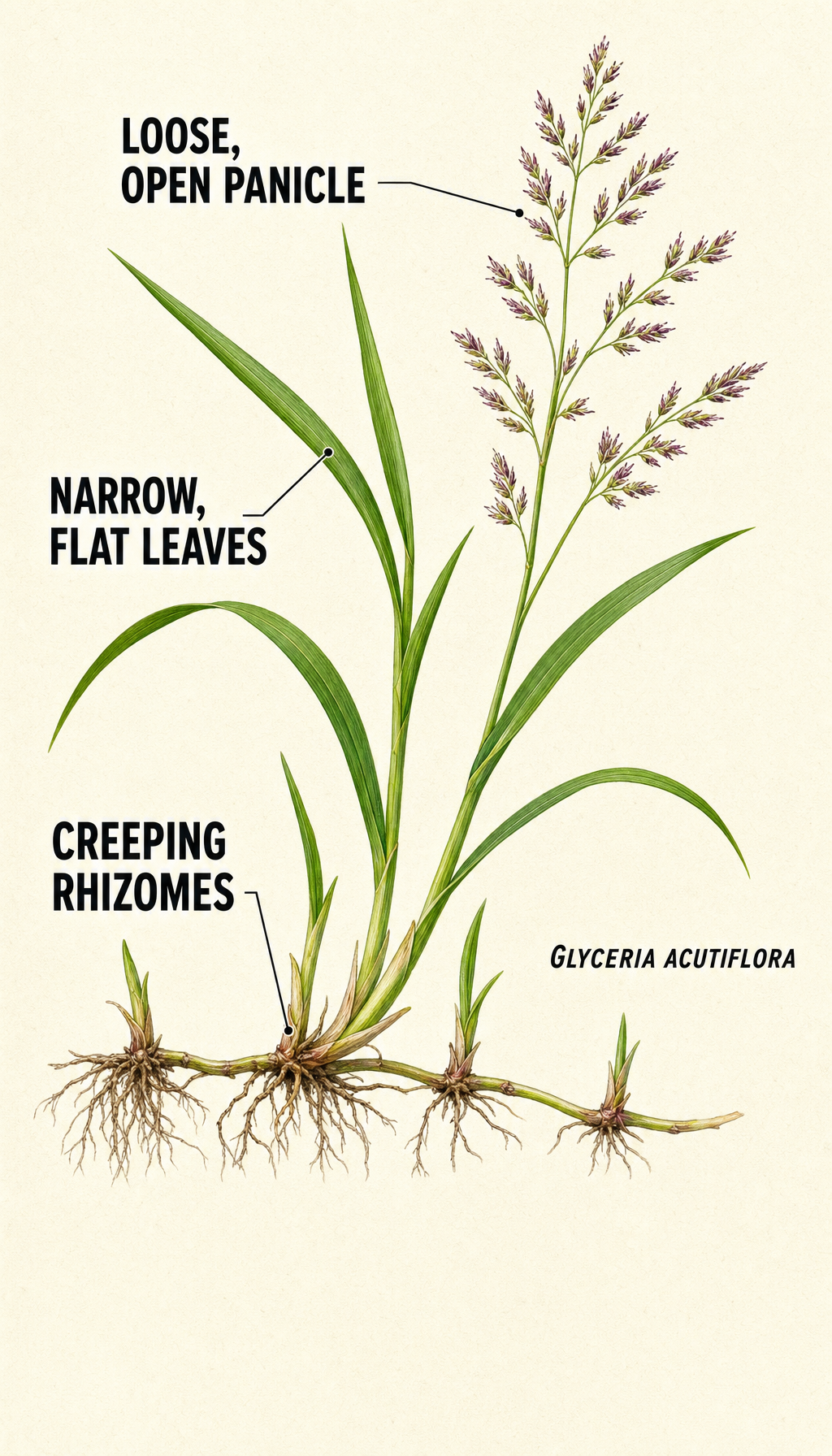
Glyceria acutiflora is a perennial, rhizomatous grass that typically forms loose mats or small tufts rather than dense tussocks. Stems (culms) are generally low to medium in height for a marsh grass and often arise from creeping underground stems. Flowers are produced in grass-type inflorescences: spikelets arranged on a panicle that can be open to somewhat contracted. Each spikelet contains several florets (often a few per spikelet) protected by the grass-specific bracts (lemma and palea); the lemmas are often acute-tipped, a feature reflected in the species name acutiflora. Leaves are usually flat, somewhat soft, and borne alternately along the stem; sheaths clasp the stem and ligules are membranous or thin. Distinctive identifying features include the rhizomatous habit, tendency to form loose mats on wet ground, and the sharp-pointed lemmas of the spikelets. Seasonal variation: foliage and flowering are most conspicuous in the growing season, with flowering and seed production typically occurring in late spring to summer in many parts of its range.
Habitat & Distribution
This species is typically found in wet or seasonally inundated habitats such as marsh edges, wet meadows, ditches, pond margins, and other shallow-water or saturated soils. It commonly prefers full sun to partial shade and moist to wet substrates, often tolerating periodic flooding. Glyceria acutiflora has been recorded in multiple U.S. states, including Alabama, Connecticut, Delaware, Georgia, Indiana and additional states (a total of about 21 state records), and is generally associated with temperate eastern wetland regions.
Ecological Role
As a member of the grass family, G. acutiflora is wind-pollinated. Its rhizomatous growth habit allows it to stabilize soft, wet soils and contribute to the vegetative structure of marsh and wet-meadow communities. The plant may provide cover and structural habitat for wetland invertebrates and small animals; its seeds can be part of the food base for wetland birds and other wildlife in some locations.
Human Uses & Cultural Significance
No specific, well-documented widespread traditional or modern human uses for Glyceria acutiflora are reliably established in the literature; related Glyceria species have been noted historically as sources of edible seed in other regions, but such uses should not be assumed for this species without verification.
Conservation & Interesting Facts
Glyceria species are notable for their adaptations to flooded soils and ability to spread by rhizomes, traits that help them colonize and stabilize wet substrates. The genus name Glyceria comes from a Greek root meaning “sweet,” a reference historically applied to sweet-tasting features in some species.
From Instagram