spotted geranium
Geranium maculatum
BloomEDU
Identify it today. Know it next time.
Add spotted geranium to BloomEDU and a short quiz tomorrow will check if the name stuck.
Get BloomEDU — add spotted geraniumFree · iOS · Android
Identity & Classification
Scientific name: Geranium maculatum. Verified common names: spotted geranium, wild geranium, wood geranium, crane’s-bill. Family: Geraniaceae. Genus: Geranium (the crane’s-bills). Taxonomically it is a typical member of the temperate Geranium species group within Geraniaceae.
Visual Description
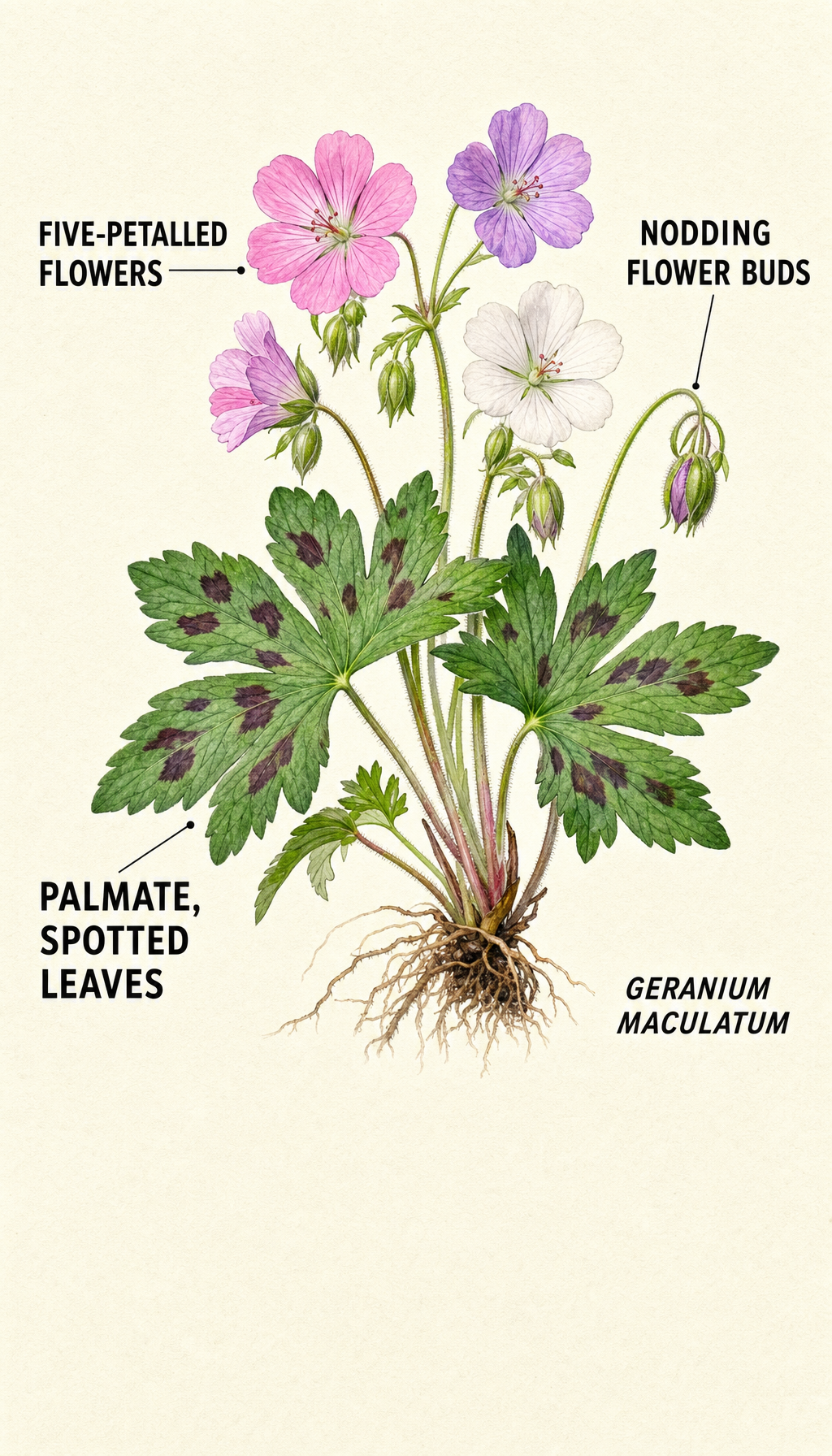
Geranium maculatum is a herbaceous, clump-forming perennial that typically produces a low rosette of leaves with erect flowering stems rising above the foliage. Plants generally form compact colonies in the understory rather than tall, single-stemmed specimens. Flowers usually bear 4–6 petals and are most often pink to lavender but can be paler or nearly white; petals commonly show darker veins or spotting. Flowers are borne singly or in small clusters on wiry stalks above the leaves. Leaves are palmately divided, typically into 5–7 lobes, arising on long petioles from the base and occasionally along the flowering stems; lobes are toothed or coarsely cut. A distinctive identifying feature is the beak-like fruit (the “crane’s-bill”) that splits to release seeds. Seasonal variation: plants typically bloom in spring to early summer, and the foliage may die back or become less conspicuous later in the growing season.
Habitat & Distribution
Geranium maculatum commonly occurs in deciduous woodlands, shaded slopes, rich mesic forests, and open woods, often in humus-rich, well-drained soils. It typically favors partial to full shade and moderate moisture, tolerating a range from mesic to moderately dry sites when shaded. Geographic distribution is eastern and central North America; it is recorded from many U.S. states including AL, AR, CT, DE, FL and about 30 additional states, and is commonly found across the eastern portion of the continent.
Ecological Role
Flowers are attractive to a variety of pollinators and are often visited by bees and other insect pollinators seeking nectar and pollen. The species’ beaked fruit employs a ballistic seed-release mechanism—mechanical tension in the fruit ejects seeds away from the parent plant—an effective means of local seed dispersal. As an understory native, it contributes to spring floral resources and diversity in woodland ecosystems.
Human Uses & Cultural Significance
Historically, roots of wild geranium (cranesbill) have been used in traditional herbal medicine as an astringent; such traditional uses are documented in botanical literature. The species is also grown ornamentally in native-plant and shade gardens for its early-season flowers and attractive foliage.
Conservation & Interesting Facts
Geranium maculatum is generally widespread across its range and not typically a conservation concern at large scales. A notable adaptation is its beaked fruit and explosive seed dispersal, which gives the genus its common name “crane’s-bill.” The specific epithet maculatum refers to the spotting or darker veining often visible on the petals.
From Instagram