longstalk cranesbill
Geranium columbinum
BloomEDU
Identify it today. Know it next time.
Add longstalk cranesbill to BloomEDU and a short quiz tomorrow will check if the name stuck.
Get BloomEDU — add longstalk cranesbillFree · iOS · Android
From Instagram
Identity & Classification
Geranium columbinum L. — commonly called long-stalked crane’s-bill or longstalk cranesbill — is an herbaceous annual in the family Geraniaceae. It was named by Carl Linnaeus (the “L.” in the scientific name). Within the genus Geranium it is one of the smaller, annual species often grouped with other ruderal and meadow geraniums. Taxonomic treatments may recognize regional varieties or forms, but the species-level name Geranium columbinum is the standard binomial.
Physical Description
A compact, often inconspicuous geranium with the classic “crane’s-bill” fruiting structure. Key features:
Growth form: herbaceous annual, typically forming an upright to somewhat sprawling stem habit (often low to the ground rather than tall-climbing).
Height: generally a low plant; stems commonly range from a few centimeters up to several decimeters (often reported in the small-to-medium range for annual geraniums).
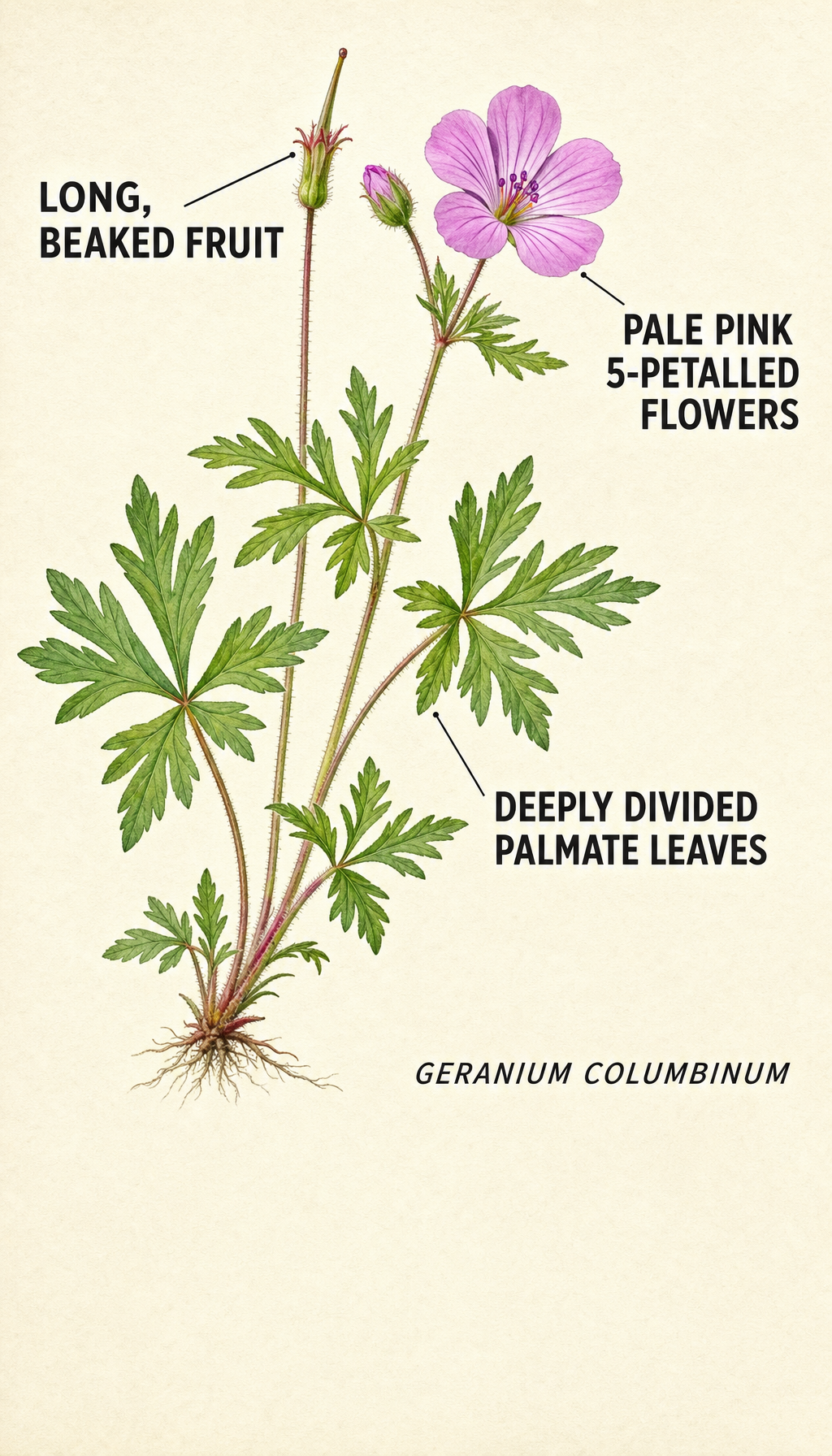
Leaves: palmately divided (geranium-typical palmate leaves) into several lobes; leaf petioles relatively long compared with the leaf blades; margins toothed to lobed.
Stems and foliage: usually hairy (pubescent), which can give a slightly rough texture to touch.
Flowers: solitary or a few flowers borne on relatively long peduncles (hence “long-stalked”); each flower with five petals, often pink to pale pink or purplish, frequently showing radiating darker veins; petals commonly notched or emarginate at the tip. Flowers are modest in size compared with showier perennial geraniums.
Fruit: the characteristic geranium schizocarp (“crane’s-bill”) — a central column with five carpels that, when ripe, separate and eject seeds. The fruit’s elongated beak-like column is a distinctive diagnostic feature of the genus.
Habitat & Range
Geranium columbinum is typically associated with open, often disturbed habitats and temperate climates.
Typical habitats: meadows, arable fields, roadside verges, wasteland, and other open, well-drained sites; it often tolerates disturbed and moderately dry soils.
Geographic distribution: the species is native to parts of Europe and adjacent temperate regions of Eurasia; it is also reported from other areas where it has become naturalized. (Specific country-level distributions and introduced-status details vary by source; consult regional floras for precise local status.)
Ecological Role
Geranium columbinum participates in common meadow and ruderal plant community dynamics and displays several ecological interactions typical of small-flowered annual geraniums:
Pollination: the flowers are visited by generalist, short-tongued pollinators — small bees, flies, and other nectar- or pollen-seeking insects — although detailed pollinator lists for this species are not exhaustively documented here.
Seed dispersal: the species uses the classic geranium ballistic seed-dispersal mechanism — the drying fruit “snaps” and flings seeds from the beak-like column (the “crane’s-bill”), which helps spread seeds locally.
Community role: as an early- to mid-season annual in open habitats, it can contribute to nectar and pollen resources for small insects and adds to species richness in meadows and disturbed ground.
Interesting Facts
Name origins: “crane’s-bill” comes from the fruit’s resemblance to a bird’s long beak — a lovely bit of botanical poetry that also describes a real seed-dispersal mechanism.
Seed catapult: the plant’s fruit is a mechanical marvel — as the tissues dry, tension builds and the carpels separate, flinging seeds out of the beak. It’s a tiny ballistic launcher you can see in many geraniums.
Annual habit: unlike many showy garden geraniums (which are often perennial or shrubby pelargoniums in horticulture), G. columbinum completes its life cycle in one season — a life-history strategy well-suited to disturbed or ephemeral habitats.
Subtle but diagnostic: its combination of small pink-veined flowers on conspicuously long stalks (peduncles) and the annual, hairy habit helps separate it from some similar wild geraniums. columbinum apart from a few similar Geranium species, or point you to regional floras and identification keys for precise local identification.