Indian blanket
Gaillardia pulchella
BloomEDU
Identify it today. Know it next time.
Add Indian blanket to BloomEDU and a short quiz tomorrow will check if the name stuck.
Get BloomEDU — add Indian blanketFree · iOS · Android
From Instagram
Identity & Classification
Gaillardia pulchella — common names: Indian blanket, firewheel, Indian blanketflower, sundance.
Family: Asteraceae (the sunflower/daisy family)
Genus: Gaillardia
Species: Gaillardia pulchella
Taxonomic notes: G. pulchella is a short‑lived perennial or an annual in cultivation and the wild, and it is closely related to Gaillardia aristata. It readily hybridizes with G. aristata; many garden forms (often listed as Gaillardia × grandiflora) come from crosses between these species.
Physical Description
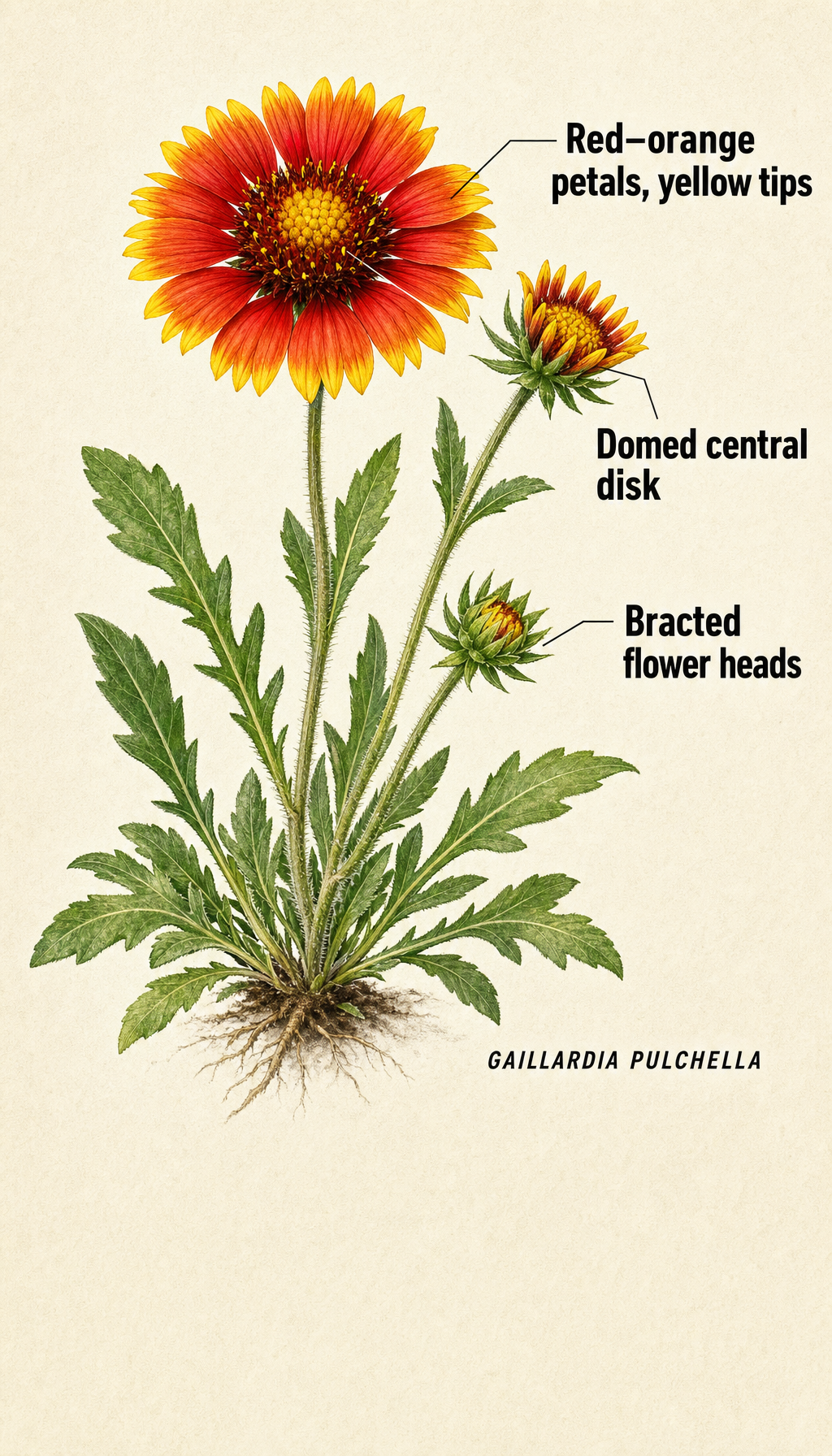
A showy, daisy‑type flower plant with a compact habit. Key characteristics:
Growth form: Often short‑lived perennial or behaves as an annual; usually low to medium in height (often under about 60 cm).
Leaves: Basal and along the stem; typically simple, somewhat lance‑shaped to spatulate, and often covered with hairs giving a gray‑green to green appearance.
Stems: Generally erect, often hairy.
Flower heads (inflorescences): Composite heads typical of Asteraceae, with conspicuous ray florets surrounding a central disk of tubular florets. The classic look is bicolored rays—red or deep orange near the center grading to bright yellow at the tips—creating the “blanket” or “firewheel” effect. Disk florets are usually orange to reddish.
Fruit: Produces achenes (the dry, one‑seed fruits typical of the sunflower family).
Habitat & Range
Native to North America.
Typical habitat preferences: open, sunny sites with well‑drained soils. The species often performs well on dry, sandy, or otherwise poor soils and tolerates heat and drought conditions.
Occurrence: Often seen in open fields, roadsides, disturbed ground, and in cultivated wildflower plantings. (Specific, detailed geographic limits are not provided here — descriptions above are general habitat tendencies.)
Ecological Role
Pollinators: The flowers are nectar‑ and pollen‑rich and commonly visited by a variety of pollinating insects, especially bees and butterflies. These visits make Gaillardia pulchella a useful species for supporting pollinator communities.
Community function: As a fast‑flowering, showy plant that thrives in poor soils, it often establishes quickly in open and disturbed areas and can contribute to early floral resources in such habitats.
Other interactions: Detailed, species‑specific food web relationships (for example, specialist herbivores or seed predators) are not comprehensively documented here.
Interesting Facts
The common name “Indian blanket” (or “blanketflower”) comes from the flower’s vivid concentric colors that resemble the patterned blankets made by some Native American cultures — a visual nickname rather than a literal cultural attribution. - The striking two‑tone (or multitone) ray florets make Gaillardia pulchella a favorite for bright, long‑season color in low‑maintenance landscapes. - It hybridizes readily with related Gaillardia species, which is why many garden cultivars combine the bright colors of G. pulchella with other desirable traits (such as increased perenniality). - It’s a great choice for poor or dry sites where many other ornamentals struggle — think of it as a little fireworks display for the tough, sunny corners of the garden.