showy forsythia
Forsythia ×intermedia
BloomEDU
Identify it today. Know it next time.
Add showy forsythia to BloomEDU and a short quiz tomorrow will check if the name stuck.
Get BloomEDU — add showy forsythiaFree · iOS · Android
**Identity & Classification**
Scientific name: Forsythia × intermedia
Verified common names: showy forsythia, border forsythia, hybrid forsythia
Family: Oleaceae
Genus: Forsythia
Taxonomic note: Forsythia × intermedia is a garden hybrid within the genus Forsythia, commonly attributed to crosses involving Asian species such as F. suspensa and F. viridissima.
**Visual Description**
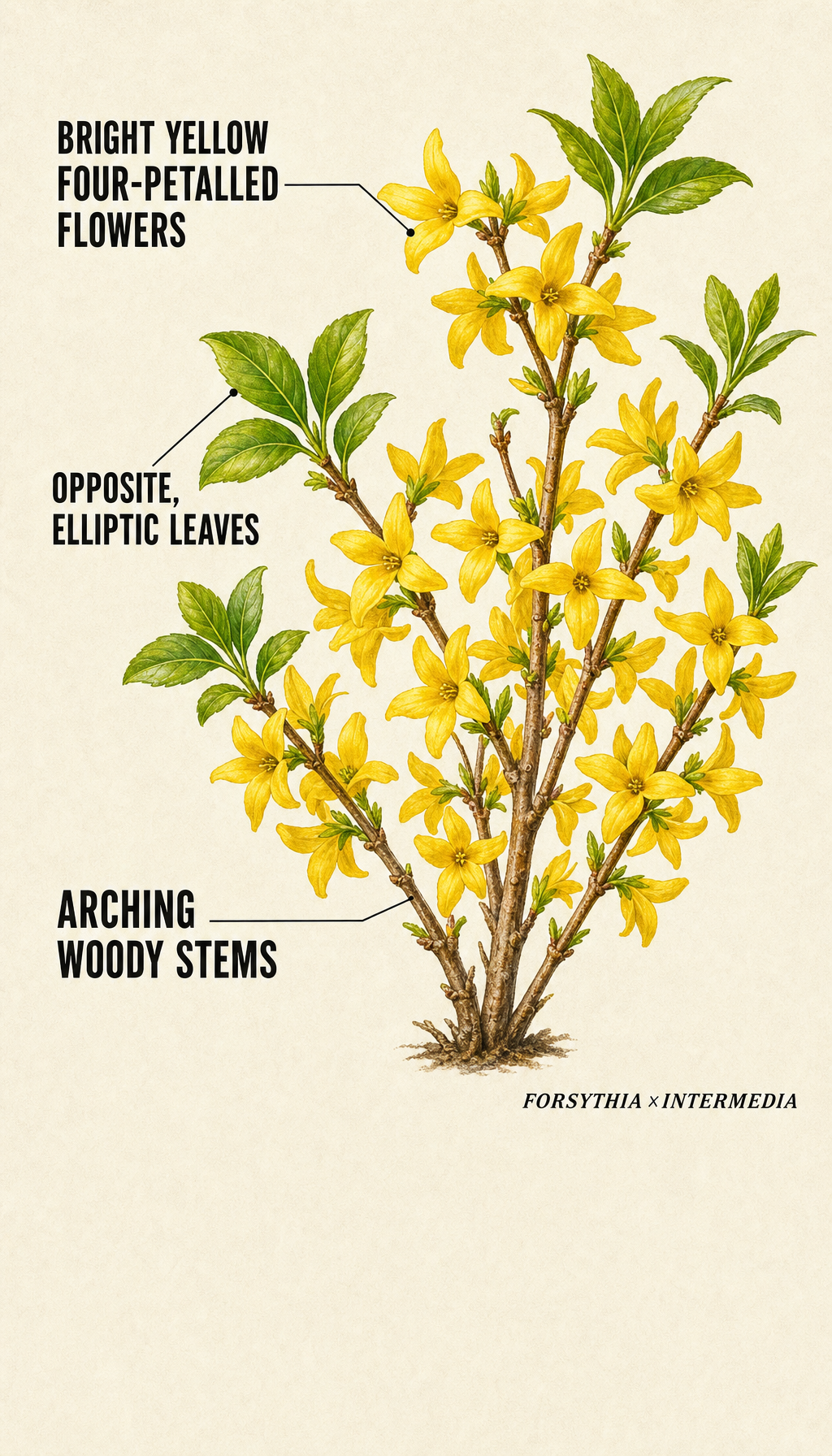
Overall form: Deciduous, arching shrub forming a rounded to spreading habit with multiple stems. Plants typically reach about 1–3 m in height, though landscape specimens can vary with pruning and site conditions.
Flowers: Bright yellow, tubular-bell shaped flowers produced profusely on last year’s wood in early spring, usually before leaf-out. Each flower generally has four spreading lobes/segments that give a star-like appearance when open. Flowers are borne singly or in small clusters along stems.
Leaves: Leaves are opposite (a characteristic of the olive family), simple, and generally ovate to elliptic in outline with serrated or finely toothed margins. Leaves usually appear after flowering and may have short petioles; some cultivars show slight variations in shape and size.
Distinctive features: Very early, showy yellow blooms on bare stems; opposite leaves; arching dense branching. Many cultivated forms have been selected for compact habit or profuse flowering.
Seasonal variation: Notable for vivid spring bloom before leaves appear. Foliage emerges after flowering and may turn muted yellow in autumn. Flowers give way to small, inconspicuous dry capsules later in the season.
**Habitat & Distribution**
Growing conditions: Commonly planted in gardens, parks, and hedgerows; typically tolerant of a range of soils if well-drained and often performs best in full sun to part shade. Adaptable to urban and suburban landscapes and often resilient to pruning.
Moisture & soil: Generally prefers moderate moisture and well-drained soils; can tolerate a range from loamy to clay soils and is often drought-tolerant once established.
Geographic distribution: Cultivated and commonly found in the provided states (IN, OH, VA) as an ornamental shrub; may escape into disturbed sites in some areas but is primarily known from plantings.
**Ecological Role**
Pollinators: Serves as an important early-season nectar and pollen source for bees and other early-emerging pollinators when few other shrubs are in bloom.
Wildlife interactions: Dense branching can provide shelter for small birds; fruits are dry capsules and generally are not a major wildlife food.
**Human Uses & Cultural Significance**
Modern uses: Widely used as an ornamental for spring color, specimen planting, and formal or informal hedges.
Toxicity: Forsythia is not widely reported as toxic, though standard caution is advised around pets and children with any garden plant.
**Conservation & Interesting Facts**
Conservation: As a cultivated hybrid, Forsythia × intermedia is not of conservation concern.
Interesting facts: Its habit of flowering on bare stems maximizes visibility to early pollinators and gardeners alike. Many garden cultivars trace to 19th- and 20th-century selections that emphasized bloom timing and form.
From Instagram