redstem stork's bill
Erodium cicutarium
BloomEDU
Identify it today. Know it next time.
Add redstem stork's bill to BloomEDU and a short quiz tomorrow will check if the name stuck.
Get BloomEDU — add redstem stork's billFree · iOS · Android
From Instagram
Identity & Classification
Erodium cicutarium (L.) L'Hér. — family Geraniaceae. Common names include Redstem Stork’s‑bill, common stork’s‑bill, redstem filaree, filaree, pinweed, and storksbill. Taxonomic notes: Erodium is a distinct genus within the geranium family (Geraniaceae), often confused in casual use with Geranium and Pelargonium because of similar flower shapes. The specific epithet cicutarium and the familiar “stork’s‑bill”/“filaree” names refer to the characteristic beak‑like fruit (see Interesting Facts).
Physical Description
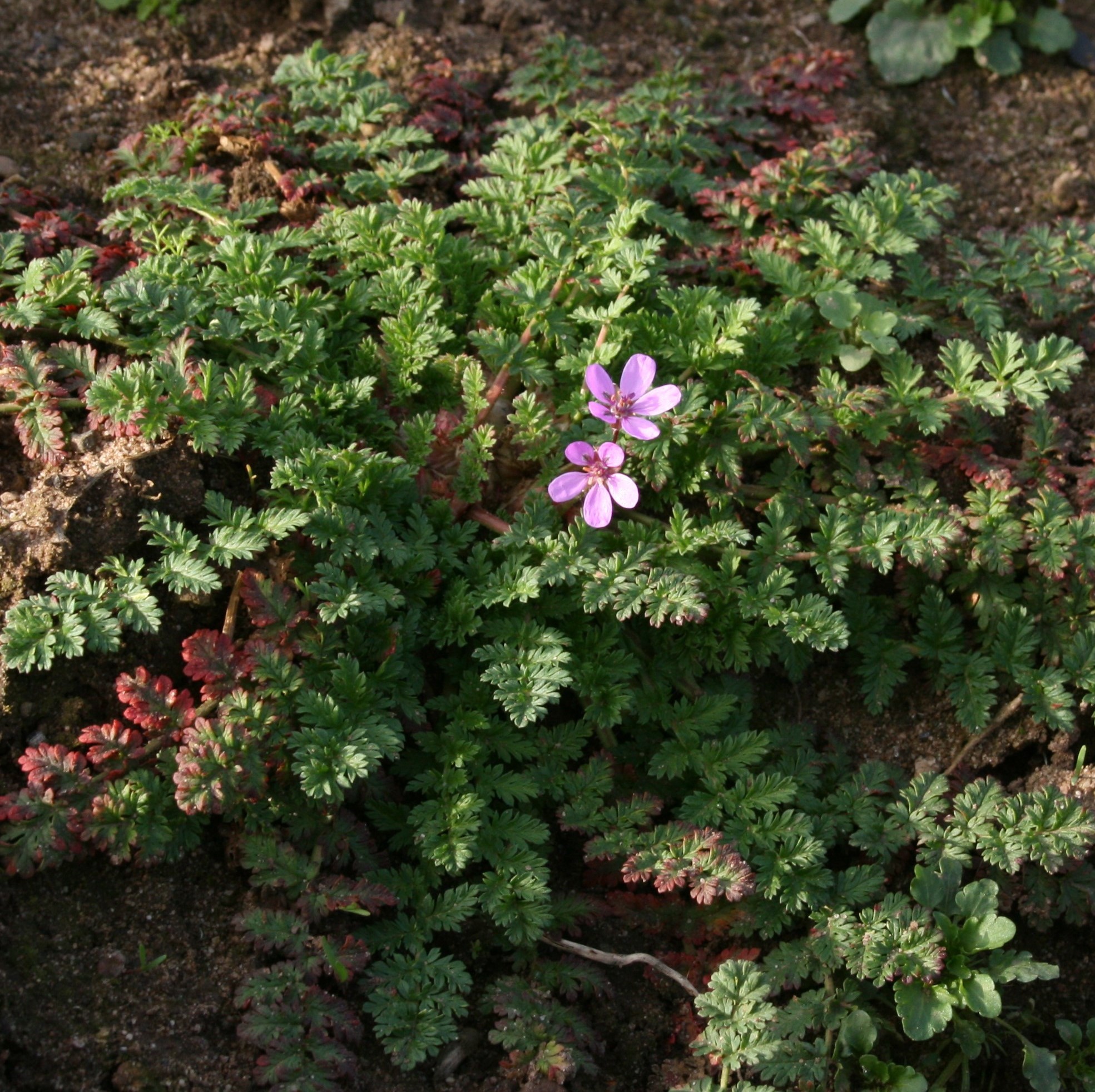
A wiry, often low‑growing herb that is usually an annual and in warmer climates can behave as a biennial. Key identification features:
Growth form: Basal rosette of leaves with flowering stems arising singly or in small clusters; stems frequently slender and often tinged red or purple (hence “redstem”).
Height: Typically low to the ground; flowering stalks most often in the range of a few centimeters up to a few tens of centimeters tall (commonly reported roughly 5–40 cm).
Leaves: Pinnately divided leaves (feather‑like) with numerous narrow, toothed leaflets; leaves often form a basal rosette and can be sparsely hairy to moderately hairy.
Flowers: Five‑petaled flowers, usually pink to purple (sometimes pale), often with darker veins; petals often slightly notched at the tip. Individual flowers typically a small but noticeable size (around 1–2 cm across is commonly reported).
Fruit: A distinctive elongated “beak” (the stork’s‑bill) containing several seeds. The seed has a long, needlelike awn that is hygroscopic (responds to moisture) and assists in self‑burying — a classic Geraniaceae adaptation.
Surface: Plant surfaces (stems and leaves) range from glabrous to softly hairy depending on conditions and local populations.
Habitat & Range
Native range: Macaronesia, temperate Eurasia, and north and northeast Africa.
Introduced and naturalized: Introduced to North America (documented from the 18th century onward) and now widespread and naturalized in many regions, including arid and semiarid parts of the southwestern United States. It is also naturalized in other temperate regions worldwide.
Typical habitats: Often found in open, sunny, well‑drained sites—disturbed ground, roadsides, fields, grasslands, pastures, and dry slopes. It tolerates dry soils and is commonly associated with Mediterranean‑type and other seasonally dry climates.
Soil and light: Prefers full sun to partial sun and well‑drained soils; shows good drought tolerance once established.
Ecological Role
Pollinators: Flowers provide nectar and pollen to a variety of insects; bees and other generalist pollinators are commonly observed visiting Erodium flowers.
Early‑successional/weed ecology: Because it establishes readily in disturbed soils and open sites, E. cicutarium often functions as an early colonizer, contributing ground cover and rapid seed production. In regions where it is introduced it may compete with local native annuals.
Seed dispersal & establishment: The awned, beak‑like fruit uses a hygroscopic mechanism to twist and push seeds into the soil — an effective strategy for self‑planting and persistence in dry, loose soils.
Wildlife interactions: The plant can provide forage and habitat structure at small scales and is part of food webs involving invertebrate herbivores and pollinators. Specific, well‑documented trophic relationships (e.g., specialist herbivores or seed predators) vary by region and are not universally documented.
Interesting Facts
The “stork’s‑bill” name is literal: the dry fruit looks like a long beak (a stork’s bill), and that beak contains a coiling awn that helps screw the seed into the ground as humidity changes—plant‑powered drilling, essentially. - Red stems are common enough in many populations that “redstem” is a useful field cue, but stem color can vary with light, temperature, and provenance.
It’s a small plant with big strategies: rapid life cycle, prolific seed production, and a moisture‑driven seed burial mechanism make it a successful colonizer of dry, disturbed habitats. - Although often dismissed as “just a weed,” Erodium cicutarium can be a valuable early nectar source for pollinators in spring in some ecosystems.