common water hyacinth
Eichhornia crassipes
BloomEDU
Identify it today. Know it next time.
BloomEDU can suggest a name from a plant photo, and later ask if you still know it.
Get BloomEDUiOS · Android
From Instagram
Do you know common water hyacinth?
Three questions from BloomEDU's question library for this plant. Pick an answer, or open Show the answer, to see why.
What distinctive feature helps identify common water hyacinth in the field?
Show the answer
Answer: Inflated, spongy petioles that act as floats
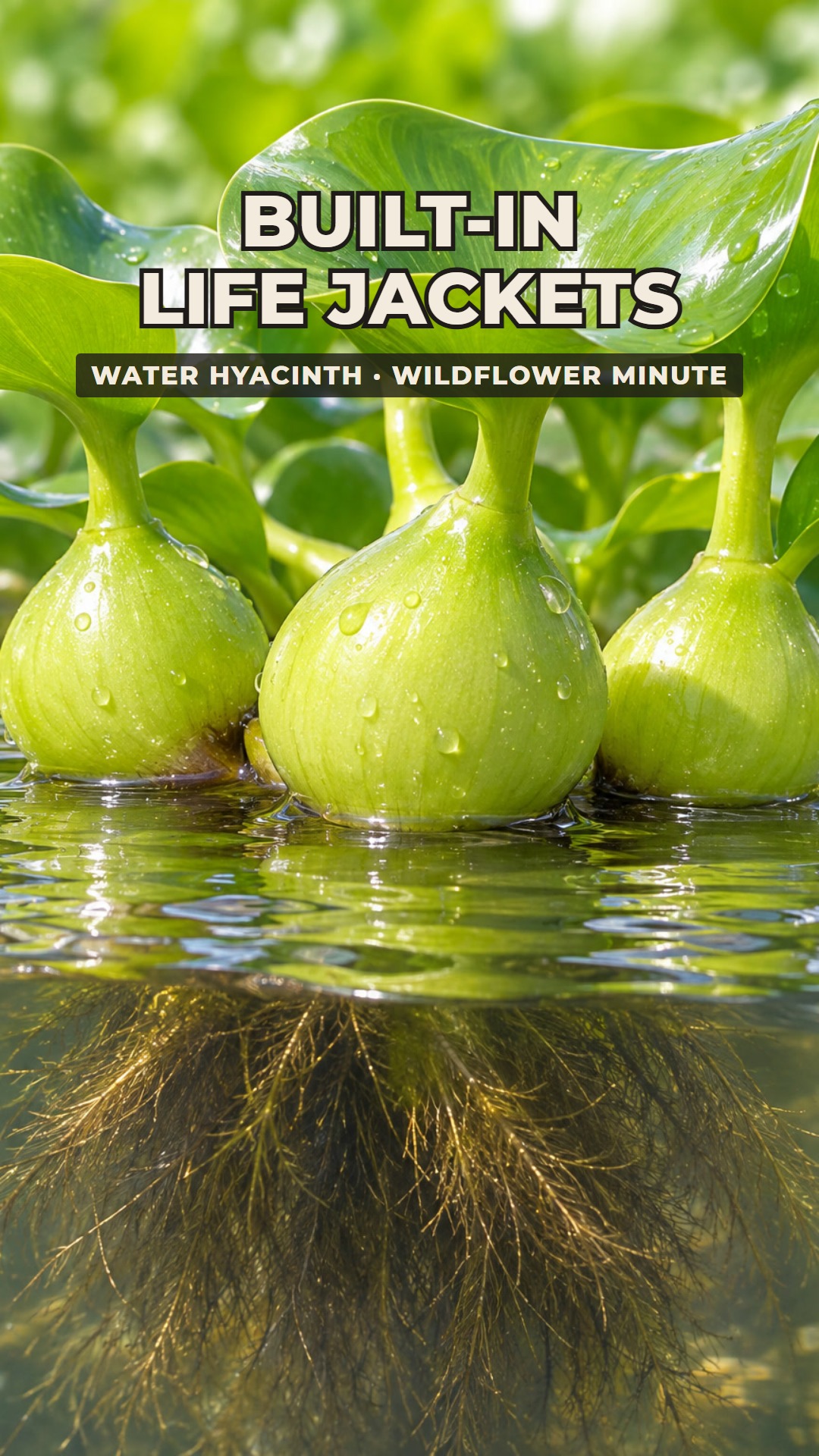
Why: The giveaway is the swollen, spongy leaf stalks: they act like little floats and keep the glossy rosette riding on the water.
The flowers of common water hyacinth are typically what color and have which conspicuous marking?
Show the answer
Answer: Pale lilac to deep violet flowers often with a darker patch and a yellow spot
Why: Its flower spikes range from pale lilac to deep violet, often with a darker patch marked by a bright yellow spot—like a tiny painted signal.
Which characteristic habitat is common water hyacinth most likely to be found in?
Show the answer
Answer: Freshwater lakes, ponds, slow-moving rivers, canals and ditches
Why: Look for it in still or slow freshwater, including lakes, ponds, sluggish rivers, canals, and ditches; it is a floating plant rather than a shoreline one.
Identity & Classification
Eichhornia crassipes — Common water hyacinth
Kingdom: Plantae
Clade: Angiosperms (flowering plants) → Monocots
Order: Commelinales
Family: Pontederiaceae
Genus: Eichhornia
Species: Eichhornia crassipes (Mart.) Solms (authorities may be shown in different formats in taxonomic references)
Taxonomic notes: Eichhornia crassipes is the best-known species in the genus Eichhornia and is placed in the family Pontederiaceae. The species epithet crassipes is Latin (crassus = thick, pes = foot), a reference to the plant’s thick, swollen leaf stalks that function as floats. Synonymy and finer taxonomic treatments can vary among botanical databases; consult regional floras or authoritative plant lists for the most current nomenclature.
Physical Description
A charismatic, free‑floating aquatic perennial with several unmistakable features.
Habit: Free-floating rosettes that form dense mats; plants are rooted to nothing — they float.
Leaves: Glossy, broad, often elliptic to rounded or cordate (heart-shaped at the base), rising above the water on inflated, spongy petioles (these swollen stalks provide buoyancy). Leaf blades may form a conspicuous rosette.
Petioles/stems: Thick, bulbous, spongy petioles that trap air; short stolon-like structures can link plants vegetatively.
Roots: A dense, feathery mass of dark, fibrous roots that hang beneath the rosette into the water; roots can vary in length depending on water depth and nutrient status.
Flowers: Showy, borne on an erect stem (inflorescence) rising above the leaves; flowers are typically pale lilac to deep violet/lavender, often with a darker patch and a yellowish spot on the uppermost petal that can function as a nectar guide. Inflorescences bear multiple flowers.
Size: Individual rosettes vary with conditions; leaf diameters and overall rosette size can be modest to quite large under favorable conditions. (Exact sizes vary with environment and are best given using local reference guides.)
Distinguishing features: the combination of inflated, bulbous petioles (floats), glossy broad leaves in a rosette, dense hanging root mass, and the characteristic lavender spike of flowers with a yellow spot makes this species readily recognizable among floating aquatic plants.
Habitat & Range
Where it grows and the environments it prefers.
Native range: Native to tropical and subtropical parts of South America—particularly the Amazon basin region.
Introduced range: Widely introduced beyond its native range and now occurs in many warm-temperate, subtropical, and tropical regions worldwide. It is regarded as invasive in numerous countries and regions.
Typical habitat: Freshwater bodies — lakes, ponds, slow-moving rivers, canals, ditches, floodplains and other standing or slow-flowing waters. Prefers nutrient-rich (eutrophic) water and calmer conditions where mats can establish.
Environmental preferences: Thrives in warm climates with ample nutrients; mats can expand rapidly in favorable temperatures and nutrient-rich waters. It is less tolerant of cold and is typically limited by freezing conditions.
Ecological Role
How it interacts with ecosystems and other organisms.
Habitat structure: Floating mats create a three-dimensional habitat — providing surface cover and sheltered water below that can be used by a variety of aquatic organisms for resting or refuge.
Effects on light and oxygen: Dense mats shade the water surface and reduce light penetration, which can suppress submerged aquatic plants and alter photosynthesis dynamics. Decomposition of large mats can reduce dissolved oxygen in the water, potentially stressing fish and other oxygen-dependent organisms.
Nutrient cycling and water chemistry: The species can take up substantial amounts of nutrients (nitrogen, phosphorus) from the water column; this capacity underlies both its invasiveness in nutrient-rich systems and its use in phytoremediation applications.
Species interactions: Floating mats can influence local communities of invertebrates, fish, birds and amphibians by altering habitat structure and water conditions. Because interactions vary by region, specific ecological relationships (e.g., with particular invertebrate hosts or predators) are context-dependent and are best referenced from regional ecological studies. Note: The ecological effects of large Eichhornia crassipes infestations are well documented as both beneficial (habitat, nutrient uptake) and detrimental (navigation obstruction, biodiversity impacts, oxygen depletion). The balance of those effects depends on local conditions and management.
Interesting Facts
Botanical trivia and eye-catching details to make this plant memorable.
Balloon-like floats: Those swollen petioles are little built-in life jackets — air-filled tissue that keeps the leaf rosette buoyant and efficient at intercepting sunlight.
Fast mat-former: Under warm, nutrient-rich conditions Eichhornia crassipes can form dense floating mats that expand quickly and cover large areas of water. That capacity is a big part of why it is considered one of the world’s most troublesome aquatic weeds.
Dual nature: It’s both villain and resource — ecologically problematic in many waterways, yet used intentionally for water treatment, renewable biomass, and crafts in places where it is abundant.
Distinctive flower marking: The upper petal commonly shows a darker area plus a yellow spot that acts as a nectar guide for pollinators — one reason it attracted attention as an ornamental.
Long-lived seed bank and cloning: The plant reproduces both by seed and by vegetative fragmentation/stolon growth. Seeds can remain viable for years in many aquatic weeds’ seed banks (E. crassipes is known for persistent recruitment from seed in some regions), and vegetative fragments readily give rise to new plants—making control challenging.
Biological control history: Classical biological control using specialist weevils (Neochetina species) has been deployed in multiple countries as a management tool; such programs reduced vigor and reproductive capacity of infestations in several documented cases.