Lloyd's hedgehog cactus
Echinocereus ×roetteri
BloomEDU
Identify it today. Know it next time.
Add Lloyd's hedgehog cactus to BloomEDU and a short quiz tomorrow will check if the name stuck.
Get BloomEDU — add Lloyd's hedgehog cactusFree · iOS · Android
From Instagram
Identity & Classification
Scientific name: Echinocereus × roetteri
Common name(s): Lloyd’s hedgehog cactus
Family: Cactaceae
Genus: Echinocereus
Note: The multiplication sign (×) in the scientific name indicates a hybrid origin. Taxonomic parentage is not stated here unless well documented.
Visual Description
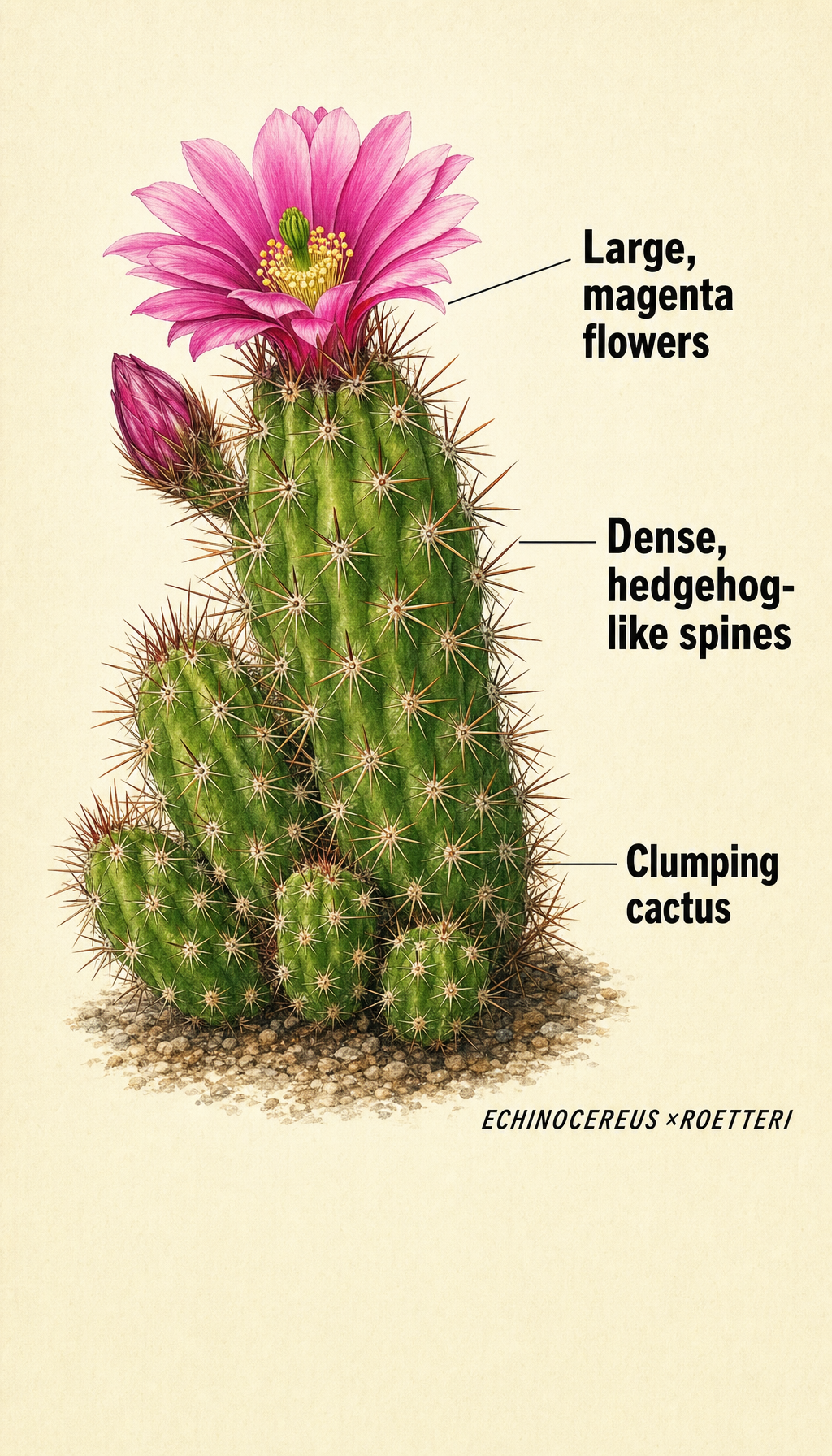
Overall form: A small to medium, usually clumping hedgehog cactus with cylindrical to slightly tapering stems arising from a central crown; individual stems typically reach heights of up to a few tens of centimeters and often form low cushions or small clusters. Stems are ribbed with distinct areoles bearing spines and sometimes woolly or hairy material.
Flowers: Showy, funnel- to cup-shaped flowers that open in daylight, typically produced near stem apices. Flowers are often pink to magenta (with possible variations in intensity) and may show a contrasting throat; they are comprised of numerous tepals rather than a small fixed number of petals. Reproductive parts (stamens and stigma) are prominent and arranged centrally.
Leaves: Like other cacti, true leaves are absent; photosynthesis is carried out by the green stems. Areoles on the ribs bear spines and occasional wool or bristles.
Distinctive identifying features: Low, clumping habit; conspicuous daytime flowers in shades of pink to magenta; dense areoles with radial and central spines that may be pale to darker in color; ribs and tubercles typical of Echinocereus. The hybrid designation can result in intermediate characteristics between parent taxa.
Seasonal variation: Typically flowers in spring into early summer, when blooms are most conspicuous; stems may produce fresh growth following seasonal rains.
Habitat & Distribution
General growing conditions: Often found on rocky slopes, hillsides, and well-drained sites where soil is coarse or gravelly. Prefers full sun to strong light and arid to semi-arid conditions.
Moisture and soil preferences: Typically occurs in dry habitats with infrequent moisture; soils are usually fast-draining and low in organic matter.
Geographic distribution: Occurs in parts of the southwestern United States, including New Mexico and Texas. Within these states it is commonly associated with desert and xeric scrubland environments.
Ecological Role
Pollinators: Flowers of Echinocereus species are commonly visited and pollinated by daytime insects, especially bees; such interactions are likely for E. × roetteri as well.
Wildlife interactions: Produces fleshy fruits after flowering that are often consumed by birds and small mammals in Echinocereus species, aiding seed dispersal; spines provide shelter and protection for small desert fauna.
Ecological niche: Functions as a spring nectar and pollen resource in xeric plant communities and contributes to the structural diversity of rocky desert microhabitats.
Conservation & Interesting Facts
The "×" in the name denotes hybrid origin; hedgehog cacti commonly hybridize in the wild, producing a range of intermediate forms that can be locally distinctive.
Well-documented desert adaptations include succulent stems for water storage, ribbed shape that allows stem expansion and contraction with water availability, and spines that reduce herbivory and provide shading for the stem surface.