woodfern
Dryopteris ×uliginosa
BloomEDU
Identify it today. Know it next time.
Add woodfern to BloomEDU and a short quiz tomorrow will check if the name stuck.
Get BloomEDU — add woodfernFree · iOS · Android
From Instagram
Identity & Classification
Scientific name: Dryopteris ×uliginosa (the "×" indicates a hybrid)
Common names: woodfern, hybrid woodfern (name usage may vary by region)
Family: Dryopteridaceae
Genus: Dryopteris
Note: The epithet and multiplication sign indicate hybrid origin within Dryopteris; specific parentage is not stated here.
Visual Description
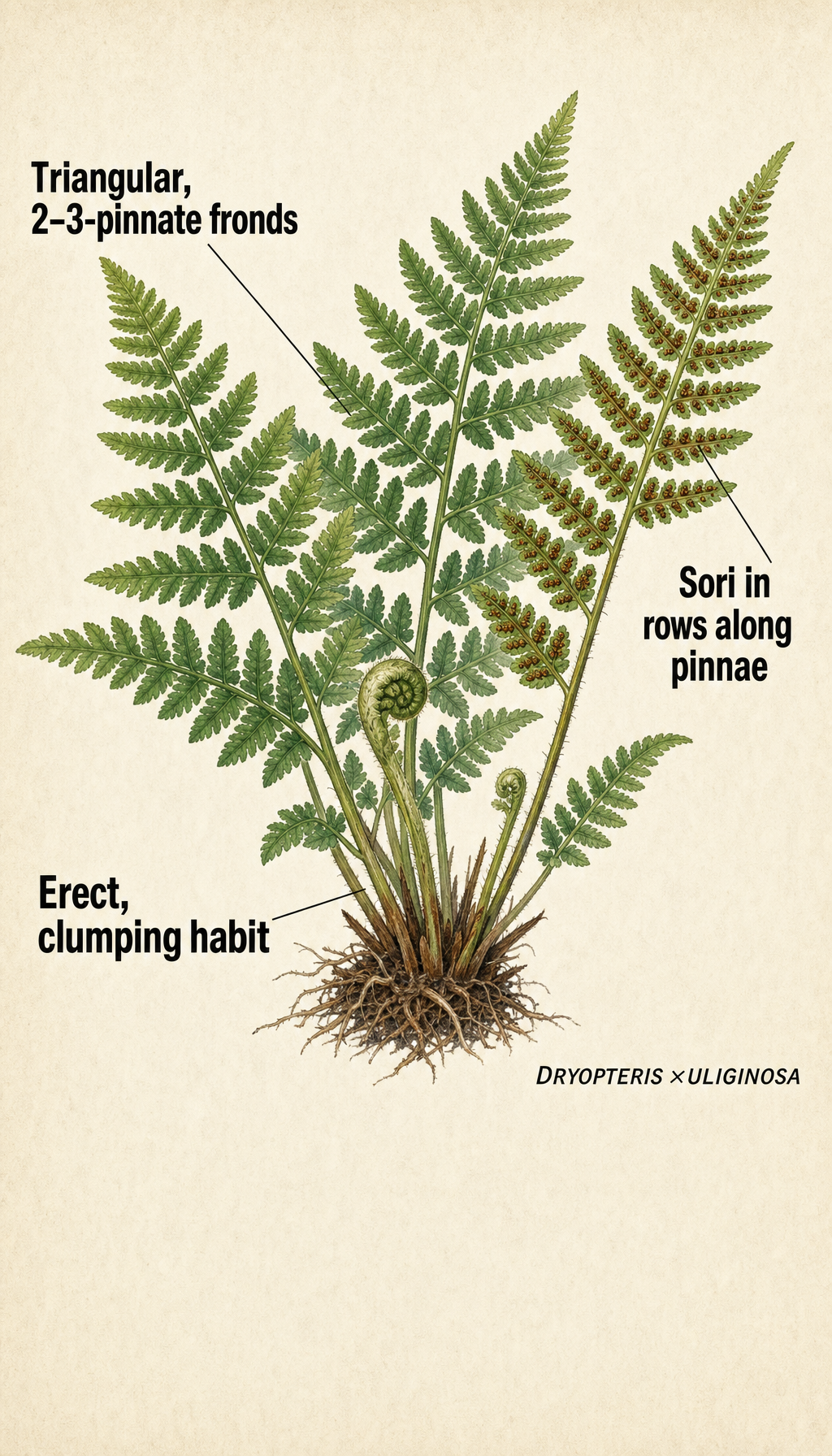
Overall form: A clumping, deciduous to semi-evergreen fern forming tufts of upright fronds arising from a short crown or rhizome. Plants typically present as low-to-medium height groundcover within the understory.
Size range: Individual fronds are typically produced in clusters and commonly reach moderate lengths for Dryopteris species; exact size can vary with site conditions.
Flower characteristics: Ferns do not produce flowers or seeds. Reproduction is by spores borne in sori on the underside of fertile fronds.
Leaf structure and arrangement: Fronds are pinnate to pinnate-pinnatifid, with pinnae arranged alternately along a central rachis. Fronds emerge in a circinate (coiled) manner when young.
Distinctive identifying features: Sori arranged along veins on the underside of fertile pinnae, usually covered by a reniform (kidney-shaped) indusium typical of Dryopteris. Stipes and rachises often bear brownish scales. Morphology may be intermediate between parent species, so scale color, frond texture, and pinna shape can vary.
Seasonal variation: Fronds may die back or become more tattered in winter in colder climates; in milder areas fronds can remain semi-evergreen. Sporangia develop on fertile fronds during the growing season and release spores when mature.
Habitat & Distribution
General growing conditions: Typically found in shady to partially shaded forest understories where moisture and organic matter accumulate.
Typical ecosystems: Moist woodlands, ravines, shaded streambanks, rocky slopes, and other sheltered forested sites.
Soil, moisture, light preferences: Often favors humus-rich, well-drained to seasonally damp soils with consistent moisture. Prefers shade to dappled light rather than full sun.
Geographic distribution: Reported from Connecticut, Delaware, Iowa, Massachusetts, Maryland and 13 additional U.S. states, suggesting a distribution across parts of the northeastern and midwestern United States where suitable habitat exists.
Ecological Role
Pollination: As a fern, Dryopteris ×uliginosa does not rely on pollinators and reproduces via spores.
Wildlife interactions: Frond clumps contribute to forest groundcover, providing microhabitat and shelter for invertebrates and small ground-dwelling organisms. Fronds and decaying leaf litter contribute to nutrient cycling in forest soils.
Ecological niche: Functions as a shade-adapted understory fern, often occupying moist microsites where it can persist under tree canopy.
Conservation & Interesting Facts
Conservation status: No single, well-established conservation status is provided here; local populations may vary in abundance. Hybrids such as Dryopteris ×uliginosa commonly arise where parent species co-occur and may display intermediate characters. Notable adaptations include tolerance for low light and the classic fern reproduction strategy of spore dispersal via sori protected by indusia.