hairy crabgrass
Digitaria sanguinalis
BloomEDU
Identify it today. Know it next time.
Add hairy crabgrass to BloomEDU and a short quiz tomorrow will check if the name stuck.
Get BloomEDU — add hairy crabgrassFree · iOS · Android
From Instagram
Identity & Classification
Digitaria sanguinalis — common names: hairy crabgrass, hairy finger-grass, large crabgrass, crab finger grass, purple crabgrass, Polish millet (when referenced as a cultivated grain).
Family: Poaceae (the grass family).
Genus: Digitaria.
Taxonomic notes: Digitaria sanguinalis is one of the better-known Digitaria species and is frequently encountered as a common lawn and field weed. The genus name Digitaria refers to the finger-like arrangement of its flowering spikes. Common names vary by region and can overlap with other Digitaria species, so careful morphological or herbarium-based identification is advisable when precision is required.
Physical Description
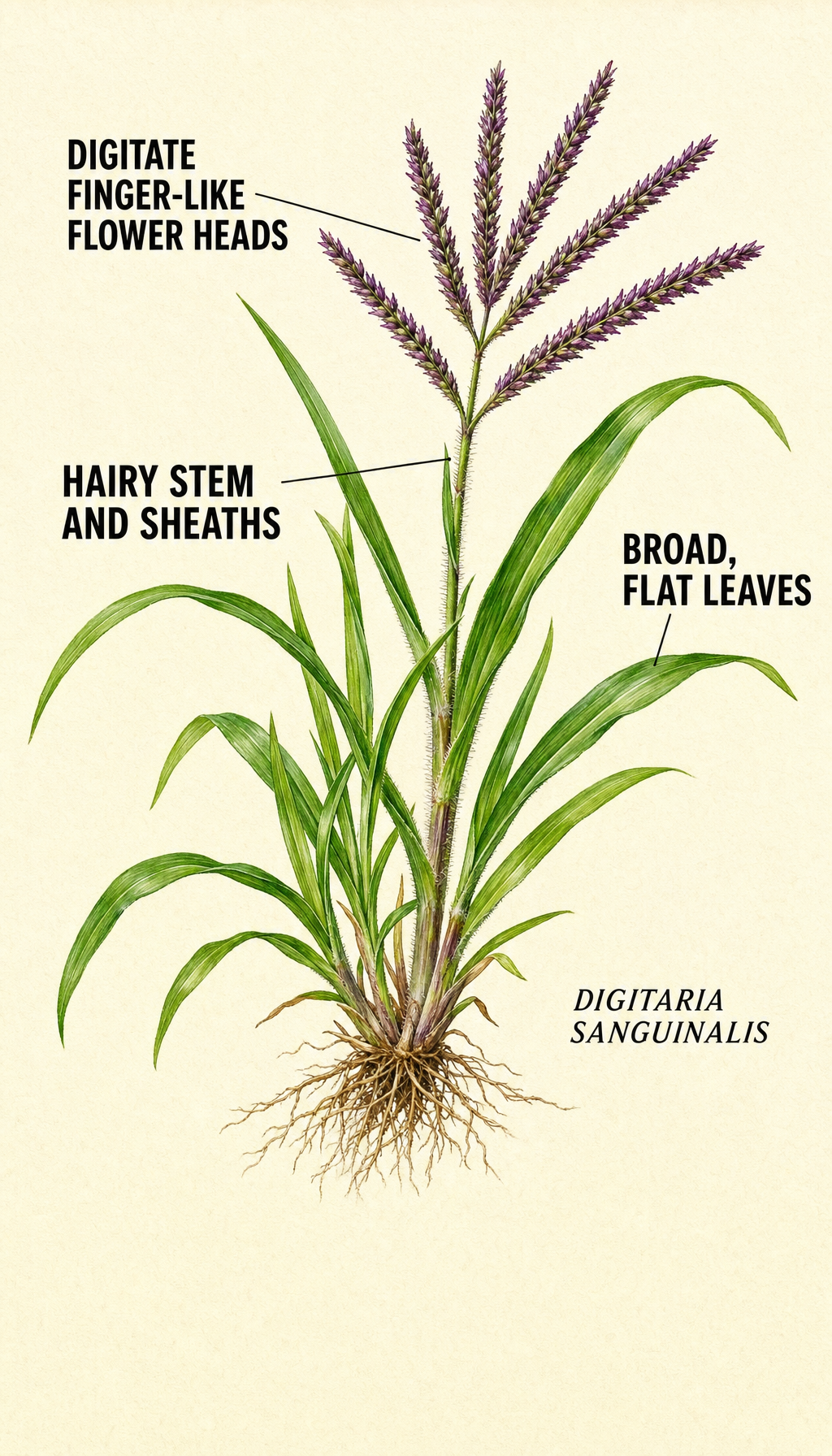
A warm-season, annual grass with a prostrate to ascending habit and characteristic finger-like flower clusters. Key identifying features:
Growth form: stems often radiate from a central crown forming mats; nodes on prostrate stems may root where they contact soil (stoloniferous/decumbent habit).
Leaves: alternate, typically lanceolate to linear, often hairy — the common name “hairy” refers to hairs on the leaf sheath and sometimes the blades.
Ligule: a fringe of hairs (typical for many Digitaria species) rather than a conspicuous membranous ligule.
Inflorescence: distinctive digitate (finger-like) arrangement of several slender spikes (spikelets borne along the length of each spike). This “finger” pattern is the genus hallmark.
Spikelets & seeds: small, flattened spikelets arranged along the spike; spikelets and mature seed heads may take on a purplish tint in some conditions (hence the name “purple crabgrass”).
Reproductive habit: reproduces by seed and spreads vegetatively by rooting nodes on stems; seed production contributes to its success as a weed.
Habitat & Range
Typical habitats: common in disturbed, open, sunny sites — lawns, roadsides, agricultural fields, gardens, and compacted soils. It thrives in places where turf or vegetation is thin or disturbed.
Preferred conditions: warm-season (C4) grass that performs well in warm, sunny conditions and tolerates compacted or poor soils; drought-tolerant compared with many cool-season grasses.
Geographic distribution: Digitaria sanguinalis is widely distributed and often described as cosmopolitan as a weed in temperate to subtropical regions. Exact, fine-scale native vs. introduced status can vary by region; sources commonly report it as nearly worldwide in distribution where conditions suit its warm-season life cycle.
Ecological Role
Pollination: like most grasses, it is wind-pollinated (anemophilous) rather than insect-pollinated.
Food and forage: known to serve as forage or fodder for livestock in some contexts; its seeds are also edible and can be used as a grain (see Human Uses).
Wildlife interactions: by producing seeds and vegetative cover, it can provide food and shelter for birds and small mammals, and it may be part of diets for some herbivores; however, species-specific interactions vary by location.
Ecosystem function: often an early colonizer of disturbed soils, contributing to soil cover and erosion control in the short term; conversely, it can be a competitive weed in managed turf and agricultural systems, competing with desired plants.
Interesting Facts
“Crabgrass” refers to the way stems radiate from a central crown like a crab’s legs; “hairy” points to hairs on the leaf sheaths and parts of the plant. - It is a warm-season (C4) grass — that photosynthetic pathway gives it efficiency in hot, sunny conditions and helps explain its success in summer lawns and dry patches. - The inflorescence looks like a tiny hand or set of fingers — the genus name Digitaria literally evokes “digits.” Observing the seedheads makes identification much easier than looking at leaves alone. - Though often dismissed as a nuisance weed, it has a dual identity as both fodder and an occasional grain (Polish millet), illustrating how human use and weediness can be two sides of the same plant story. sanguinalis from similar Digitaria species, or brief management suggestions for gardeners dealing with it.