woolly rosette grass
Dichanthelium scabriusculum
BloomEDU
Identify it today. Know it next time.
Add woolly rosette grass to BloomEDU and a short quiz tomorrow will check if the name stuck.
Get BloomEDU — add woolly rosette grassFree · iOS · Android
From Instagram
Identity & Classification
Scientific name: Dichanthelium scabriusculum
Verified common names: woolly rosette grass (common name usage may vary)
Family: Poaceae
Genus: Dichanthelium
Taxonomic note: Dichanthelium is a distinct genus in the grass family that was historically treated within a broad Panicum; many species were reclassified into Dichanthelium.
Visual Description
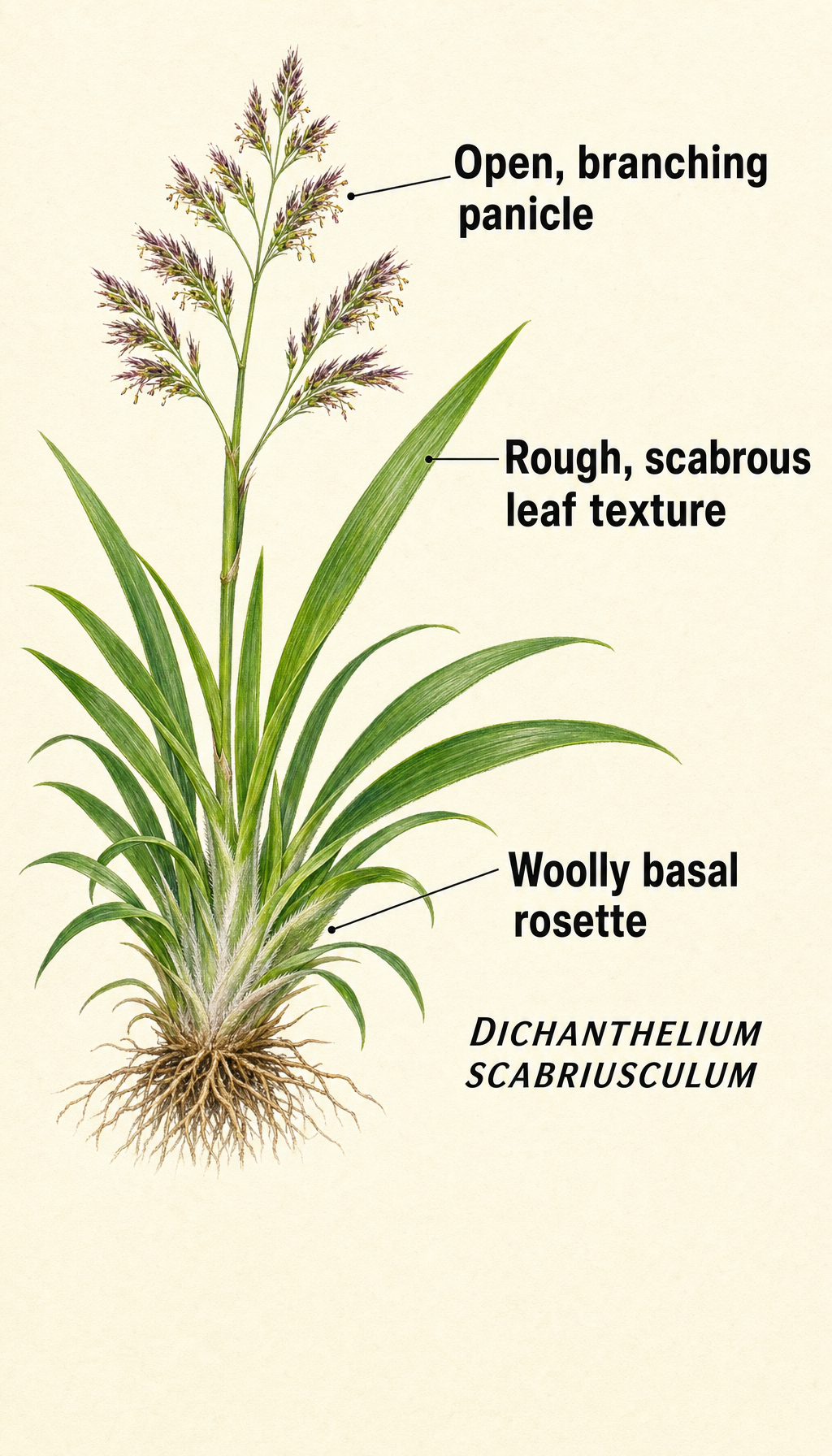
Overall form: A perennial warm‑season grass that typically begins growth as a low basal rosette of leaves and later produces erect or ascending flowering culms. Plants often present a compact, woolly basal cluster of foliage before bolting.
Size: Typically a small to medium grass in stature relative to prairie grasses; basal rosettes are low and flowering stems rise above the rosette.
Flowers/inflorescence: Inflorescences are grass panicles composed of numerous small spikelets rather than showy petals. Flowering often includes two types of flowers: open (chasmogamous) panicles that are wind‑pollinated and later or concurrently produced cleistogamous (self‑fertilizing, often more inconspicuous) spikelets on short shoots.
Leaves: Leaves are alternate, linear to narrowly lanceolate, arising from the rosette and along the culms. Leaf surfaces and sheaths are often softly hairy, giving the basal foliage a woolly appearance in many plants.
Distinctive features: The combination of a woolly basal rosette, hairy leaf sheaths or blades, and the presence of both chasmogamous and cleistogamous flowers helps distinguish this species from similar grasses. Inflorescences tend to be subtle, with small, grass‑typical spikelets.
Seasonal variation: Appears as a low rosette in the growing season before producing flowering stems; seed production via cleistogamous flowers may persist later into the season. Above‑ground parts generally die back seasonally.
Habitat & Distribution
General conditions: Typically found in open or semi‑open sites; often associated with dry to mesic upland habitats but may occur in a range of light conditions from full sun to partial shade.
Soil and moisture: Often associated with well‑drained soils; tolerates a range of moisture regimes from relatively dry to mesic sites.
Geographic distribution: Recorded from multiple states across the eastern and central United States, including Alabama (AL), Arkansas (AR), Connecticut (CT), Delaware (DE), Florida (FL) and others (approximately 20 states total). Occurrence is generally in eastern and central U.S. regions.
Ecological Role
Pollination and reproduction: Primarily wind‑pollinated for chasmogamous flowers; cleistogamous flowers provide assured selfing reproduction when cross‑pollination is limited.
Wildlife interactions: Seeds of small grasses like Dichanthelium species are commonly utilized by seed‑eating birds and small mammals; the low leaf rosettes can provide microhabitat for invertebrates.
Ecological niche: Functions as a component of understory and open‑habitat grass layers, contributing to groundcover, seed rain, and nutrient cycling in native plant communities.
Conservation & Interesting Facts
Conservation: No single federal conservation status is asserted here; local rarity can vary by state.
Interesting facts: Dichanthelium species commonly produce both open, wind‑pollinated flowers and hidden, self‑fertilizing cleistogamous flowers—an adaptive strategy that stabilizes reproduction across variable conditions. The genus was historically included in Panicum and was later segregated based on morphological and genetic studies.