saltmarsh dodder
Cuscuta salina
BloomEDU
Identify it today. Know it next time.
Add saltmarsh dodder to BloomEDU and a short quiz tomorrow will check if the name stuck.
Get BloomEDU — add saltmarsh dodderFree · iOS · Android
From Instagram
Identity & Classification
Scientific name: Cuscuta salina
Common name(s): saltmarsh dodder
Family: Cuscutaceae (some treatments place the genus Cuscuta within Convolvulaceae)
Genus: Cuscuta
Visual Description
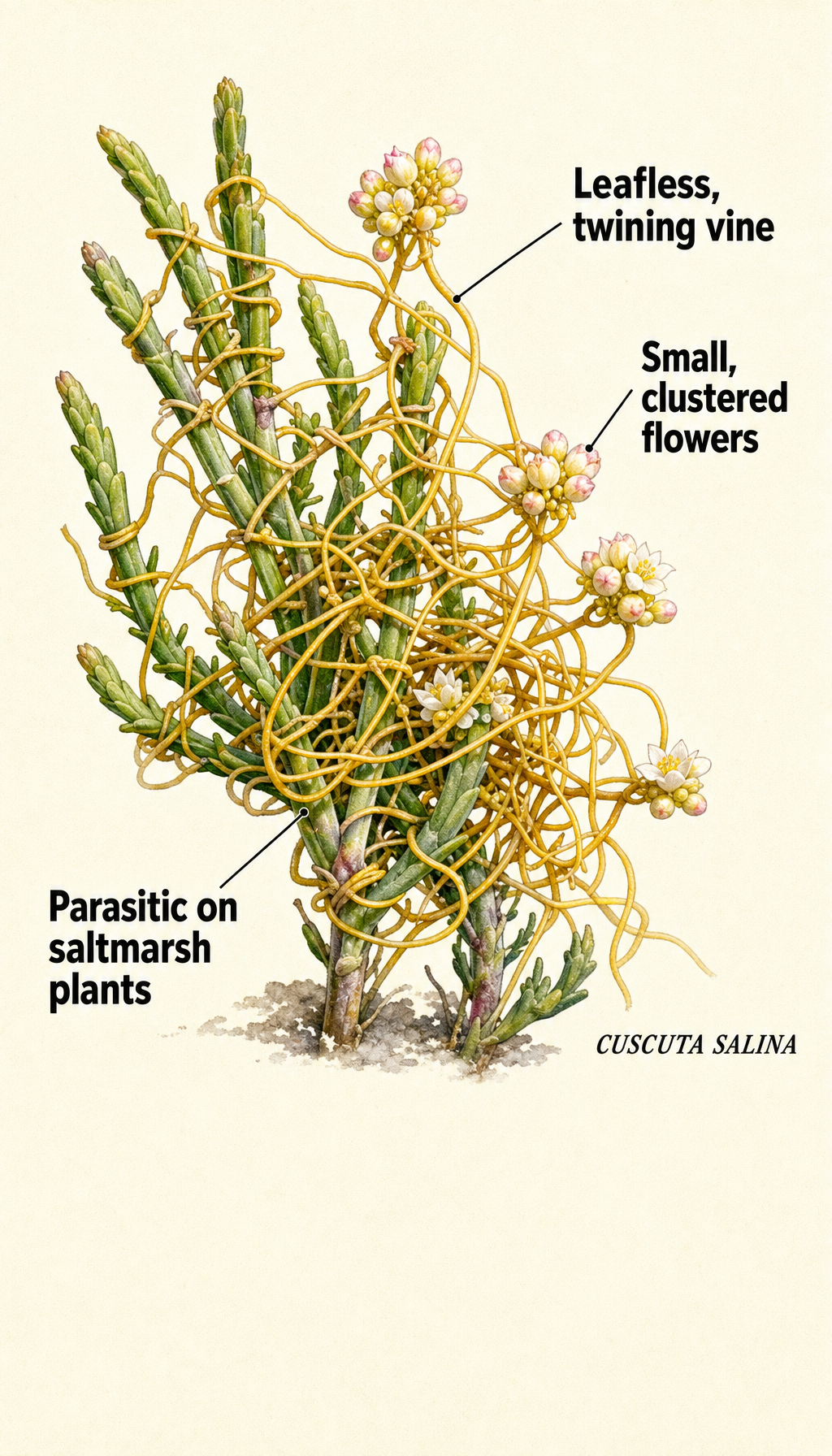
Saltmarsh dodder is a leafless, twining parasitic vine that forms tangled mats or networks over host plants. Stems are threadlike and typically yellowish to orange or reddish, often appearing as a web of fine cords draped across salt-marsh vegetation. Plants are generally inconspicuous until flowering or when dense mats cover hosts.
Flowers are small, tubular to bell-shaped, with corolla lobes typically in the range of 4–6; colors may be pale white, cream, or tinged with pink or yellow. Flowers occur in clusters along the stems and give the vine a more visible presence during bloom. Fruit is a small capsule containing several seeds.
Leaves are reduced to minute scale-like structures and are not photosynthetic in any meaningful way. The most distinctive identifying features are the leafless, twining stems that clasp hosts, the bright yellow-orange coloration in many populations, and the clusters of small tubular flowers produced directly on the stems. Seasonal visibility often peaks when plants flower; outside of bloom the vine may be mistaken for nonliving debris wrapped on host plants.
Habitat & Distribution
Saltmarsh dodder is typically found in saline and brackish coastal wetlands, including tidal marshes, salt flats, and estuarine margins. It often grows on halophytic host plants adapted to salty soils and standing water. Preferred conditions are generally open, sunlit marsh zones with periodic tidal influence or saline groundwater; soils are usually muddy to sandy and seasonally inundated.
Geographically it occurs in western North America and is reported from Arizona (coastal or saline locales), California, New Mexico, Nevada, Oregon and two additional U.S. states, commonly associated with Pacific and southwestern salt-marsh systems.
Ecological Role
As a holoparasite, Cuscuta salina derives water and nutrients through haustorial connections to host plants, directly affecting host vigor and competitive relationships in salt-marsh plant communities. Its flowers are small and may be visited by a variety of small generalist insects, which can effect pollination in some populations. By parasitizing dominant halophytes, saltmarsh dodder can influence plant community composition and nutrient flow within marsh patches.
Conservation & Interesting Facts
Saltmarsh dodder is specialized for saline wetland habitats and shows classic parasitic adaptations: nearly complete loss of true leaves and roots and the development of haustoria to tap host vascular systems. One notable fact is that dodders often go unnoticed until flowering, when the otherwise threadlike stems produce conspicuous clusters of small flowers; this life habit makes them important but easily overlooked components of salt-marsh ecology.