limestone hawksbeard
Crepis intermedia
BloomEDU
Identify it today. Know it next time.
Add limestone hawksbeard to BloomEDU and a short quiz tomorrow will check if the name stuck.
Get BloomEDU — add limestone hawksbeardFree · iOS · Android
From Instagram
Identity & Classification
Crepis intermedia — common name: limestone hawksbeard — is a flowering plant in the daisy family, Asteraceae. Confident taxonomic placement:
Kingdom: Plantae
Clade: Angiosperms (flowering plants)
Clade: Eudicots
Order: Asterales
Family: Asteraceae
Genus: Crepis
Species: Crepis intermedia
Taxonomic notes: Crepis is the group commonly called “hawksbeards,” a genus of plants in Asteraceae characterized by heads composed of ligulate (strap-shaped) florets. Crepis intermedia is one of the North American members of this genus. Further finer-scale taxonomic or synonymy details are not presented here.
Physical Description
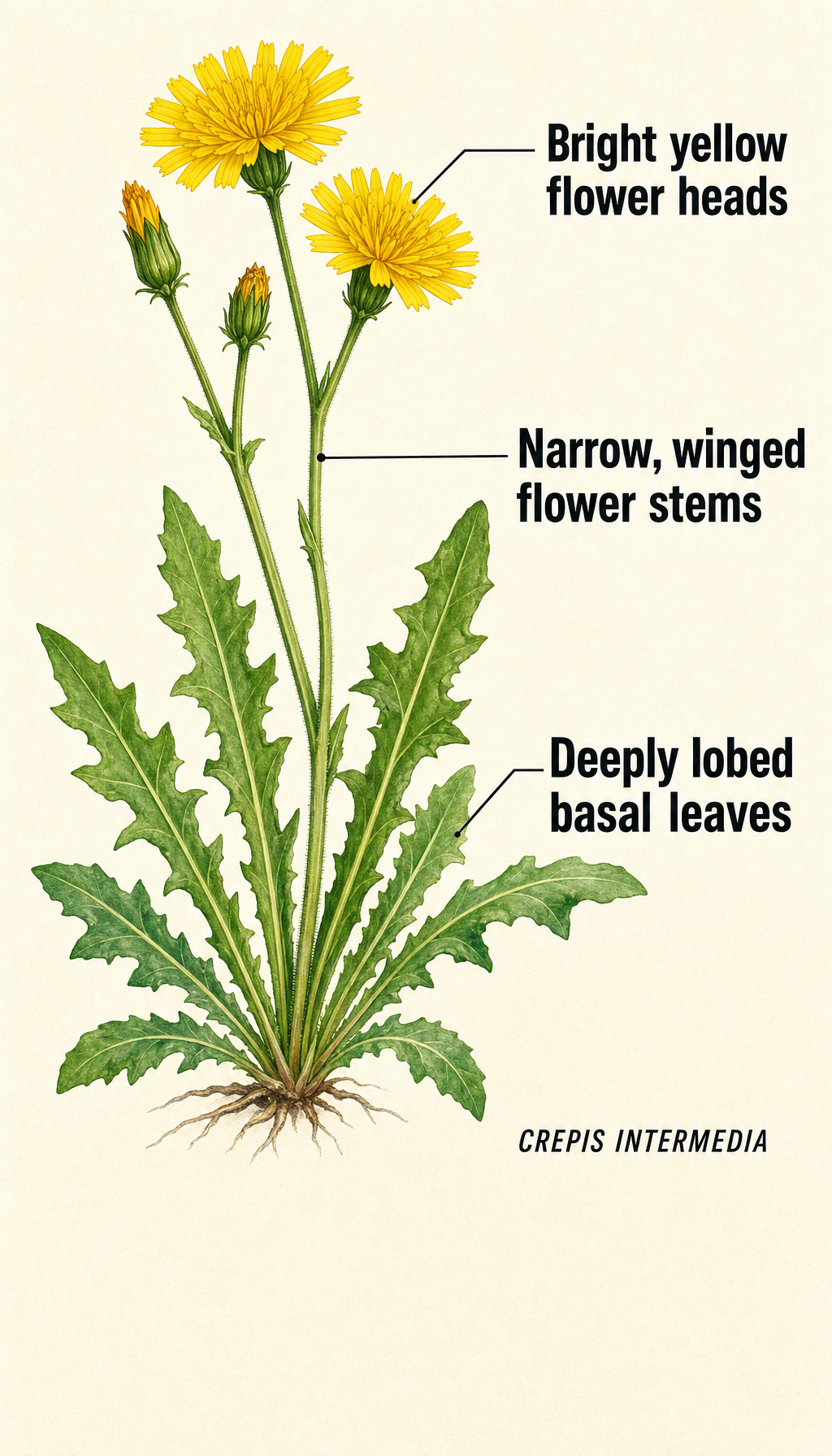
A straightforward, slightly woolly perennial that can look both delicate and robust depending on where it’s growing. Key characteristics:
Habit: Perennial herb with an erect, multibranched flowering stem produced from a thick taproot.
Size: Stems may reach up to about 70 cm (≈28 inches) tall.
Herbage: Green and noticeably woolly (tomentose) — the plant has a soft, hairy texture.
Leaves: Lower (basal/lowermost) leaves can be quite large, approaching 40 cm (≈16 inches) long; leaves are lined with triangular lobes. Leaves nearer the top of the plant are smaller.
Inflorescence: An open array (loose cluster) of many flower heads.
Flower heads: Each head is composed only of ligulate (strap-shaped) yellow ray florets — there are no disc florets present. Phyllaries (the small bracts around the base of each head) are woolly.
Fruit: A narrow, ribbed achene (dry, single-seeded fruit) just under 1 cm in length.
Habitat & Range
Native region: Western North America. It is recorded from broad regions including the Pacific Northwest, the Columbia Plateau, parts of the Great Plains, and southwestern regions of the continent.
Habitats: Reported from a variety of open and forested habitats. It is a species that occurs across multiple habitat types rather than being restricted to a single highly specialized niche.
Soil/special substrate note: It is commonly called “limestone hawksbeard”; that name suggests an association with calcareous substrates, but occurrence records indicate the species can grow in diverse soils. Specific, consistent soil preferences are not universally documented.
Ecological Role
Flowers and pollinators: The yellow ligulate florets are structured to offer pollen and (likely) nectar; such heads are generally attractive to a broad suite of generalist pollinators (for example, bees, flies, and butterflies). Saying definitively which species visit C. intermedia in every part of its range would require local pollination studies.
Plant community function: As a perennial with a substantial taproot, it contributes to perennial herb layer diversity and can play a role in soil anchoring and nutrient cycling in the habitats where it occurs.
Seed ecology: The species produces achenes (typical for Asteraceae). The exact dispersal mechanisms and which animals—if any—interact with the seeds of C. intermedia are not comprehensively documented here.
Interesting Facts
Only rays, no discs: Each flower head is composed solely of ligulate (strap-shaped) yellow ray florets — no central disc florets — which makes its blooms superficially similar to small dandelion- or salsify-like heads.
Woolly detail: Both the vegetative parts and the flower head’s phyllaries show woolliness (tomentum), an adaptation that can help reduce water loss and protect tissues from temperature extremes or herbivory in exposed sites.
Size contrast: The species is notable for the contrast between very large lower leaves (approaching 40 cm) and the tall flowering stems (up to ~70 cm), producing a stately appearance when in bloom.
Typical hawksbeard architecture: The plant exemplifies the hawksbeard growth form — a taprooted perennial sending up branched stems bearing numerous yellow ligulate heads — a familiar sight in many western North American grassland and open-woodland floras. intermedia from similar Crepis species, or
provide a short field ID checklist you can use on hikes.